image8
006 Data management systems from data mining to business challenges
6 December 2024
image13
008 The beginning of the data volume boom as an evolutionary wave
9 December 2024

007 Corporate mycelium how data connects to business processes

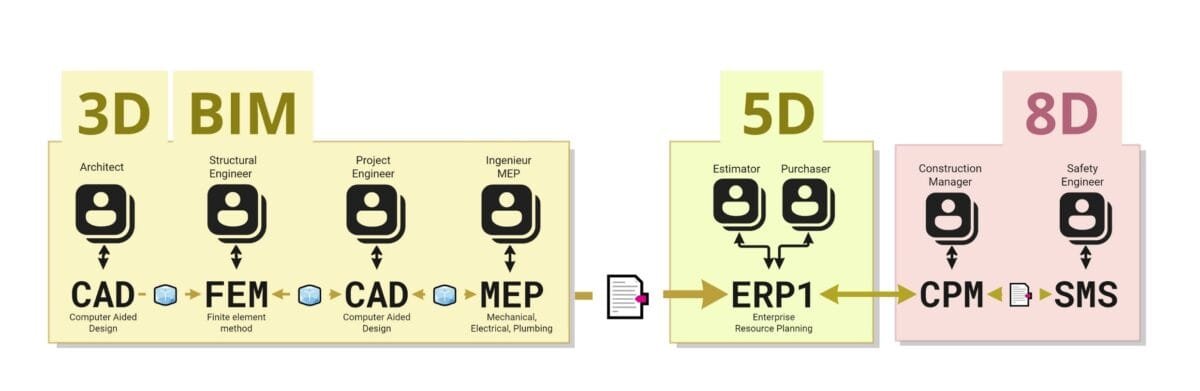
The process of integrating data into applications and databases relies on the aggregation of information from a variety of sources, including different departments and specialists (Fig. 1.2-4). Specialists search for relevant data, process it, and transfer it to their systems and applications for further use.

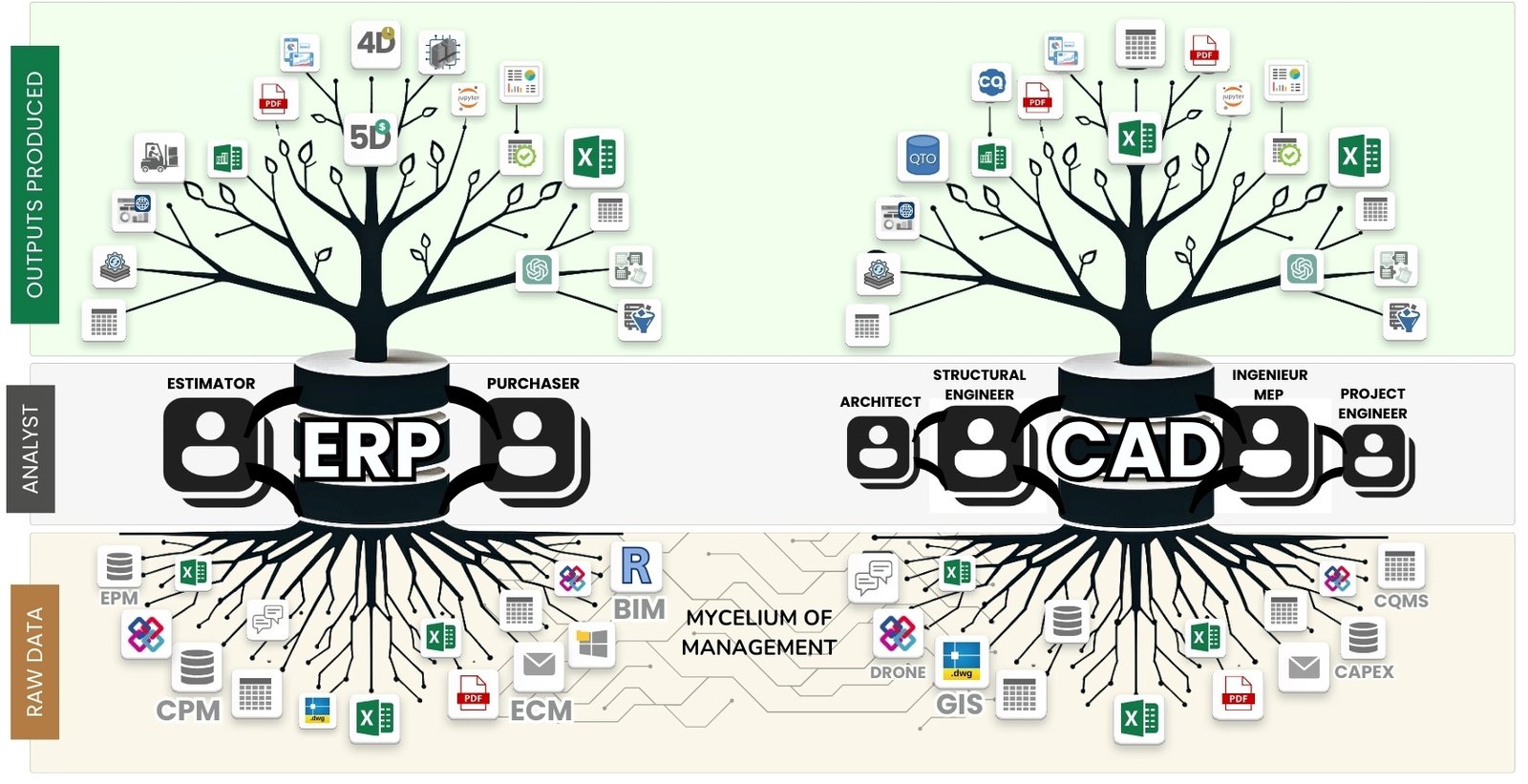
Each company system, consisting of a set of tools, technologies and databases, is a knowledge tree rooted in the soil of historical data and growing to bear new fruit in the form of ready-made solutions: documents, calculations, tables, graphs and dashboards (Fig. 1.2-5). The systems in a company, like trees in a particular patch of forest interact and communicate with each other, representing a complex and well-structured system, supported and managed by expert managers.

A company’s information retrieval and transfer system works like a complex forest network consisting of trees (systems) and mycelium mushrooms (managers) that act as conductors and recyclers, ensuring that information is transferred and flows to the right systems. This helps to maintain a healthy and efficient flow and distribution of data within the company.

Experts, like roots, absorb raw data at the initial stages of a project, turning it into nutrients for the corporate ecosystem. Data and content management systems (Fig. 1.2-4 – ERP, CPM, BIM, etc.) act as powerful information highways through which this knowledge circulates through all levels of the company.

As in nature, where each element of the ecosystem plays its own role, in a company’s business landscape, each process participant – from engineer to analyst – contributes to the growth and fertility of the information environment. These systemic “data trees” (Fig. 1.2-5) are not just mechanisms for gathering information, but a competitive advantage that ensures a company’s sustainability.

Forest ecosystems are a surprisingly accurate reflection of how digital corporate structures are organized. Like the tiered structure of a forest – from the undergrowth to the treetops – corporate governance categorizes tasks by levels of responsibility and functional departments.

Deep and branching tree roots provide resilience and access to nutrients. Similarly, a strong organizational structure and stable processes for working with quality data support the entire information ecosystem of a company, contributing to its sustainable growth and development even during periods of (high wind) market instability and crises.
.

image102
Fig. 1.2-5 Integrating data through different systems is like a mycelium that connects managers and specialists into a single information network.

The modern understanding of scale in business has evolved. Today, the value of a company is determined not only by its visible part – the “crowns” in the form of final documents and reports – but also by the depth of the “root system” of qualitatively collected and systematically processed data. The more information can be collected and processed, the higher the business value becomes. Companies that methodically accumulate a “compost” of already processed data and are able to extract useful insights from it gain a strategic advantage

Historical information is becoming a new kind of capital, enabling growth, process optimization and competitive advantage. In a data-driven world, it’s not who has more, but who knows more that wins.

For the construction industry, this means moving to real-time project management, where all processes – from design and procurement to contractor coordination – will be based on relevant, daily updated data. The integration of information from various sources (ERP -systems, CAD -models, sensors IoT on construction sites, RFID) will make it possible to make more accurate forecasts, react quickly to changes and avoid delays caused by the lack of up-to-date data.

According to the Data-Driven Enterprise 2025 study (McKinsey & Company®,2022 (Mckinsey, “The data-driven enterprise of 2025,” 28 Jan. 2022)), successful companies of the future will rely on data in all key aspects of their operations, from strategic decisions to operational interactions.

Data will cease to be just an analytics tool and will become an integral part of all business processes, providing transparency, control and automation of management. Data-driven under move will allow organizations to minimize the influence of human factor, reduce operational risks and increase transparency and efficiency of decision-making.

The 21st century is turning the economic paradigm upside down: whereas oil used to be called “black gold” for its ability to power machinery and transportation, today, compressed under time pressure, historical data is becoming a new strategic resource, powering not machines but decision-making algorithms that will drive business.

.

.

Leave a Reply

Change language

Post's Highlights

Stay updated: news and insights


We’re Here to Help

Fresh solutions are released through our social channels

UNLOCK THE POWER OF DATA
 IN CONSTRUCTION

Dive into the world of data-driven construction with this accessible guide, perfect for professionals and novices alike.
From the basics of data management to cutting-edge trends in digital transformation, this book
will be your comprehensive guide to using data in the construction industry.

Related posts 

Focus Areas

Search

Search
Sorry, no articles found.

Don't miss the new solutions


Linux

macOS

Looking for the Linux or MAC version? Send us a quick message using the button below, and we’ll guide you through the process!


📥 Download OnePager

Welcome to DataDrivenConstruction—where data meets innovation in the construction industry. Our One-Pager offers a concise overview of how our data-driven solutions can transform your projects, enhance efficiency, and drive sustainable growth. 

🚀 Welcome to the future of data in construction!

You're taking your first step into the world of open data, working with normalized, structured data—the foundation of data analytics and modern automation tools.

By downloading, you agree to the DataDrivenConstruction terms of use 

Stay ahead with the latest updates on converters, tools, AI, LLM
and data analytics in construction — Subscribe now!

🚀 Welcome to the future of data in construction!

You're taking your first step into the world of open data, working with normalized, structured data—the foundation of data analytics and modern automation tools.

By downloading, you agree to the DataDrivenConstruction terms of use 

Stay ahead with the latest updates on converters, tools, AI, LLM
and data analytics in construction — Subscribe now!

🚀 Welcome to the future of data in construction!

You're taking your first step into the world of open data, working with normalized, structured data—the foundation of data analytics and modern automation tools.

By downloading, you agree to the DataDrivenConstruction terms of use 

Stay ahead with the latest updates on converters, tools, AI, LLM
and data analytics in construction — Subscribe now!

🚀 Welcome to the future of data in construction!

You're taking your first step into the world of open data, working with normalized, structured data—the foundation of data analytics and modern automation tools.

By downloading, you agree to the DataDrivenConstruction terms of use 

Stay ahead with the latest updates on converters, tools, AI, LLM
and data analytics in construction — Subscribe now!

🚀 Welcome to the future of data in construction!

You're taking your first step into the world of open data, working with normalized, structured data—the foundation of data analytics and modern automation tools.

By downloading, you agree to the DDC terms of use 

🚀 Welcome to the future of data in construction!

You're taking your first step into the world of open data, working with normalized, structured data—the foundation of data analytics and modern automation tools.

By downloading, you agree to the DataDrivenConstruction terms of use 

Stay ahead with the latest updates on converters, tools, AI, LLM
and data analytics in construction — Subscribe now!

DataDrivenConstruction offers workshops tested and practiced on global leaders in the construction industry to help your team navigate and leverage the power of data and artificial intelligence in your company's decision making.

Reserve your spot now to rethink your
approach to decision making!


🚀 Welcome to the future of data in construction!

By downloading, you agree to the DataDrivenConstruction terms of use 

Stay ahead with the latest updates on converters, tools, AI, LLM
and data analytics in construction — Subscribe now!

Have a question or need more information? Reach out to us directly!
Schedule a time to discuss your needs with our team.
Tailored sessions to help your team grow — let's plan together!
Have you attended one of our workshops, read our book, or used our solutions? Share your thoughts with us!
Name
Data Maturity Diagnostics

🧰 Data-Driven Readiness Check

This short assessment will help you identify your company's data management pain points and offer solutions to improve project efficiency. It takes only 1–2 minutes to complete and you will receive personalized recommendations tailored to your needs.

Clean & Organized Data

Theoretical Chapters:

Practical Chapters:

What You'll Find on
DDC Solutions:

  • CAD/BIM to spreadsheet/database converters (Revit, AutoCAD, IFC, Microstation)
  • Ready-to-deploy n8n workflows for construction processes
  • ETL pipelines for data synchronization between systems
  • Customizable Python scripts for repetitive tasks
  • Intelligent data validation and error detection
  • Real-time dashboard connectors
  • Automated reporting systems

Connect Everything

Theoretical Chapters:

Practical Chapters:

What You'll Find on
DDC Solutions:

  • CAD/BIM to spreadsheet/database converters (Revit, AutoCAD, IFC, Microstation)
  • Ready-to-deploy n8n workflows for construction processes
  • ETL pipelines for data synchronization between systems
  • Customizable Python scripts for repetitive tasks
  • Intelligent data validation and error detection
  • Real-time dashboard connectors
  • Automated reporting systems

Add AI & LLM Brain

Theoretical Chapters:

Practical Chapters:

What You'll Find on
DDC Solutions:

  • CAD/BIM to spreadsheet/database converters (Revit, AutoCAD, IFC, Microstation)
  • Ready-to-deploy n8n workflows for construction processes
  • ETL pipelines for data synchronization between systems
  • Customizable Python scripts for repetitive tasks
  • Intelligent data validation and error detection
  • Real-time dashboard connectors
  • Automated reporting systems
007 Corporate mycelium how data connects to business processes
This website uses cookies to improve your experience. By using this website you agree to our Data Protection Policy.
Read more
×