The problem of data heterogeneity
22 February 2024
Fourth industrial revolution (Industry 4.0) and fifth industrial revolution (Industry 5.0) in construction
23 February 2024

The problem of number and variation of business cases in construction

The construction industry faces not only the challenge of working with diverse and proprietary data and systems, but also the increasing complexity and dynamism of the business processes themselves, which are constantly changing and updating to meet the specific requirements of different countries, clients and projects.

The business of companies and the rules of the game in the construction industry are regulated and fragmented in every country in the world, and each construction project is a unique combination of multiple stakeholders with different skill sets. Additionally, the avalanche of new technologies and tools creates an urgent need to modernize and adapt management processes that cannot be easily integrated into existing ERP-type management systems.

Therefore, additional challenges for businesses in today's ever-changing world are the uniqueness of internal procedures and the need to constantly automate and unify a large number of individual business scenarios.

Within one company there may be many systems-trees that interact through a network of managers, similar to the mycelium of mushrooms. Within one system, we may encounter the processing of dozens or even hundreds of input data coming from other systems.

As a result, even within a single system of a single company, there may be hundreds of processes that need to be automated.
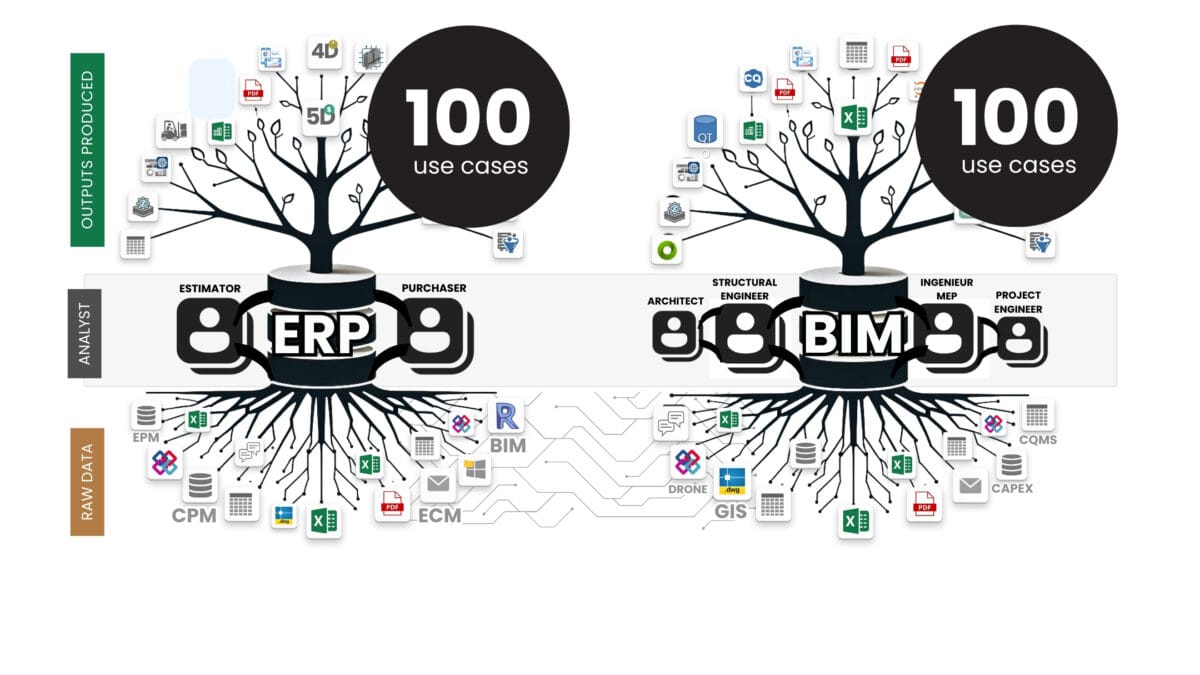
Because of the opacity of internal processes and the vast amount of data that executives and management staff often can't handle, custom technology solution vendors «come to the rescue», offering customized tools to solve specialized problems.

The market is crowded with thousands of startups and tools that compete vigorously to offer a variety of products to address specific customer needs. However, in the pursuit of meeting specific needs, the opportunity to take a holistic approach to the problem of accumulating and managing large amounts of data is missed. This results in customized solutions that are often limited to narrow solutions without considering the breadth and complexity of the problem as a whole.

In a company with multiple systems, the number of processes and use cases increases proportionally with the number of systems and users, reaching thousands of different use cases at the scale of a single medium-sized company.
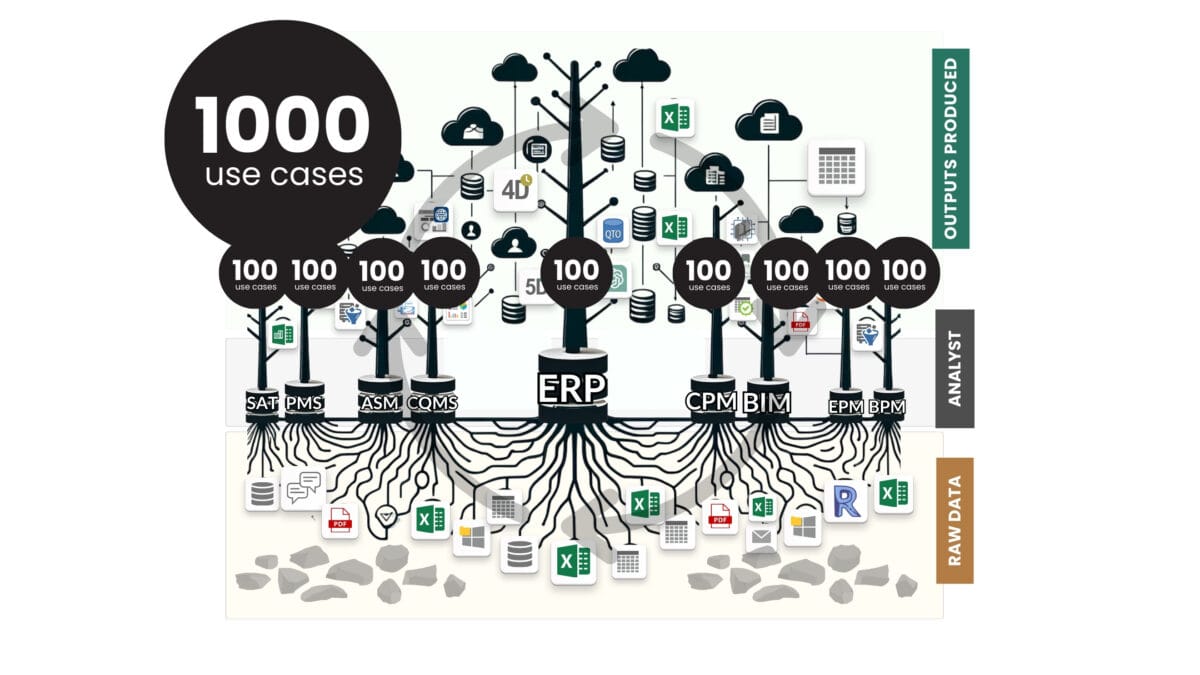
Each company is unique due to the variety of elements and resources underlying its systems, which makes it challenging to transfer systems with users between companies because of the specificity of the "soil" and the unique management network of the "mycelium of managers" where almost every process of the system, once transplanted to a new system or department will require tweaking to fit the new environment.

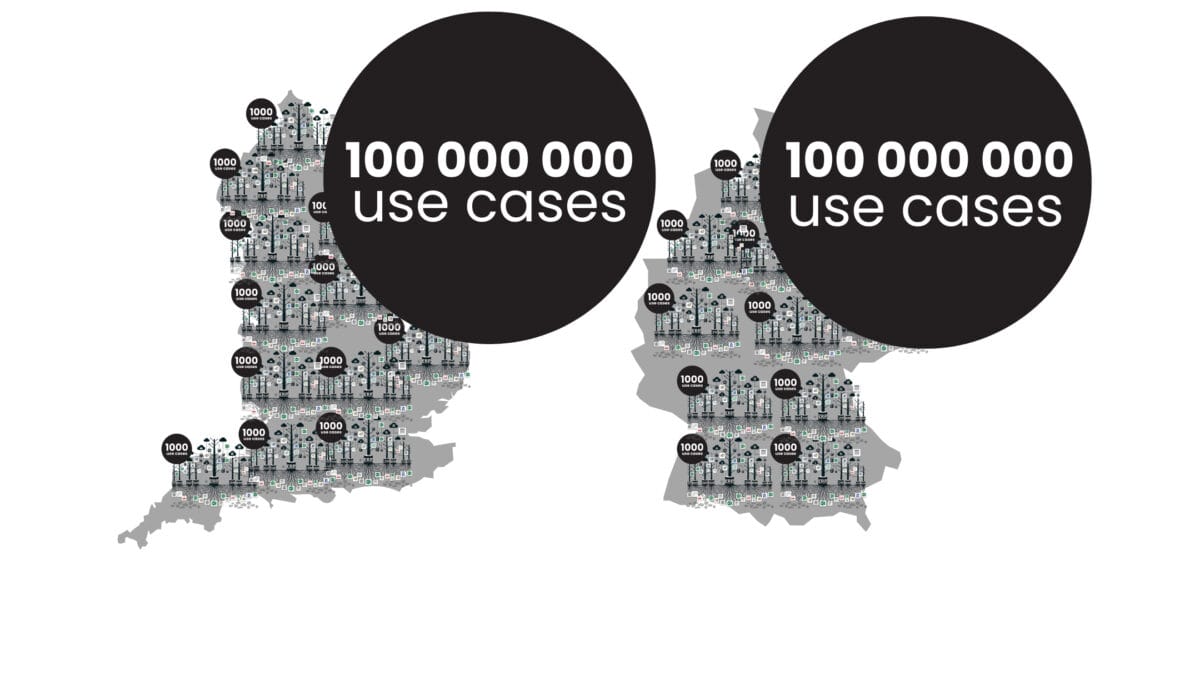
Moving a construction company, or even a single system from one country to another, is even more complex than moving systems within a company. Thus, the number of processes multiplied by the number of companies in a country will give a rough estimate of the total number of unique processes on a national scale.

In 2023, there are approximately half a million construction companies registered in England (including Wales, Scotland and Northern Ireland) and Germany. Based on the impossibility of using use cases between different companies, it can be concluded that in both Germany and England there may be around a hundred million unique construction business cases operated by construction companies in the country.
The construction industry is very diverse: different projects have different requirements, regional peculiarities, legislative norms, budget constraints, etc. Therefore, it is almost impossible to create a universal application or system that can perfectly fit all these requirements and project peculiarities.

The creation of proprietary applications and closed systems to solve specific individual business cases corresponds to the fourth technological paradigm, characterized by the emergence of digitalization of data and the emergence of the Internet.

And while the construction industry today overwhelmingly uses closed applications, leading companies in developed industries are already moving from the closed systems and formats of the fourth technology paradigm to the fifth technology paradigm with a focus on open data, customization and consulting.

Leave a Reply

Change language

Post's Highlights

Stay updated: news and insights


We’re Here to Help

Fresh solutions are released through our social channels

UNLOCK THE POWER OF DATA
 IN CONSTRUCTION

Dive into the world of data-driven construction with this accessible guide, perfect for professionals and novices alike.
From the basics of data management to cutting-edge trends in digital transformation, this book
will be your comprehensive guide to using data in the construction industry.

Related posts 

Focus Areas

Search

Search
Sorry, no articles found.

✕

Don't miss the new solutions


✕
✕

Linux

macOS

Looking for the Linux or MAC version? Send us a quick message using the button below, and we’ll guide you through the process!

✕

📥 Download OnePager

Welcome to DataDrivenConstruction—where data meets innovation in the construction industry. Our One-Pager offers a concise overview of how our data-driven solutions can transform your projects, enhance efficiency, and drive sustainable growth. 

✕

🚀 Welcome to the future of data in construction!

You're taking your first step into the world of open data, working with normalized, structured data—the foundation of data analytics and modern automation tools.

By downloading, you agree to the DataDrivenConstruction terms of use 

Stay ahead with the latest updates on converters, tools, AI, LLM
and data analytics in construction — Subscribe now!

✕

🚀 Welcome to the future of data in construction!

You're taking your first step into the world of open data, working with normalized, structured data—the foundation of data analytics and modern automation tools.

By downloading, you agree to the DataDrivenConstruction terms of use 

Stay ahead with the latest updates on converters, tools, AI, LLM
and data analytics in construction — Subscribe now!

✕

🚀 Welcome to the future of data in construction!

You're taking your first step into the world of open data, working with normalized, structured data—the foundation of data analytics and modern automation tools.

By downloading, you agree to the DataDrivenConstruction terms of use 

Stay ahead with the latest updates on converters, tools, AI, LLM
and data analytics in construction — Subscribe now!

✕

🚀 Welcome to the future of data in construction!

You're taking your first step into the world of open data, working with normalized, structured data—the foundation of data analytics and modern automation tools.

By downloading, you agree to the DataDrivenConstruction terms of use 

Stay ahead with the latest updates on converters, tools, AI, LLM
and data analytics in construction — Subscribe now!

✕

🚀 Welcome to the future of data in construction!

You're taking your first step into the world of open data, working with normalized, structured data—the foundation of data analytics and modern automation tools.

By downloading, you agree to the DDC terms of use 

✕

🚀 Welcome to the future of data in construction!

You're taking your first step into the world of open data, working with normalized, structured data—the foundation of data analytics and modern automation tools.

By downloading, you agree to the DataDrivenConstruction terms of use 

Stay ahead with the latest updates on converters, tools, AI, LLM
and data analytics in construction — Subscribe now!

✕
DataDrivenConstruction offers workshops tested and practiced on global leaders in the construction industry to help your team navigate and leverage the power of data and artificial intelligence in your company's decision making.

Reserve your spot now to rethink your
approach to decision making!

✕


🚀 Welcome to the future of data in construction!

By downloading, you agree to the DataDrivenConstruction terms of use 

Stay ahead with the latest updates on converters, tools, AI, LLM
and data analytics in construction — Subscribe now!

✕
Have a question or need more information? Reach out to us directly!
Schedule a time to discuss your needs with our team.
Tailored sessions to help your team grow — let's plan together!
✕
Have you attended one of our workshops, read our book, or used our solutions? Share your thoughts with us!
Name
✕
Data Maturity Diagnostics

🧰 Data-Driven Readiness Check

This short assessment will help you identify your company's data management pain points and offer solutions to improve project efficiency. It takes only 1–2 minutes to complete and you will receive personalized recommendations tailored to your needs.

✕

Clean & Organized Data

Theoretical Chapters:

Practical Chapters:

What You'll Find on
DDC Solutions:

  • CAD/BIM to spreadsheet/database converters (Revit, AutoCAD, IFC, Microstation)
  • Ready-to-deploy n8n workflows for construction processes
  • ETL pipelines for data synchronization between systems
  • Customizable Python scripts for repetitive tasks
  • Intelligent data validation and error detection
  • Real-time dashboard connectors
  • Automated reporting systems
✕

Connect Everything

Theoretical Chapters:

Practical Chapters:

What You'll Find on
DDC Solutions:

  • CAD/BIM to spreadsheet/database converters (Revit, AutoCAD, IFC, Microstation)
  • Ready-to-deploy n8n workflows for construction processes
  • ETL pipelines for data synchronization between systems
  • Customizable Python scripts for repetitive tasks
  • Intelligent data validation and error detection
  • Real-time dashboard connectors
  • Automated reporting systems
✕

Add AI & LLM Brain

Theoretical Chapters:

Practical Chapters:

What You'll Find on
DDC Solutions:

  • CAD/BIM to spreadsheet/database converters (Revit, AutoCAD, IFC, Microstation)
  • Ready-to-deploy n8n workflows for construction processes
  • ETL pipelines for data synchronization between systems
  • Customizable Python scripts for repetitive tasks
  • Intelligent data validation and error detection
  • Real-time dashboard connectors
  • Automated reporting systems
The problem of number and variation of business cases in construction
This website uses cookies to improve your experience. By using this website you agree to our Data Protection Policy.
Read more
×