Grafik 42
095 The reality of BIM instead of integrated databases – closed modular systems
11 March 2025
Рисунок 18
097 IFC format problem depending on geometric core
14 March 2025

096 The emergence of the open format IFC in the construction industry

The so-called open format IFC (Industry Foundation Classes) is positioned as a standard to ensure interoperability between different CAD (BIM -) systems. Its development was carried out within the framework of organizations that were created and controlled by major CAD vendors. Based on the IFC format, two CAD- companies in 2012 developed the marketing concept of OPEN BIM (А. Boiko, “Lobbykriege um Daten im Bauwesen | Techno-Feudalismus und die Geschichte von BIMs,” 2024).

IFC (Industry Foundation Classes) is an open standard for data exchange in the construction industry, designed to ensure interoperability between different CAD – (BIM-) systems.

Open BIM – concept involves working with information from CAD databases and exchanging information between systems through an open format for exchanging CAD data – IFC.

The Open BIM Program is a marketing campaign initiated by… [1 CAD vendor],… [2 CAD vendor] and other companies to encourage and facilitate global coordinated promotion of the OPEN BIM concept throughout the AEC industry, with consistent communication and common branding available to program participants.

– From CAD vendor website, OPEN BIM Program, 2012 (CAD Vendor, “OPEN BIM Program,” 2012)

IFC was adapted by the Technical University of Munich from the mechanical engineering format STEP in the late 1980s, and later registered by a major design company and a major CAD-vendor to form the IAI (Industry Alliance for Interoperability) in 1994(Wikipedia, “Industry Foundation Classes,”)(Fig. 6.1-4). The IFC format was developed to provide interoperability between different CAD -systems and was based on the principles laid down in the mechanical engineering format STEP, which, in turn, emerged from the format IGES, created back in 1979 by a group of CAD users and vendors with the support of NIST (The National Institute of Standards and Technology) and the U.S. Department of Defense (Wikipedia, “IGES,”).

However, the complex structure of IFC, its close dependence on the geometric core, as well as differences in the implementation of the format by different software solutions have led to many problems in its practical application. Similar difficulties – loss of detail, limitation of accuracy and necessity to use intermediate formats – were previously encountered by mechanical engineering specialists when working with IGES and STEP formats from which IFC was derived.
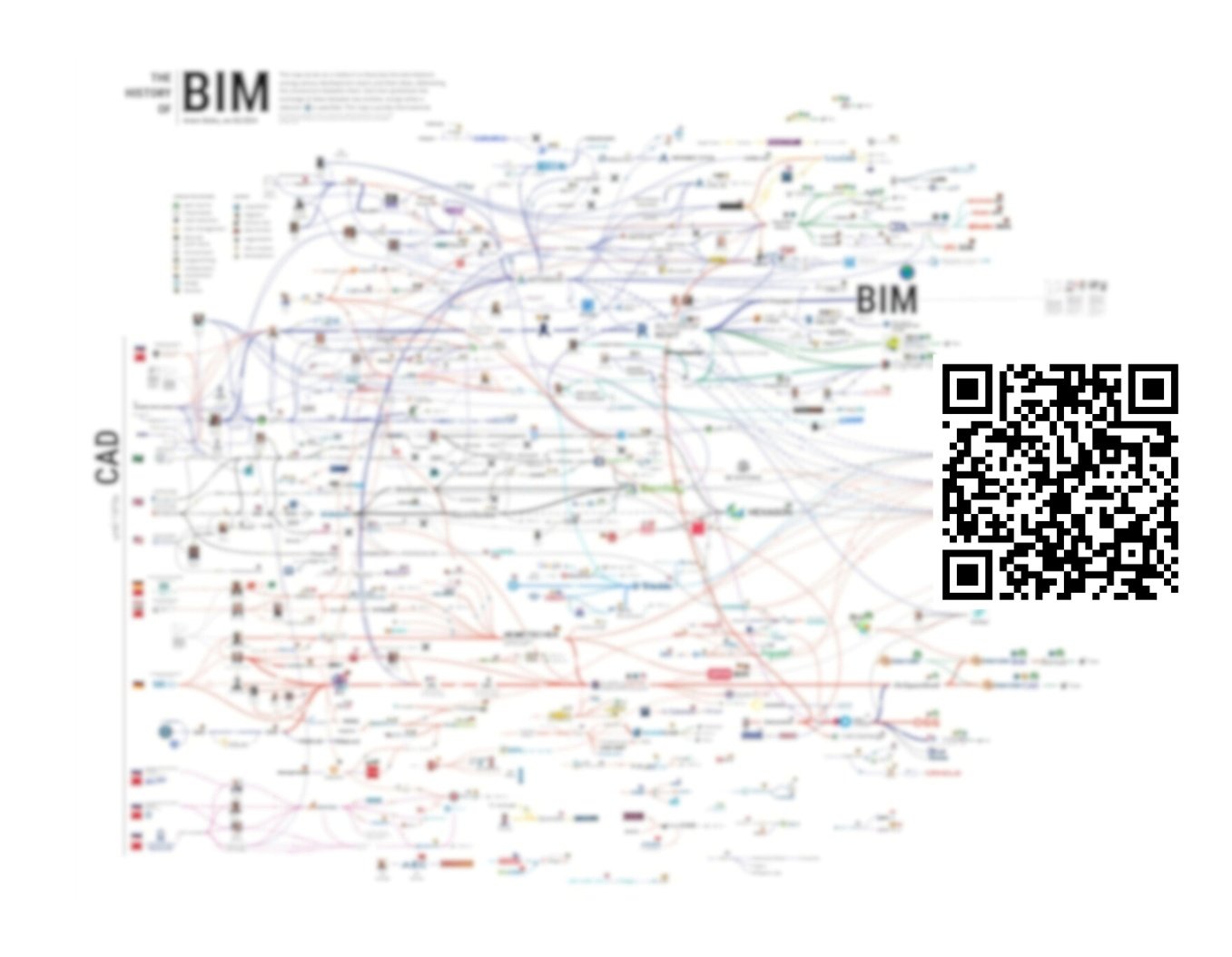
Рисунок 21
Fig.‎ 6.1-4 Map of relationships between development teams and CAD products (BIM) (А. Boiko, “History of CAD (BIM),” 15 Dec. 2021).

In 2000, the same CAD -vendor that registered the IFCformat and created the IAI (later bS) organization, publishes the Whitepaper “Integrated Design and Manufacturing: Benefits and Rationale” (ADSK, “Integrated Design-Through-Manufacturing: Benefits and Rationale,”). The paper stressed the importance of maintaining full data granularity when exchanging between programs within the same system, without using neutral formats such as IGES, STEP [identical to IFC]. Instead, it was proposed that applications should have direct access to the underlying CAD database to prevent loss of accuracy of information.

In 2002 the same CAD vendor buys parametric BOM product (Fig.‎ 3.1-18, more details in of the third part) and on its basis forms the BIM concept. As a result, only closed CAD formats or the IFC format (STEP) are used in the exchange of construction project data, the limitations of which were written about by the CAD vendor himself in 2000, who brought this format to the construction industry.

A detailed history of the interaction of more than 700 development teams involved in building data creation and processing tools is presented in the map “The Evolution of CAD (BIM)” (А. Boiko, “History of CAD (BIM),” 15 Dec. 2021).

The open form IFC consists of a geometric description of the design elements and a description of the meta-information. Various methods are used to represent geometry in IFC format, such as CSG and Swept Solids: however, the parametric representation BREP has become the leading standard for transferring element geometry in IFC format, as this format is supported when exporting from CAD- (BIM-) programs and allows for potential editing of elements when importing IFC back into CAD programs.

.

Leave a Reply

Change language

Post's Highlights

Stay updated: news and insights


We’re Here to Help

Fresh solutions are released through our social channels

UNLOCK THE POWER OF DATA
 IN CONSTRUCTION

Dive into the world of data-driven construction with this accessible guide, perfect for professionals and novices alike.
From the basics of data management to cutting-edge trends in digital transformation, this book
will be your comprehensive guide to using data in the construction industry.

Related posts 

Focus Areas

Search

Search
Sorry, no articles found.

✕

Don't miss the new solutions


✕
✕

Linux

macOS

Looking for the Linux or MAC version? Send us a quick message using the button below, and we’ll guide you through the process!

✕

📥 Download OnePager

Welcome to DataDrivenConstruction—where data meets innovation in the construction industry. Our One-Pager offers a concise overview of how our data-driven solutions can transform your projects, enhance efficiency, and drive sustainable growth. 

✕

🚀 Welcome to the future of data in construction!

You're taking your first step into the world of open data, working with normalized, structured data—the foundation of data analytics and modern automation tools.

By downloading, you agree to the DataDrivenConstruction terms of use 

Stay ahead with the latest updates on converters, tools, AI, LLM
and data analytics in construction — Subscribe now!

✕

🚀 Welcome to the future of data in construction!

You're taking your first step into the world of open data, working with normalized, structured data—the foundation of data analytics and modern automation tools.

By downloading, you agree to the DataDrivenConstruction terms of use 

Stay ahead with the latest updates on converters, tools, AI, LLM
and data analytics in construction — Subscribe now!

✕

🚀 Welcome to the future of data in construction!

You're taking your first step into the world of open data, working with normalized, structured data—the foundation of data analytics and modern automation tools.

By downloading, you agree to the DataDrivenConstruction terms of use 

Stay ahead with the latest updates on converters, tools, AI, LLM
and data analytics in construction — Subscribe now!

✕

🚀 Welcome to the future of data in construction!

You're taking your first step into the world of open data, working with normalized, structured data—the foundation of data analytics and modern automation tools.

By downloading, you agree to the DataDrivenConstruction terms of use 

Stay ahead with the latest updates on converters, tools, AI, LLM
and data analytics in construction — Subscribe now!

✕

🚀 Welcome to the future of data in construction!

You're taking your first step into the world of open data, working with normalized, structured data—the foundation of data analytics and modern automation tools.

By downloading, you agree to the DDC terms of use 

✕

🚀 Welcome to the future of data in construction!

You're taking your first step into the world of open data, working with normalized, structured data—the foundation of data analytics and modern automation tools.

By downloading, you agree to the DataDrivenConstruction terms of use 

Stay ahead with the latest updates on converters, tools, AI, LLM
and data analytics in construction — Subscribe now!

✕
DataDrivenConstruction offers workshops tested and practiced on global leaders in the construction industry to help your team navigate and leverage the power of data and artificial intelligence in your company's decision making.

Reserve your spot now to rethink your
approach to decision making!

✕


🚀 Welcome to the future of data in construction!

By downloading, you agree to the DataDrivenConstruction terms of use 

Stay ahead with the latest updates on converters, tools, AI, LLM
and data analytics in construction — Subscribe now!

✕
Have a question or need more information? Reach out to us directly!
Schedule a time to discuss your needs with our team.
Tailored sessions to help your team grow — let's plan together!
✕
Have you attended one of our workshops, read our book, or used our solutions? Share your thoughts with us!
Name
✕
Data Maturity Diagnostics

🧰 Data-Driven Readiness Check

This short assessment will help you identify your company's data management pain points and offer solutions to improve project efficiency. It takes only 1–2 minutes to complete and you will receive personalized recommendations tailored to your needs.

✕

Clean & Organized Data

Theoretical Chapters:

Practical Chapters:

What You'll Find on
DDC Solutions:

  • CAD/BIM to spreadsheet/database converters (Revit, AutoCAD, IFC, Microstation)
  • Ready-to-deploy n8n workflows for construction processes
  • ETL pipelines for data synchronization between systems
  • Customizable Python scripts for repetitive tasks
  • Intelligent data validation and error detection
  • Real-time dashboard connectors
  • Automated reporting systems
✕

Connect Everything

Theoretical Chapters:

Practical Chapters:

What You'll Find on
DDC Solutions:

  • CAD/BIM to spreadsheet/database converters (Revit, AutoCAD, IFC, Microstation)
  • Ready-to-deploy n8n workflows for construction processes
  • ETL pipelines for data synchronization between systems
  • Customizable Python scripts for repetitive tasks
  • Intelligent data validation and error detection
  • Real-time dashboard connectors
  • Automated reporting systems
✕

Add AI & LLM Brain

Theoretical Chapters:

Practical Chapters:

What You'll Find on
DDC Solutions:

  • CAD/BIM to spreadsheet/database converters (Revit, AutoCAD, IFC, Microstation)
  • Ready-to-deploy n8n workflows for construction processes
  • ETL pipelines for data synchronization between systems
  • Customizable Python scripts for repetitive tasks
  • Intelligent data validation and error detection
  • Real-time dashboard connectors
  • Automated reporting systems
096 The emergence of the open format IFC in the construction industry
This website uses cookies to improve your experience. By using this website you agree to our Data Protection Policy.
Read more
×