Structured requirements and RegEx regular expressions
19 February 2024
Visualization of inspection results
19 February 2024

Collecting data for verification

We have the data requirements defined, and now in order to start validation we need to collect the data we want to validate and capture the current state of the information in the databases. We must prepare and convert incoming data in unstructured formats into structured formats, as we did in the chapters above on converting different types of data. Now any data that comes into the process looks like open structured tables.

Let's take a snapshot of all incoming data or connecting databases at a particular point in time. In our example, this snapshot will be created fictitiously for the time 23:00:00 Friday, 29 March 2024.
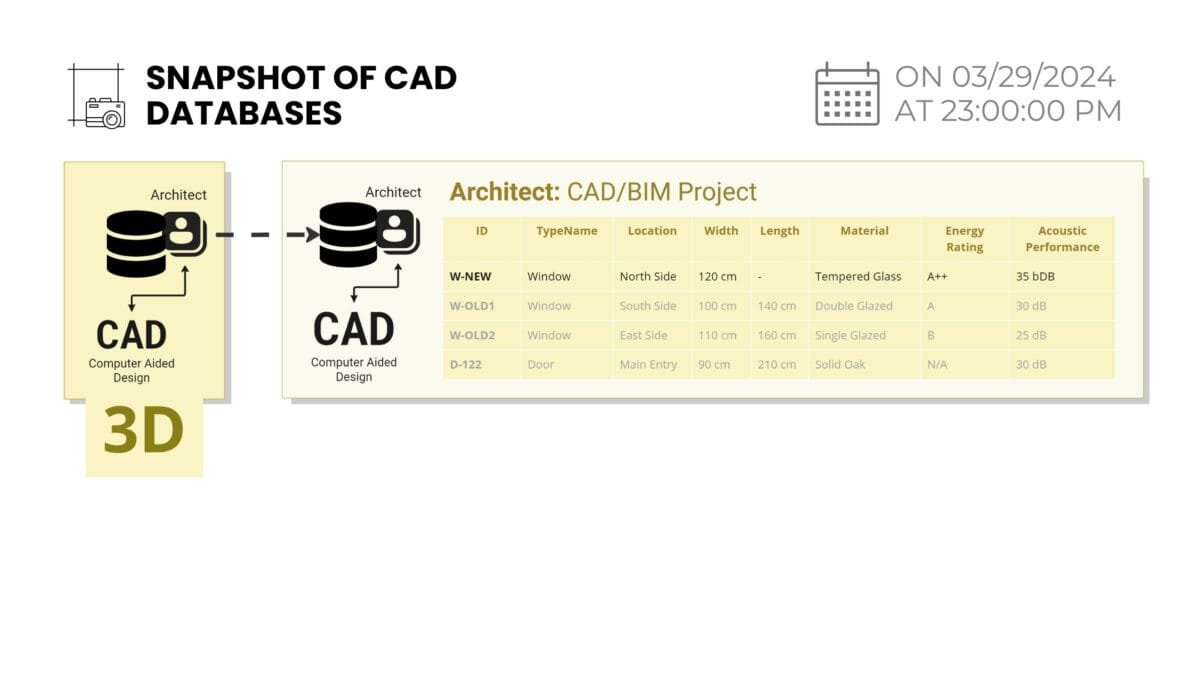
The image shows the information table of an architect's project using CAD (BIM) programs. This table-database displays unique window and door system identifiers (attribute «ID»), types (attribute «TypeName»), dimensions (attributes «Width» and «Length»), materials (attribute «Material»), Energy Rating and Acoustic Performance and hundreds of other attributes. Such a table, filled in within the CAD (BIM) program, is collected from various departments and documents, forming an information model of the project.

Thanks to the reverse engineering tools discussed in the chapter "Translating CAD (BIM) data into a structured form", this information can be organized into separate tables or combined into one common table that integrates different sections of the project.
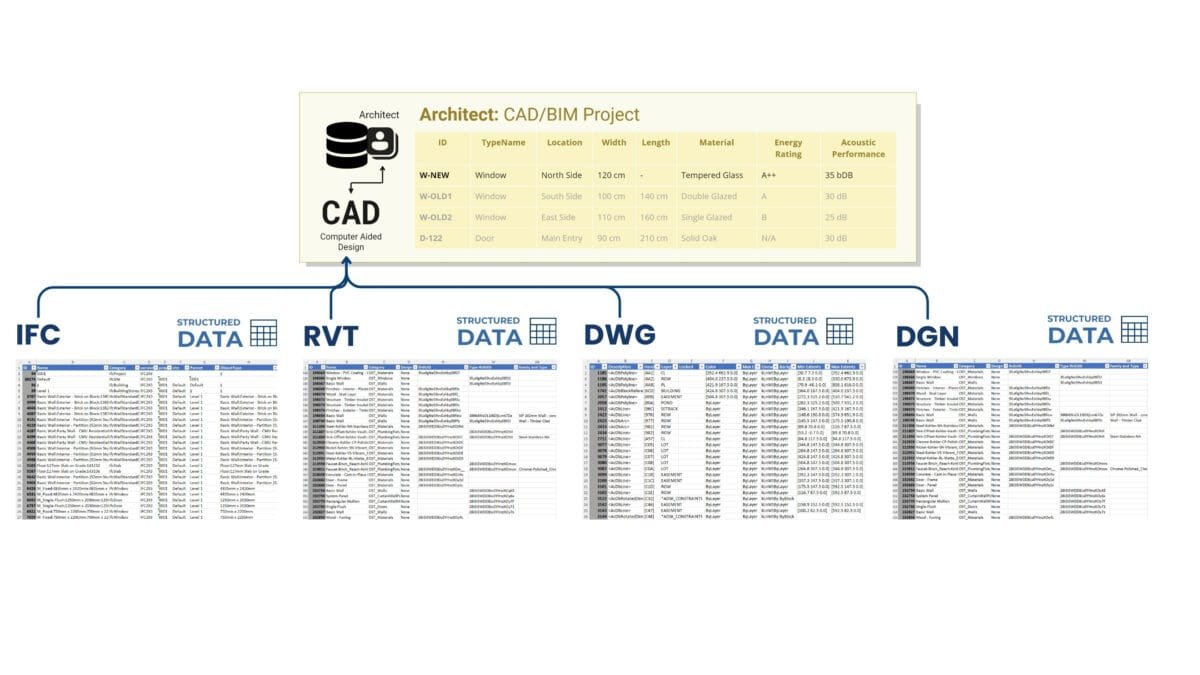
A project in the form of a CAD (BIM) database consists of tens or hundreds of thousands of elements. These elements are grouped into entities by type and category and range from windows and doors of various kinds to concrete slabs and wall elements. Unique identifiers (native IDs) from the CAD (BIM) program or its Type (attributes  «Type Name», «Type » or «Family»), such as "W-NEW" for a new window on the north side, allow the same entity to be tracked in different systems. Information about the new window must be recorded in all systems with the same numeric or alphabetic ID: in this case "W-NEW".


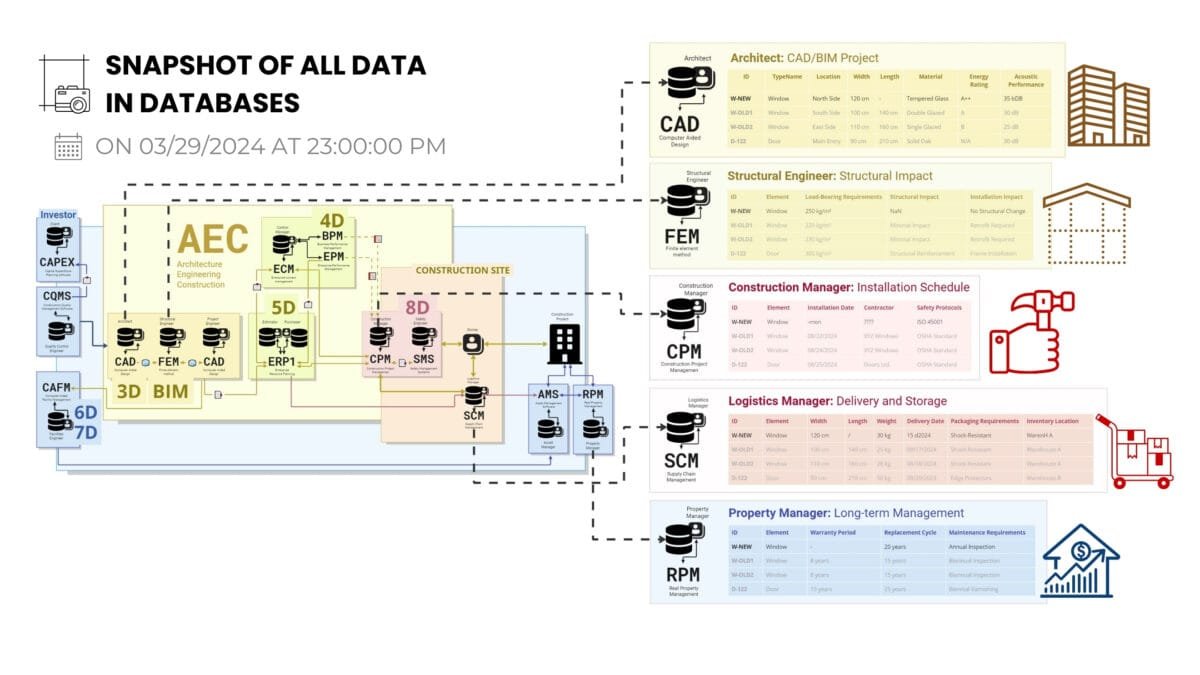
While the name and IDs of entities should be the same in all systems, the set of attribute-parameters and their values differ from one system to another. Different project professionals such as architects, structural engineers, construction managers, logisticians and property managers look at the same entities differently.

For each role in the process, databases with their own user interface are provided - from CAD (BIM) projects and structural impact assessments to installation schedules, delivery and storage logistics, and real estate management.

Each system is managed by a professional team of specialists, where behind the sum of all decisions made on the entered values at the end of the chain is the system manager, who is responsible for the legal validity and quality of the entered data.
Having collected the structured requirements and data at the logical and physical level in an organised manner, it remains for us to validate the data from the systems against the requirements we have collected.

Leave a Reply

Change language

Post's Highlights

Stay updated: news and insights


We’re Here to Help

Fresh solutions are released through our social channels

UNLOCK THE POWER OF DATA
 IN CONSTRUCTION

Dive into the world of data-driven construction with this accessible guide, perfect for professionals and novices alike.
From the basics of data management to cutting-edge trends in digital transformation, this book
will be your comprehensive guide to using data in the construction industry.

Related posts 

Focus Areas

Search

Search
Sorry, no articles found.

✕

Don't miss the new solutions


✕
✕

Linux

macOS

Looking for the Linux or MAC version? Send us a quick message using the button below, and we’ll guide you through the process!

✕

📥 Download OnePager

Welcome to DataDrivenConstruction—where data meets innovation in the construction industry. Our One-Pager offers a concise overview of how our data-driven solutions can transform your projects, enhance efficiency, and drive sustainable growth. 

✕

🚀 Welcome to the future of data in construction!

You're taking your first step into the world of open data, working with normalized, structured data—the foundation of data analytics and modern automation tools.

By downloading, you agree to the DataDrivenConstruction terms of use 

Stay ahead with the latest updates on converters, tools, AI, LLM
and data analytics in construction — Subscribe now!

✕

🚀 Welcome to the future of data in construction!

You're taking your first step into the world of open data, working with normalized, structured data—the foundation of data analytics and modern automation tools.

By downloading, you agree to the DataDrivenConstruction terms of use 

Stay ahead with the latest updates on converters, tools, AI, LLM
and data analytics in construction — Subscribe now!

✕

🚀 Welcome to the future of data in construction!

You're taking your first step into the world of open data, working with normalized, structured data—the foundation of data analytics and modern automation tools.

By downloading, you agree to the DataDrivenConstruction terms of use 

Stay ahead with the latest updates on converters, tools, AI, LLM
and data analytics in construction — Subscribe now!

✕

🚀 Welcome to the future of data in construction!

You're taking your first step into the world of open data, working with normalized, structured data—the foundation of data analytics and modern automation tools.

By downloading, you agree to the DataDrivenConstruction terms of use 

Stay ahead with the latest updates on converters, tools, AI, LLM
and data analytics in construction — Subscribe now!

✕

🚀 Welcome to the future of data in construction!

You're taking your first step into the world of open data, working with normalized, structured data—the foundation of data analytics and modern automation tools.

By downloading, you agree to the DDC terms of use 

✕

🚀 Welcome to the future of data in construction!

You're taking your first step into the world of open data, working with normalized, structured data—the foundation of data analytics and modern automation tools.

By downloading, you agree to the DataDrivenConstruction terms of use 

Stay ahead with the latest updates on converters, tools, AI, LLM
and data analytics in construction — Subscribe now!

✕
DataDrivenConstruction offers workshops tested and practiced on global leaders in the construction industry to help your team navigate and leverage the power of data and artificial intelligence in your company's decision making.

Reserve your spot now to rethink your
approach to decision making!

✕


🚀 Welcome to the future of data in construction!

By downloading, you agree to the DataDrivenConstruction terms of use 

Stay ahead with the latest updates on converters, tools, AI, LLM
and data analytics in construction — Subscribe now!

✕
Have a question or need more information? Reach out to us directly!
Schedule a time to discuss your needs with our team.
Tailored sessions to help your team grow — let's plan together!
✕
Have you attended one of our workshops, read our book, or used our solutions? Share your thoughts with us!
Name
✕
Data Maturity Diagnostics

🧰 Data-Driven Readiness Check

This short assessment will help you identify your company's data management pain points and offer solutions to improve project efficiency. It takes only 1–2 minutes to complete and you will receive personalized recommendations tailored to your needs.

✕

Clean & Organized Data

Theoretical Chapters:

Practical Chapters:

What You'll Find on
DDC Solutions:

  • CAD/BIM to spreadsheet/database converters (Revit, AutoCAD, IFC, Microstation)
  • Ready-to-deploy n8n workflows for construction processes
  • ETL pipelines for data synchronization between systems
  • Customizable Python scripts for repetitive tasks
  • Intelligent data validation and error detection
  • Real-time dashboard connectors
  • Automated reporting systems
✕

Connect Everything

Theoretical Chapters:

Practical Chapters:

What You'll Find on
DDC Solutions:

  • CAD/BIM to spreadsheet/database converters (Revit, AutoCAD, IFC, Microstation)
  • Ready-to-deploy n8n workflows for construction processes
  • ETL pipelines for data synchronization between systems
  • Customizable Python scripts for repetitive tasks
  • Intelligent data validation and error detection
  • Real-time dashboard connectors
  • Automated reporting systems
✕

Add AI & LLM Brain

Theoretical Chapters:

Practical Chapters:

What You'll Find on
DDC Solutions:

  • CAD/BIM to spreadsheet/database converters (Revit, AutoCAD, IFC, Microstation)
  • Ready-to-deploy n8n workflows for construction processes
  • ETL pipelines for data synchronization between systems
  • Customizable Python scripts for repetitive tasks
  • Intelligent data validation and error detection
  • Real-time dashboard connectors
  • Automated reporting systems
Collecting data for verification
This website uses cookies to improve your experience. By using this website you agree to our Data Protection Policy.
Read more
×