Time resources of calculations for scheduling of works
22 February 2024
6D-8D from energy efficiency to safety assurance
22 February 2024

Construction schedules and 4D project data

A construction schedule is a visual representation of the plan for executing the various phases of a project. It is created from detailed calculations such as the one above, where each task-job is timed and sequenced.

To determine the dates for the construction schedule in a Gantt chart, we take the values of the time volume attribute for each item from the foundation block costing and multiply them by the number of blocks (in this case, concrete foundation blocks). This calculation gives the duration of each task. We then plot these durations on a timeline, starting from the project start date, to construct a graph and the result is a visual representation showing when each task should start and finish.

The schedule helps project managers and workers clearly understand when and in what sequence the various phases of construction should be performed, ensuring efficient use of resources and meeting deadlines.

Let's present the scheduling of work for the installation of three concrete foundation blocks using the costings from the table above, starting May 1, 2024.

Using the costing table from the example above, let's ask ChatGPT to schedule the installation of the 3 foundation block elements from the first of May 2024. In order to send the costings to ChatGPT, we can either upload the costings table in XLSX format or simply insert a screenshot of the costings. ChatGPT will independently find a library to visualize the graph and by multiplying the time attributes of works from table by their volume will add all the data into a graph.


❏ Text request to ChatGPT:

Construct a schedule of work using the costings from the table to install 3 pieces of foundation block beginning 01/05/2024. ⏎


➤ ChatGPT Answer:
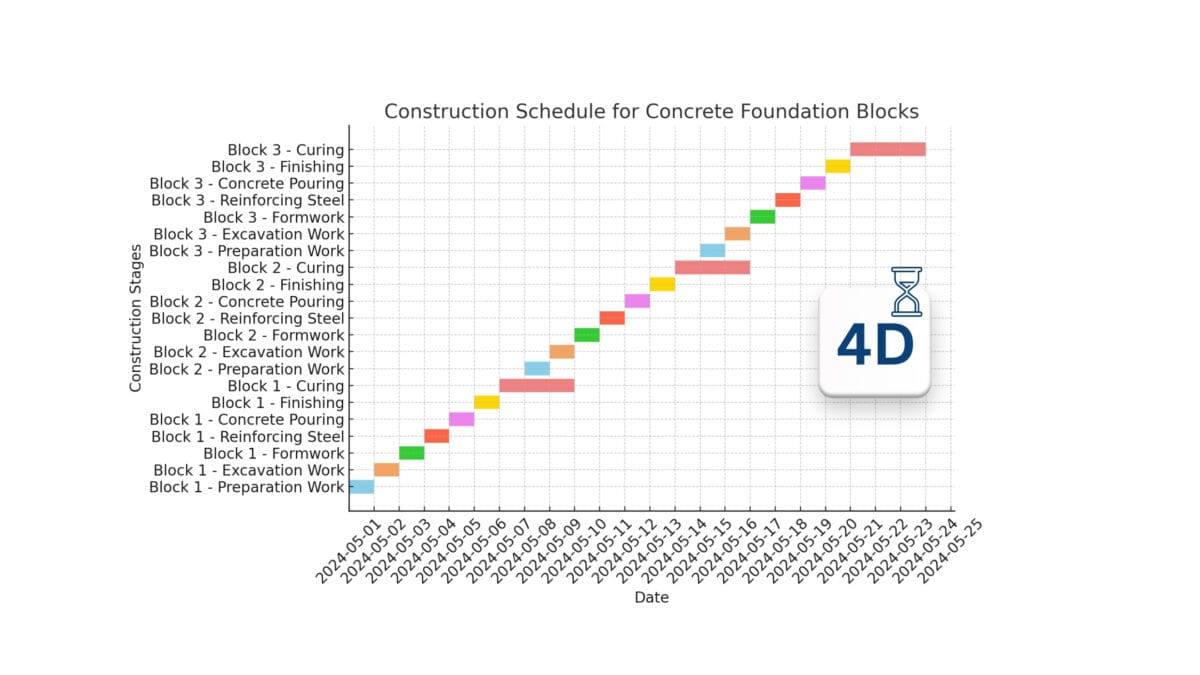
The resulting graph is divided into horizontal bars, where each bar corresponds to a certain stage of work on the block. The colors distinguish the stages such as preparation, excavation, formwork, reinforcement, concrete pouring, finishing work and concrete curing. The duration of each stage is shown by the length of the corresponding-colored bar on the graph.

This schedule not only helps to estimate how long each phase will take, but also shows how work on one block overlaps with work on another. For example, when concrete pouring for the first block is finished, preparations for the installation of the second block begin. This scheduling method allows for optimal allocation of labor and equipment, reducing overall project completion time and improving site efficiency.

Using costing, we can, thanks to the attributes of volumes from 3D geometries, automatically calculate the time characteristics of groups in the form of tables or graphs for different project variants
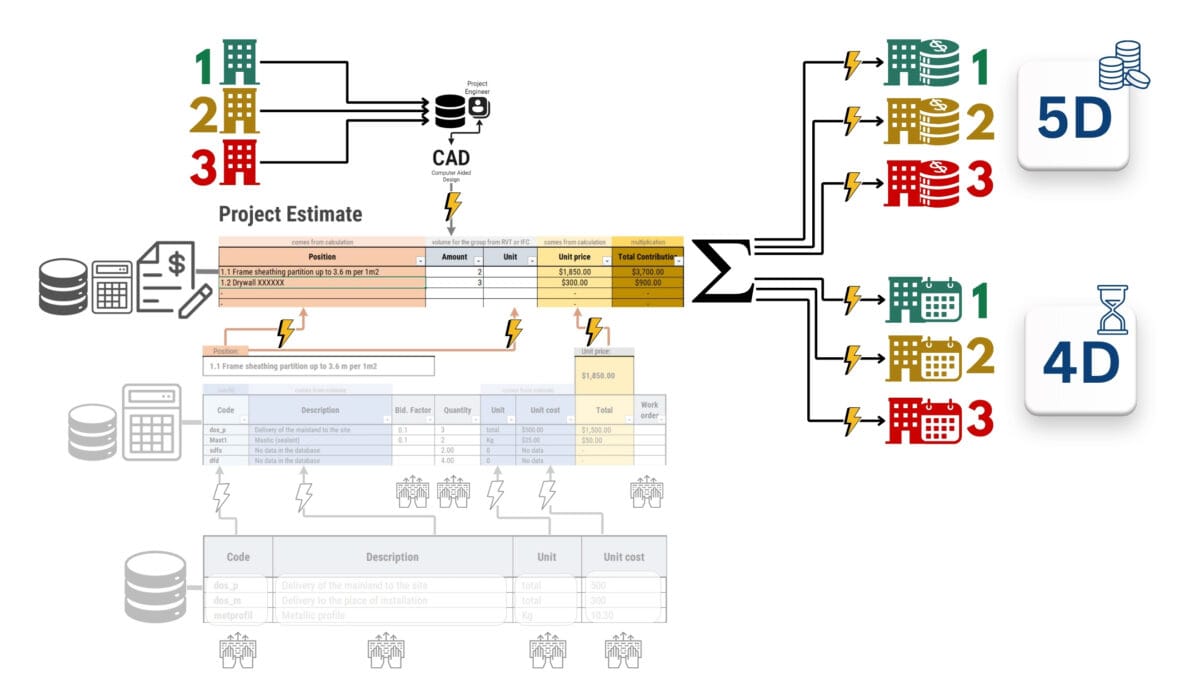
Modern ERP systems employ automated methods for calculating time, which substantially shorten the decision-making process. This enables swift and precise planning of work schedules and the computation of the total time required for completing project tasks.

Leave a Reply

Change language

Post's Highlights

    Stay updated: news and insights


    We’re Here to Help

    Fresh solutions are released through our social channels

    UNLOCK THE POWER OF DATA
     IN CONSTRUCTION

    Dive into the world of data-driven construction with this accessible guide, perfect for professionals and novices alike.
    From the basics of data management to cutting-edge trends in digital transformation, this book
    will be your comprehensive guide to using data in the construction industry.

    Related posts 

    Focus Areas

    navigate
    • ALL THE CHAPTERS IN THIS PART
    • A PRACTICAL GUIDE TO IMPLEMENTING A DATA-DRIVEN APPROACH (8)
    • CLASSIFICATION AND INTEGRATION: A COMMON LANGUAGE FOR CONSTRUCTION DATA (8)
    • DATA FLOW WITHOUT MANUAL EFFORT: WHY ETL (8)
    • DATA INFRASTRUCTURE: FROM STORAGE FORMATS TO DIGITAL REPOSITORIES (8)
    • DATA UNIFICATION AND STRUCTURING (7)
    • SYSTEMATIZATION OF REQUIREMENTS AND VALIDATION OF INFORMATION (7)
    • COST CALCULATIONS AND ESTIMATES FOR CONSTRUCTION PROJECTS (6)
    • EMERGENCE OF BIM-CONCEPTS IN THE CONSTRUCTION INDUSTRY (6)
    • MACHINE LEARNING AND PREDICTIONS (6)
    • BIG DATA AND ITS ANALYSIS (5)
    • DATA ANALYTICS AND DATA-DRIVEN DECISION-MAKING (5)
    • DATA CONVERSION INTO A STRUCTURED FORM (5)
    • DESIGN PARAMETERIZATION AND USE OF LLM FOR CAD OPERATION (5)
    • GEOMETRY IN CONSTRUCTION: FROM LINES TO CUBIC METERS (5)
    • LLM AND THEIR ROLE IN DATA PROCESSING AND BUSINESS PROCESSES (5)
    • ORCHESTRATION OF ETL AND WORKFLOWS: PRACTICAL SOLUTIONS (5)
    • SURVIVAL STRATEGIES: BUILDING COMPETITIVE ADVANTAGE (5)
    • 4D-6D and Calculation of Carbon Dioxide Emissions (4)
    • CONSTRUCTION ERP AND PMIS SYSTEMS (4)
    • COST AND SCHEDULE FORECASTING USING MACHINE LEARNING (4)
    • DATA WAREHOUSE MANAGEMENT AND CHAOS PREVENTION (4)
    • EVOLUTION OF DATA USE IN THE CONSTRUCTION INDUSTRY (4)
    • IDE WITH LLM SUPPORT AND FUTURE PROGRAMMING CHANGES (4)
    • QUANTITY TAKE-OFF AND AUTOMATIC CREATION OF ESTIMATES AND SCHEDULES (4)
    • THE DIGITAL REVOLUTION AND THE EXPLOSION OF DATA (4)
    • Uncategorized (4)
    • CLOSED PROJECT FORMATS AND INTEROPERABILITY ISSUES (3)
    • MANAGEMENT SYSTEMS IN CONSTRUCTION (3)
    • AUTOMATIC ETL CONVEYOR (PIPELINE) (2)

    Search

    Search

    057 Speed of decision making depends on data quality

    Today’s design data architecture is undergoing fundamental changes. The industry is moving away from bulky, isolated models and closed formats towards more flexible, machine-readable structures focused on analytics, integration and process automation. However, the transition...

    060 A common language of construction the role of classifiers in digital transformation

    In the context of digitalization and automation of inspection and processing processes, a special role is played by classification systems elements – a kind of “digital dictionaries” that ensure uniformity in the description and parameterization...

    061 Masterformat, OmniClass, Uniclass and CoClass the evolution of classification systems

    Historically, construction element and work classifiers have evolved in three generations, each reflecting the level of available technology and the current needs of the industry in a particular time period (Fig. 4.2-8): First generation (early...

    Don't miss the new solutions


    Linux

    macOS

    Looking for the Linux or MAC version? Send us a quick message using the button below, and we’ll guide you through the process!


    📥 Download OnePager

    Welcome to DataDrivenConstruction—where data meets innovation in the construction industry. Our One-Pager offers a concise overview of how our data-driven solutions can transform your projects, enhance efficiency, and drive sustainable growth. 

    🚀 Welcome to the future of data in construction!

    You're taking your first step into the world of open data, working with normalized, structured data—the foundation of data analytics and modern automation tools.

    By downloading, you agree to the DataDrivenConstruction terms of use 

    Stay ahead with the latest updates on converters, tools, AI, LLM
    and data analytics in construction — Subscribe now!

    🚀 Welcome to the future of data in construction!

    You're taking your first step into the world of open data, working with normalized, structured data—the foundation of data analytics and modern automation tools.

    By downloading, you agree to the DataDrivenConstruction terms of use 

    Stay ahead with the latest updates on converters, tools, AI, LLM
    and data analytics in construction — Subscribe now!

    🚀 Welcome to the future of data in construction!

    You're taking your first step into the world of open data, working with normalized, structured data—the foundation of data analytics and modern automation tools.

    By downloading, you agree to the DataDrivenConstruction terms of use 

    Stay ahead with the latest updates on converters, tools, AI, LLM
    and data analytics in construction — Subscribe now!

    🚀 Welcome to the future of data in construction!

    You're taking your first step into the world of open data, working with normalized, structured data—the foundation of data analytics and modern automation tools.

    By downloading, you agree to the DataDrivenConstruction terms of use 

    Stay ahead with the latest updates on converters, tools, AI, LLM
    and data analytics in construction — Subscribe now!

    🚀 Welcome to the future of data in construction!

    You're taking your first step into the world of open data, working with normalized, structured data—the foundation of data analytics and modern automation tools.

    By downloading, you agree to the DDC terms of use 

    🚀 Welcome to the future of data in construction!

    You're taking your first step into the world of open data, working with normalized, structured data—the foundation of data analytics and modern automation tools.

    By downloading, you agree to the DataDrivenConstruction terms of use 

    Stay ahead with the latest updates on converters, tools, AI, LLM
    and data analytics in construction — Subscribe now!

    DataDrivenConstruction offers workshops tested and practiced on global leaders in the construction industry to help your team navigate and leverage the power of data and artificial intelligence in your company's decision making.

    Reserve your spot now to rethink your
    approach to decision making!


    🚀 Welcome to the future of data in construction!

    By downloading, you agree to the DataDrivenConstruction terms of use 

    Stay ahead with the latest updates on converters, tools, AI, LLM
    and data analytics in construction — Subscribe now!

    Have a question or need more information? Reach out to us directly!
    Schedule a time to discuss your needs with our team.
    Tailored sessions to help your team grow — let's plan together!
    Have you attended one of our workshops, read our book, or used our solutions? Share your thoughts with us!
    Name
    Data Maturity Diagnostics

    🧰 Data-Driven Readiness Check

    This short assessment will help you identify your company's data management pain points and offer solutions to improve project efficiency. It takes only 1–2 minutes to complete and you will receive personalized recommendations tailored to your needs.

    Clean & Organized Data

    Theoretical Chapters:

    Practical Chapters:

    What You'll Find on
    DDC Solutions:

    • CAD/BIM to spreadsheet/database converters (Revit, AutoCAD, IFC, Microstation)
    • Ready-to-deploy n8n workflows for construction processes
    • ETL pipelines for data synchronization between systems
    • Customizable Python scripts for repetitive tasks
    • Intelligent data validation and error detection
    • Real-time dashboard connectors
    • Automated reporting systems

    Connect Everything

    Theoretical Chapters:

    Practical Chapters:

    What You'll Find on
    DDC Solutions:

    • CAD/BIM to spreadsheet/database converters (Revit, AutoCAD, IFC, Microstation)
    • Ready-to-deploy n8n workflows for construction processes
    • ETL pipelines for data synchronization between systems
    • Customizable Python scripts for repetitive tasks
    • Intelligent data validation and error detection
    • Real-time dashboard connectors
    • Automated reporting systems

    Add AI & LLM Brain

    Theoretical Chapters:

    Practical Chapters:

    What You'll Find on
    DDC Solutions:

    • CAD/BIM to spreadsheet/database converters (Revit, AutoCAD, IFC, Microstation)
    • Ready-to-deploy n8n workflows for construction processes
    • ETL pipelines for data synchronization between systems
    • Customizable Python scripts for repetitive tasks
    • Intelligent data validation and error detection
    • Real-time dashboard connectors
    • Automated reporting systems
    Construction schedules and 4D project data
    This website uses cookies to improve your experience. By using this website you agree to our Data Protection Policy.
    Read more
    ×