
Semi-structured data
18 February 2024
BIM data and BOM-BIM concept
18 February 2024

Geometric data

If meta-information about project elements is stored almost always in the form of tables and structured data, then geometric data of project elements in most cases are created using special 2D and 3D CAD (BIM) tools that allow to visualize the project elements in detail as a set of lines (2D) or geometric bodies (3D).

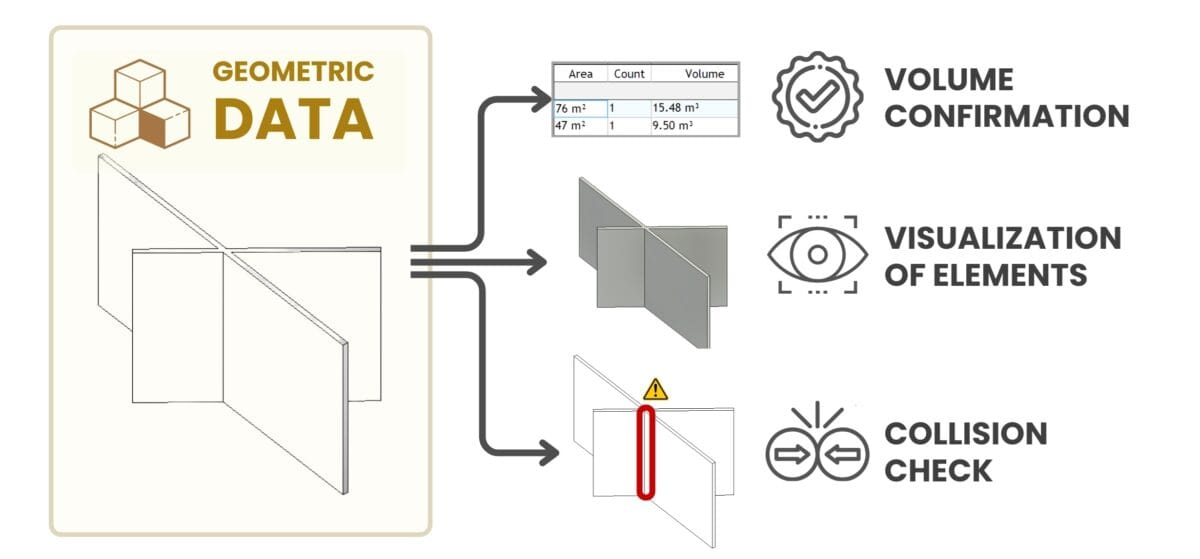
In working with geometric data in construction and architecture, three key areas of application for geometric CAD (BIM) data can be identified:

  • Confirmation of Volumes: Geometric data generated by CAD (BIM) programs is critical to automatically and accurately determine the volumes and dimensions of elements in a project. This data includes automatically calculated areas, volumes, lengths and other important attributes needed for planning, budgeting and ordering resources and materials.
  • Project Visualization: Visualization of project elements in 3D makes it possible, in case of any changes in the project, to automatically generate updated drawings in various planes. Visualization of the project at the initial stages allows to accelerate mutual understanding between all participants, saving valuable time and resources during construction.
  • Collision checking: In complex construction and engineering projects where the interaction of multiple elements (e.g. pipes and walls) without "geometric conflicts" is critical, collision checking plays a key role. Utilizing collision detection software allows to proactively detect potential geometric conflicts between project elements, preventing costly errors during the construction process.
From the very beginning of appearance of engineering and design bureaus, design engineers provided geometric information in the form of drawings of lines and flat geometric elements (in papyrus, A0 watman or formats, DWG, PDF, PLT), on the basis of which foremen and estimators, for the last thousands of years, with the help of rulers and conveyors collected attribute volumes or the number of elements (entities).

This manual and time-consuming task is now solved by full automation thanks to the advent of volumetric modelling in modern CAD tools (BIM), which now allows to automatically obtain the volumetric attributes of any element, without having to calculate these values manually on a calculator.

“We need to be able to manage all that data (CAD (BIM) project data - Author's note), store it digitally and sell lifecycle and process management software, because for every engineer who creates something (in (CAD (BIM) - Author's note), there are ten people who work with that data”.

Interview C.B. CEO Autodesk®, 2005

Modern CAD (BIM) tools provide project elements not only with precise geometry: shape and dimensions, but also allow to automatically create from these geometries tables of specifications for volumes, which are later used in ERP systems at the stages of calculations, scheduling or e.g. calculation of CO2 emissions. We will talk more about the topic of obtaining specifications, QTO and volume tables and practical cases in the chapter "Obtaining Volumes and Quantity Take-Off".
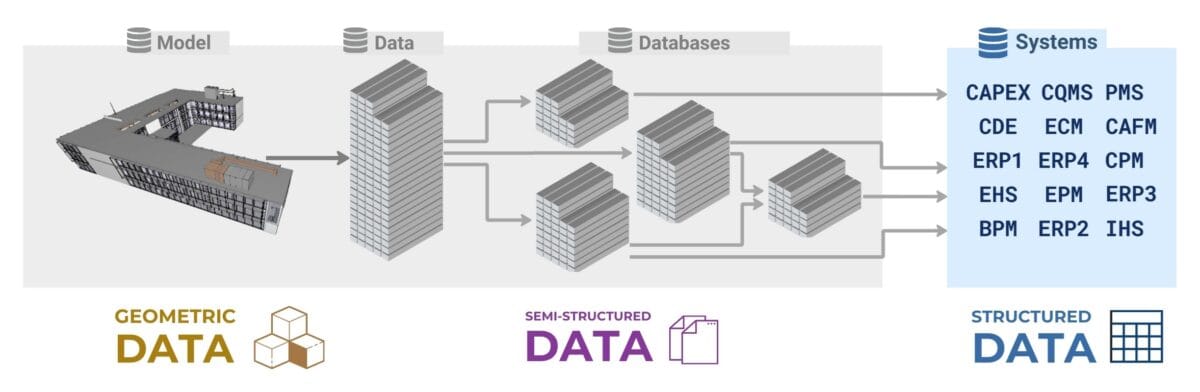
In addition to volumetric modelling of elements in CAD (BIM) tools, there is an additional information layer due to the BOM concept from mechanical engineering, which CAD (BIM) vendors vendors have labelled with special marketing acronym BIM (Building Information Modeling) - an acronym that has been actively promoted since 2003.

Thanks to the efforts of CAD (BIM) suppliers, data created in CAD (BIM) solutions has become a separate, as if existing, new type of BIM data combining both geometric information about elements and meta-information, collected in special CAD (BIM) format.

Leave a Reply

Change language

Post's Highlights

Stay updated: news and insights


We’re Here to Help

Fresh solutions are released through our social channels

UNLOCK THE POWER OF DATA
 IN CONSTRUCTION

Dive into the world of data-driven construction with this accessible guide, perfect for professionals and novices alike.
From the basics of data management to cutting-edge trends in digital transformation, this book
will be your comprehensive guide to using data in the construction industry.

Related posts 

Focus Areas

Search

Search
Sorry, no articles found.

✕

Don't miss the new solutions


✕
✕

Linux

macOS

Looking for the Linux or MAC version? Send us a quick message using the button below, and we’ll guide you through the process!

✕

📥 Download OnePager

Welcome to DataDrivenConstruction—where data meets innovation in the construction industry. Our One-Pager offers a concise overview of how our data-driven solutions can transform your projects, enhance efficiency, and drive sustainable growth. 

✕

🚀 Welcome to the future of data in construction!

You're taking your first step into the world of open data, working with normalized, structured data—the foundation of data analytics and modern automation tools.

By downloading, you agree to the DataDrivenConstruction terms of use 

Stay ahead with the latest updates on converters, tools, AI, LLM
and data analytics in construction — Subscribe now!

✕

🚀 Welcome to the future of data in construction!

You're taking your first step into the world of open data, working with normalized, structured data—the foundation of data analytics and modern automation tools.

By downloading, you agree to the DataDrivenConstruction terms of use 

Stay ahead with the latest updates on converters, tools, AI, LLM
and data analytics in construction — Subscribe now!

✕

🚀 Welcome to the future of data in construction!

You're taking your first step into the world of open data, working with normalized, structured data—the foundation of data analytics and modern automation tools.

By downloading, you agree to the DataDrivenConstruction terms of use 

Stay ahead with the latest updates on converters, tools, AI, LLM
and data analytics in construction — Subscribe now!

✕

🚀 Welcome to the future of data in construction!

You're taking your first step into the world of open data, working with normalized, structured data—the foundation of data analytics and modern automation tools.

By downloading, you agree to the DataDrivenConstruction terms of use 

Stay ahead with the latest updates on converters, tools, AI, LLM
and data analytics in construction — Subscribe now!

✕

🚀 Welcome to the future of data in construction!

You're taking your first step into the world of open data, working with normalized, structured data—the foundation of data analytics and modern automation tools.

By downloading, you agree to the DDC terms of use 

✕

🚀 Welcome to the future of data in construction!

You're taking your first step into the world of open data, working with normalized, structured data—the foundation of data analytics and modern automation tools.

By downloading, you agree to the DataDrivenConstruction terms of use 

Stay ahead with the latest updates on converters, tools, AI, LLM
and data analytics in construction — Subscribe now!

✕
DataDrivenConstruction offers workshops tested and practiced on global leaders in the construction industry to help your team navigate and leverage the power of data and artificial intelligence in your company's decision making.

Reserve your spot now to rethink your
approach to decision making!

✕


🚀 Welcome to the future of data in construction!

By downloading, you agree to the DataDrivenConstruction terms of use 

Stay ahead with the latest updates on converters, tools, AI, LLM
and data analytics in construction — Subscribe now!

✕
Have a question or need more information? Reach out to us directly!
Schedule a time to discuss your needs with our team.
Tailored sessions to help your team grow — let's plan together!
✕
Have you attended one of our workshops, read our book, or used our solutions? Share your thoughts with us!
Name
✕
Data Maturity Diagnostics

🧰 Data-Driven Readiness Check

This short assessment will help you identify your company's data management pain points and offer solutions to improve project efficiency. It takes only 1–2 minutes to complete and you will receive personalized recommendations tailored to your needs.

✕

Clean & Organized Data

Theoretical Chapters:

Practical Chapters:

What You'll Find on
DDC Solutions:

  • CAD/BIM to spreadsheet/database converters (Revit, AutoCAD, IFC, Microstation)
  • Ready-to-deploy n8n workflows for construction processes
  • ETL pipelines for data synchronization between systems
  • Customizable Python scripts for repetitive tasks
  • Intelligent data validation and error detection
  • Real-time dashboard connectors
  • Automated reporting systems
✕

Connect Everything

Theoretical Chapters:

Practical Chapters:

What You'll Find on
DDC Solutions:

  • CAD/BIM to spreadsheet/database converters (Revit, AutoCAD, IFC, Microstation)
  • Ready-to-deploy n8n workflows for construction processes
  • ETL pipelines for data synchronization between systems
  • Customizable Python scripts for repetitive tasks
  • Intelligent data validation and error detection
  • Real-time dashboard connectors
  • Automated reporting systems
✕

Add AI & LLM Brain

Theoretical Chapters:

Practical Chapters:

What You'll Find on
DDC Solutions:

  • CAD/BIM to spreadsheet/database converters (Revit, AutoCAD, IFC, Microstation)
  • Ready-to-deploy n8n workflows for construction processes
  • ETL pipelines for data synchronization between systems
  • Customizable Python scripts for repetitive tasks
  • Intelligent data validation and error detection
  • Real-time dashboard connectors
  • Automated reporting systems
Geometric data
This website uses cookies to improve your experience. By using this website you agree to our Data Protection Policy.
Read more
×