The emergence of data requirements
19 February 2024
Block diagrams of processes and the effectiveness of conceptual frameworks
19 February 2024

Requirements gathering and analysis: key players

Analyzing and gathering process requirements starts with finding all stakeholders. Let's imagine a company has a project where the client makes a new request - "add an additional window on the north side of the building".

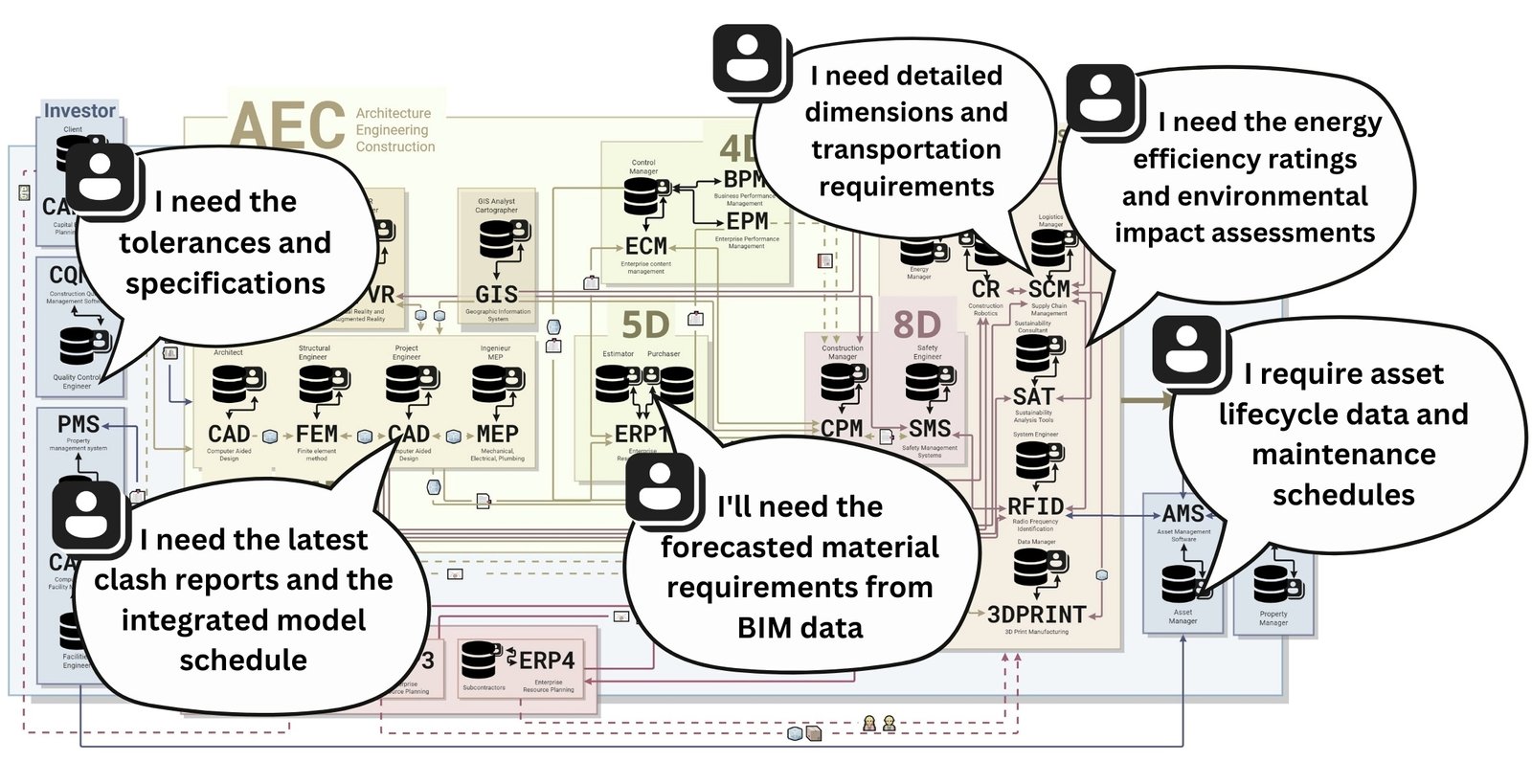
The small process of "client request to add a new window to the current project" involves the architect, client, CAD (BIM) specialist, construction manager, logistics manager, ERP analyst, quality control engineer, safety engineer, control manager and real estate manager.

Even a small process can involve dozens to hundreds of different specialists. Each process participant needs to understand the requirements of the specialists to whom they are linked at the data level.

At the textual level, the communication between the client and the specialists is as follows:

Customer: "We have decided to add an additional window on the north side for better lighting. Can this be realized?"

Architect: "Of course, I will revise the design to include the new window and send updated CAD (BIM) plans."

CAD (BIM) specialist: "Got a new project. I update CAD (BIM) model with additional window and after coordination with statistician I provide exact location and dimensions of new window.

Construction Manager: "New design received. We adjust the timing of 4D installation and inform all relevant organisations".

Facilities Engineer (CAFM): "I will enter 6D data on the new window into the CAFM system for future facility management and maintenance planning."

Logistics Manager: "I need the dimensions and weight of the new window to organize the delivery of the window to the site."

ERP Analyst: "Updating the 5D budget in our ERP system to reflect the cost of the new window in the overall project estimate."

Quality Control Engineer: "Once the window specifications are ready, I will make sure they meet our quality and material standards."

Safety Engineer: 'I will assess the safety aspects of the new window, focusing on compliance and 8D evacuation.

Controls Manager: "Let's update our 4D timeline to reflect the new window installation and save the new data into the project's content management system."

Worker (installer): "Need instructions on installation, assembly, and lead times. Also, any special safety protocols I need to follow?

Property Manager: "Once installed, I will document warranty and maintenance information for long-term management."

Asset Manager: 'Equipment Engineer, please send final data for asset tracking and lifecycle management'.

Client: "Wait, maybe I'm in a hurry and the window won't be needed. It might be worth making a balcony.".

In this scenario, communication between different professionals, including the client and the architect, occurs predominantly through textual data such as emails, dialogs, calls and meetings.
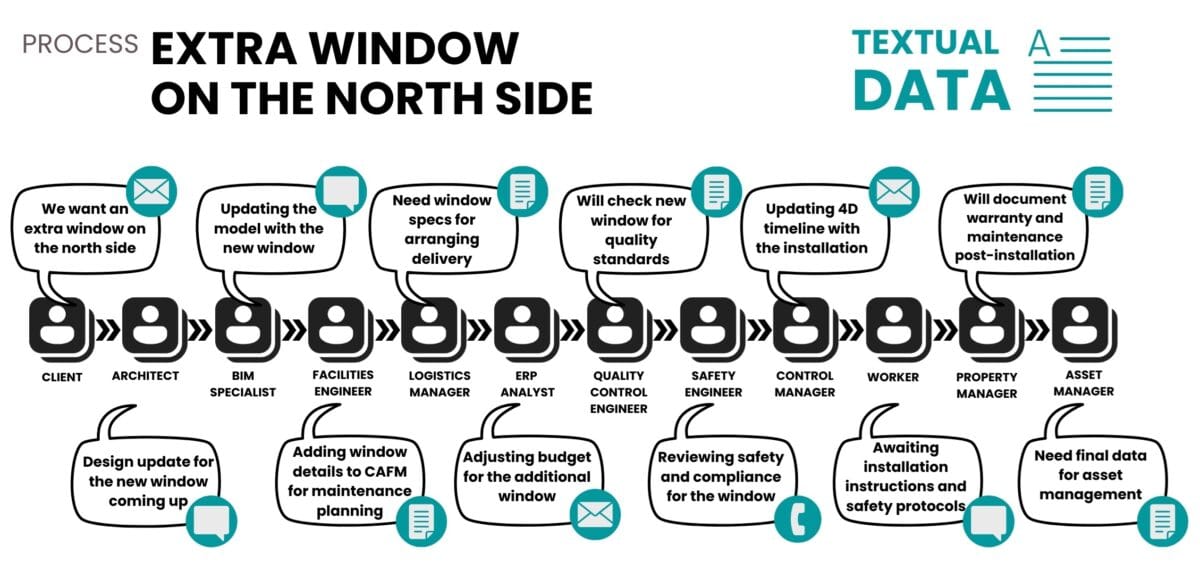
In such a text-based communication system for a construction project, a system of legal confirmation and recording of all data exchange transactions and all decisions made is essential. This is to ensure that every decision, instruction and change made is legally valid and traceable, reducing the risk of misunderstandings in the future.

The lack of legal control and confirmation of decisions in the relevant systems of a construction project can lead to serious problems for all involved. Every decision, instruction or change made without proper documentation and confirmation can lead to disputes and legal proceedings.

Lack of text transaction confirmations not only delays the project but can also lead to additional financial losses and deterioration of relationships between project participants.

Legal fixation of all decisions in text communication can be ensured only with a large number of signed documents, which will fall on the shoulders of the management, which will be obliged to record all transactions. Text-based communication require each specialist to either familiarize himself with the full correspondence or to participate in all meetings on a regular basis to understand the current status of the project.
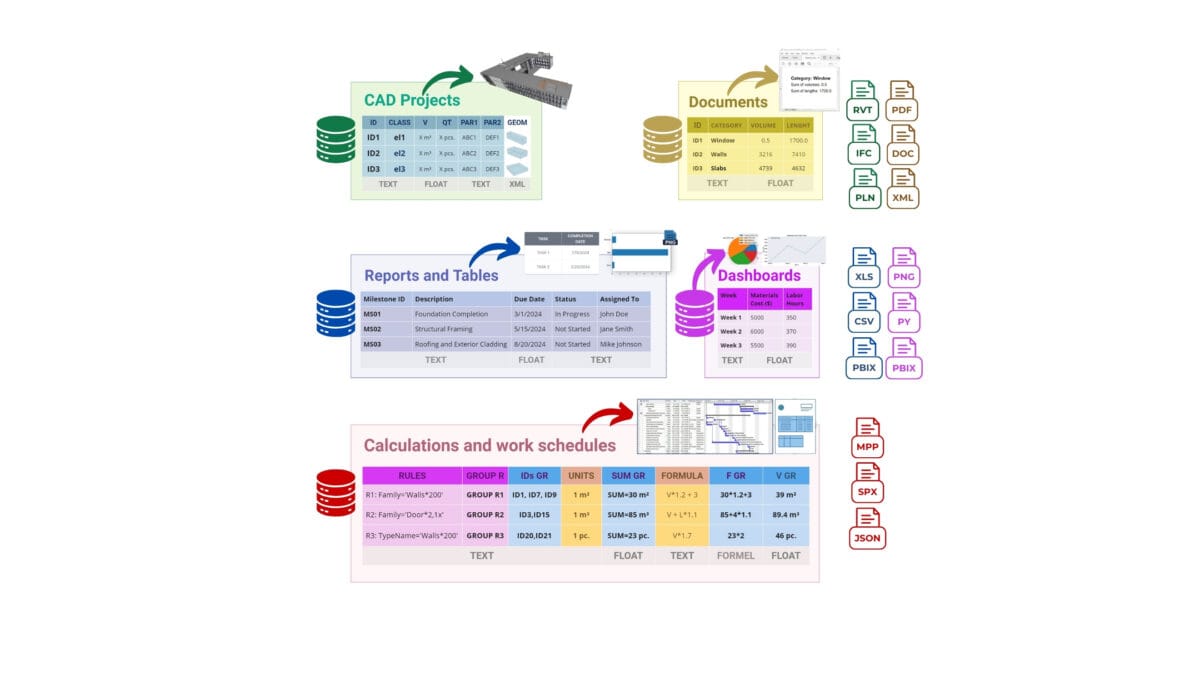
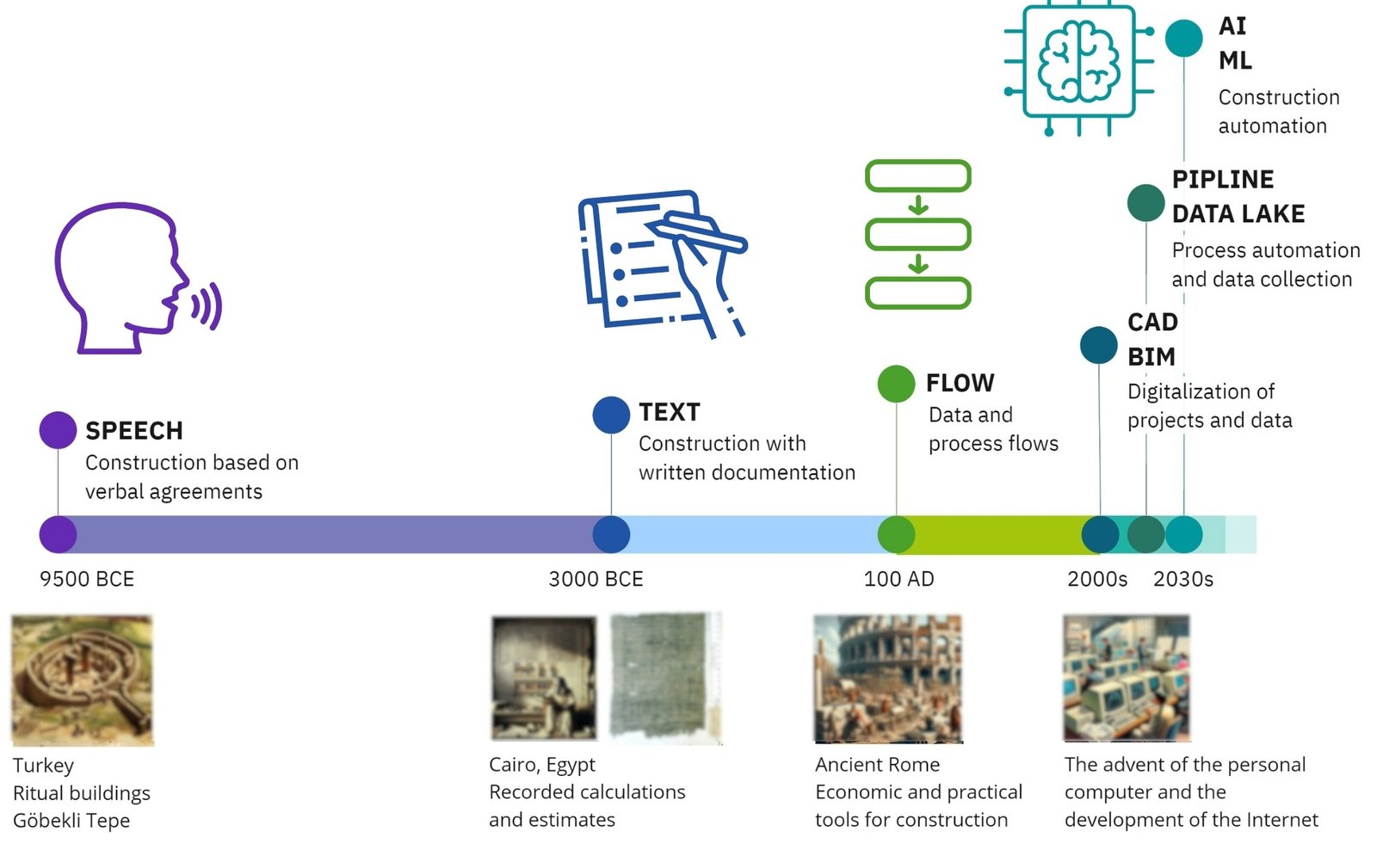
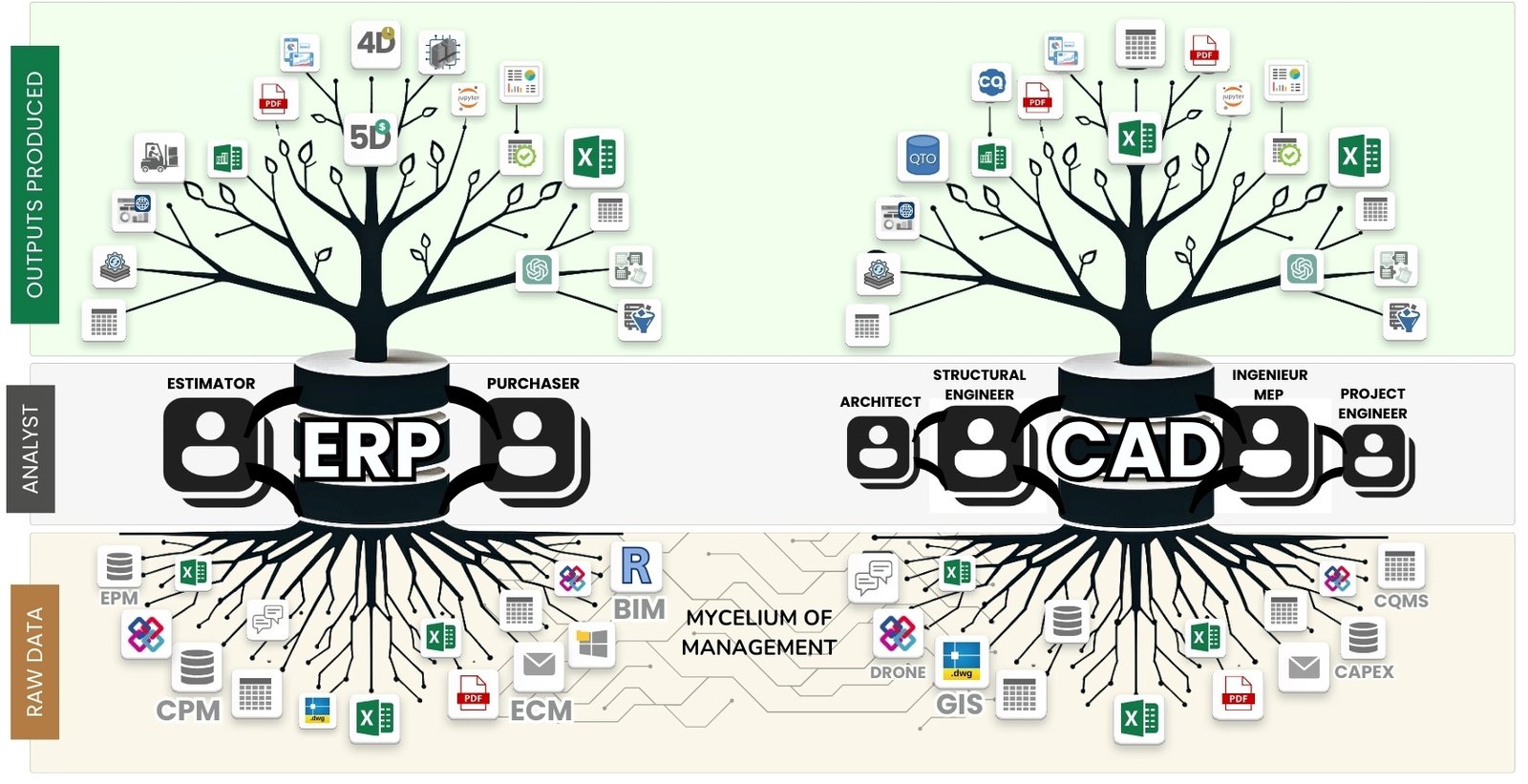
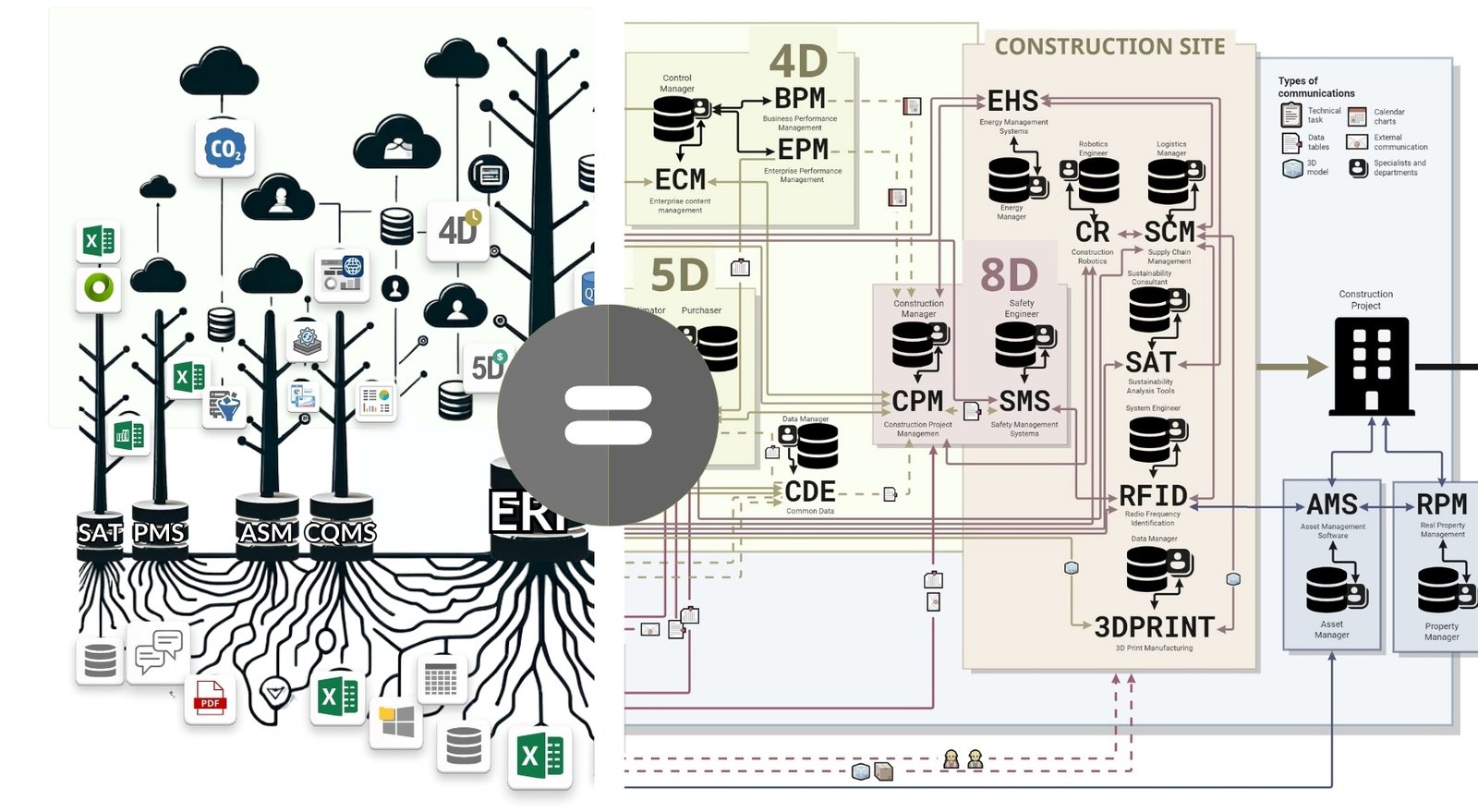
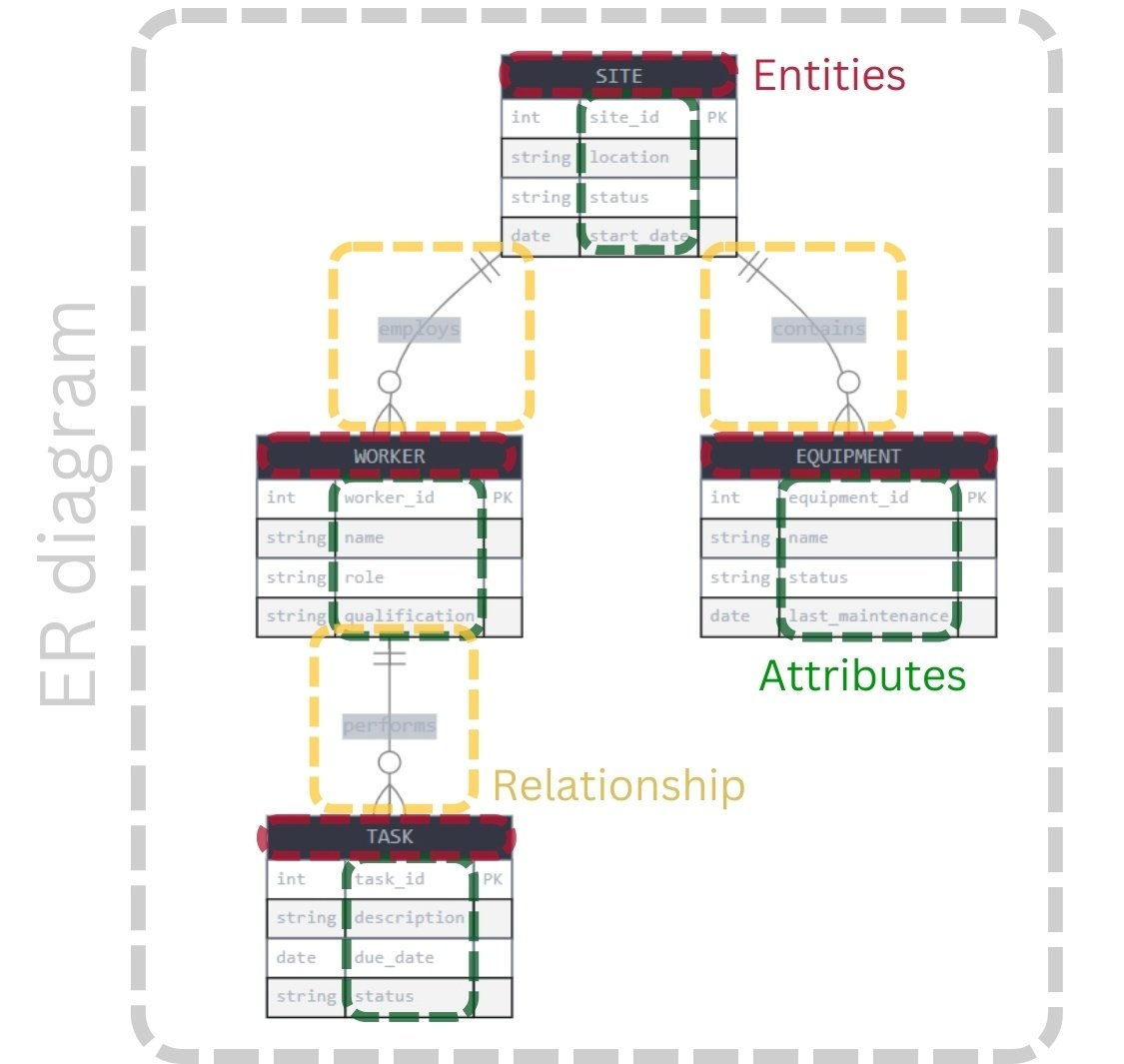
In order to move from textual communication and textual records of "decision-making operations" to the system level, methods for converting textual operations into a more structured and usable format are needed. As in data modelling (Figure 2.5-2), we moved from the contextual-idea level to the conceptual level, adding the systems and tools used by participants and the links between them.

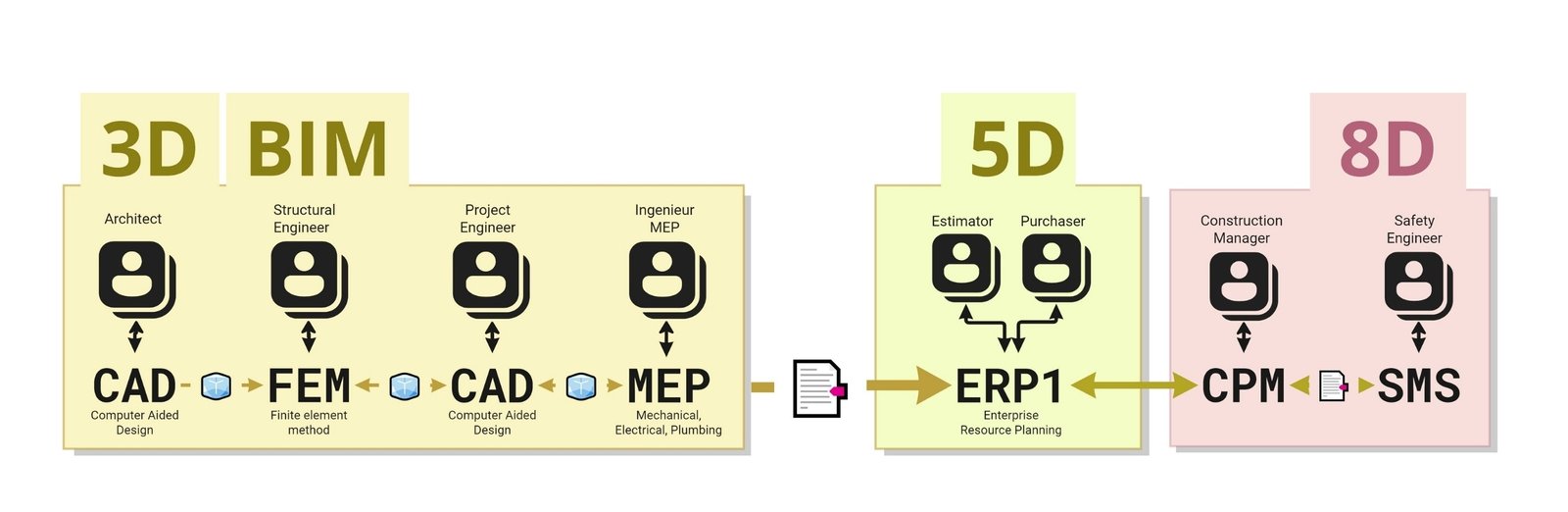
And the first step in systematising requirements and relationships is to visualise all links and relationships with the help of visual flowcharts. The conceptual level not only makes it easier for all process participants to understand the entire process chain, but also visualises why and for whom data is needed at each process step.

Leave a Reply

Change language

Post's Highlights

    Stay updated: news and insights


    We’re Here to Help

    Fresh solutions are released through our social channels

    UNLOCK THE POWER OF DATA
     IN CONSTRUCTION

    Dive into the world of data-driven construction with this accessible guide, perfect for professionals and novices alike.
    From the basics of data management to cutting-edge trends in digital transformation, this book
    will be your comprehensive guide to using data in the construction industry.

    Related posts 

    Focus Areas

    navigate
    • ALL THE CHAPTERS IN THIS PART
    • A PRACTICAL GUIDE TO IMPLEMENTING A DATA-DRIVEN APPROACH (8)
    • CLASSIFICATION AND INTEGRATION: A COMMON LANGUAGE FOR CONSTRUCTION DATA (8)
    • DATA FLOW WITHOUT MANUAL EFFORT: WHY ETL (8)
    • DATA INFRASTRUCTURE: FROM STORAGE FORMATS TO DIGITAL REPOSITORIES (8)
    • DATA UNIFICATION AND STRUCTURING (7)
    • SYSTEMATIZATION OF REQUIREMENTS AND VALIDATION OF INFORMATION (7)
    • COST CALCULATIONS AND ESTIMATES FOR CONSTRUCTION PROJECTS (6)
    • EMERGENCE OF BIM-CONCEPTS IN THE CONSTRUCTION INDUSTRY (6)
    • MACHINE LEARNING AND PREDICTIONS (6)
    • BIG DATA AND ITS ANALYSIS (5)
    • DATA ANALYTICS AND DATA-DRIVEN DECISION-MAKING (5)
    • DATA CONVERSION INTO A STRUCTURED FORM (5)
    • DESIGN PARAMETERIZATION AND USE OF LLM FOR CAD OPERATION (5)
    • GEOMETRY IN CONSTRUCTION: FROM LINES TO CUBIC METERS (5)
    • LLM AND THEIR ROLE IN DATA PROCESSING AND BUSINESS PROCESSES (5)
    • ORCHESTRATION OF ETL AND WORKFLOWS: PRACTICAL SOLUTIONS (5)
    • SURVIVAL STRATEGIES: BUILDING COMPETITIVE ADVANTAGE (5)
    • 4D-6D and Calculation of Carbon Dioxide Emissions (4)
    • CONSTRUCTION ERP AND PMIS SYSTEMS (4)
    • COST AND SCHEDULE FORECASTING USING MACHINE LEARNING (4)
    • DATA WAREHOUSE MANAGEMENT AND CHAOS PREVENTION (4)
    • EVOLUTION OF DATA USE IN THE CONSTRUCTION INDUSTRY (4)
    • IDE WITH LLM SUPPORT AND FUTURE PROGRAMMING CHANGES (4)
    • QUANTITY TAKE-OFF AND AUTOMATIC CREATION OF ESTIMATES AND SCHEDULES (4)
    • THE DIGITAL REVOLUTION AND THE EXPLOSION OF DATA (4)
    • Uncategorized (4)
    • CLOSED PROJECT FORMATS AND INTEROPERABILITY ISSUES (3)
    • MANAGEMENT SYSTEMS IN CONSTRUCTION (3)
    • AUTOMATIC ETL CONVEYOR (PIPELINE) (2)

    Search

    Search

    057 Speed of decision making depends on data quality

    Today’s design data architecture is undergoing fundamental changes. The industry is moving away from bulky, isolated models and closed formats towards more flexible, machine-readable structures focused on analytics, integration and process automation. However, the transition...

    060 A common language of construction the role of classifiers in digital transformation

    In the context of digitalization and automation of inspection and processing processes, a special role is played by classification systems elements – a kind of “digital dictionaries” that ensure uniformity in the description and parameterization...

    061 Masterformat, OmniClass, Uniclass and CoClass the evolution of classification systems

    Historically, construction element and work classifiers have evolved in three generations, each reflecting the level of available technology and the current needs of the industry in a particular time period (Fig. 4.2-8): First generation (early...

    Don't miss the new solutions


    Linux

    macOS

    Looking for the Linux or MAC version? Send us a quick message using the button below, and we’ll guide you through the process!


    📥 Download OnePager

    Welcome to DataDrivenConstruction—where data meets innovation in the construction industry. Our One-Pager offers a concise overview of how our data-driven solutions can transform your projects, enhance efficiency, and drive sustainable growth. 

    🚀 Welcome to the future of data in construction!

    You're taking your first step into the world of open data, working with normalized, structured data—the foundation of data analytics and modern automation tools.

    By downloading, you agree to the DataDrivenConstruction terms of use 

    Stay ahead with the latest updates on converters, tools, AI, LLM
    and data analytics in construction — Subscribe now!

    🚀 Welcome to the future of data in construction!

    You're taking your first step into the world of open data, working with normalized, structured data—the foundation of data analytics and modern automation tools.

    By downloading, you agree to the DataDrivenConstruction terms of use 

    Stay ahead with the latest updates on converters, tools, AI, LLM
    and data analytics in construction — Subscribe now!

    🚀 Welcome to the future of data in construction!

    You're taking your first step into the world of open data, working with normalized, structured data—the foundation of data analytics and modern automation tools.

    By downloading, you agree to the DataDrivenConstruction terms of use 

    Stay ahead with the latest updates on converters, tools, AI, LLM
    and data analytics in construction — Subscribe now!

    🚀 Welcome to the future of data in construction!

    You're taking your first step into the world of open data, working with normalized, structured data—the foundation of data analytics and modern automation tools.

    By downloading, you agree to the DataDrivenConstruction terms of use 

    Stay ahead with the latest updates on converters, tools, AI, LLM
    and data analytics in construction — Subscribe now!

    🚀 Welcome to the future of data in construction!

    You're taking your first step into the world of open data, working with normalized, structured data—the foundation of data analytics and modern automation tools.

    By downloading, you agree to the DDC terms of use 

    🚀 Welcome to the future of data in construction!

    You're taking your first step into the world of open data, working with normalized, structured data—the foundation of data analytics and modern automation tools.

    By downloading, you agree to the DataDrivenConstruction terms of use 

    Stay ahead with the latest updates on converters, tools, AI, LLM
    and data analytics in construction — Subscribe now!

    DataDrivenConstruction offers workshops tested and practiced on global leaders in the construction industry to help your team navigate and leverage the power of data and artificial intelligence in your company's decision making.

    Reserve your spot now to rethink your
    approach to decision making!


    🚀 Welcome to the future of data in construction!

    By downloading, you agree to the DataDrivenConstruction terms of use 

    Stay ahead with the latest updates on converters, tools, AI, LLM
    and data analytics in construction — Subscribe now!

    Have a question or need more information? Reach out to us directly!
    Schedule a time to discuss your needs with our team.
    Tailored sessions to help your team grow — let's plan together!
    Have you attended one of our workshops, read our book, or used our solutions? Share your thoughts with us!
    Name
    Data Maturity Diagnostics

    🧰 Data-Driven Readiness Check

    This short assessment will help you identify your company's data management pain points and offer solutions to improve project efficiency. It takes only 1–2 minutes to complete and you will receive personalized recommendations tailored to your needs.

    Clean & Organized Data

    Theoretical Chapters:

    Practical Chapters:

    What You'll Find on
    DDC Solutions:

    • CAD/BIM to spreadsheet/database converters (Revit, AutoCAD, IFC, Microstation)
    • Ready-to-deploy n8n workflows for construction processes
    • ETL pipelines for data synchronization between systems
    • Customizable Python scripts for repetitive tasks
    • Intelligent data validation and error detection
    • Real-time dashboard connectors
    • Automated reporting systems

    Connect Everything

    Theoretical Chapters:

    Practical Chapters:

    What You'll Find on
    DDC Solutions:

    • CAD/BIM to spreadsheet/database converters (Revit, AutoCAD, IFC, Microstation)
    • Ready-to-deploy n8n workflows for construction processes
    • ETL pipelines for data synchronization between systems
    • Customizable Python scripts for repetitive tasks
    • Intelligent data validation and error detection
    • Real-time dashboard connectors
    • Automated reporting systems

    Add AI & LLM Brain

    Theoretical Chapters:

    Practical Chapters:

    What You'll Find on
    DDC Solutions:

    • CAD/BIM to spreadsheet/database converters (Revit, AutoCAD, IFC, Microstation)
    • Ready-to-deploy n8n workflows for construction processes
    • ETL pipelines for data synchronization between systems
    • Customizable Python scripts for repetitive tasks
    • Intelligent data validation and error detection
    • Real-time dashboard connectors
    • Automated reporting systems
    Requirements gathering and analysis: key players
    This website uses cookies to improve your experience. By using this website you agree to our Data Protection Policy.
    Read more
    ×