

Das Zeitalter des Wandels: IFC gehört der Vergangenheit an oder warum ADSK und andere CAD-Anbieter bereit sind, IFC für USD aufzugeben — 14 wichtige Fakten
3 December 2024
Рисунок 2
004 Digitalization of construction process information
4 December 2024

003 Process as a tool for data-driven experience

At the heart of any process is the transformation of past experience into a tool for planning the future. Experience in the modern sense is a structured set of data, the analysis of which allows making reasonable forecasts.

It is historical data that serves as the foundation of forecasting, as it clearly demonstrates the results of the work performed and provides insight into the factors affecting those results.

Let’s take a concrete example from monolithic construction: usually when planning the timing of works, the volume of concrete, the complexity of the structure and weather conditions are taken into account. Suppose that a particular site foreman or the company’s historical data for the last three years (2023-2025) show that pouring a 200 m² monolithic structure in rainy weather took between 4.5 and 6 days (Fig.‎ 1.1-3). These accumulated statistics become the basis for predicting lead times and costing resources when planning similar work in future projects. Based on this historical data, the foreman or estimator can make an informed forecast, based on experience, of the time required to complete future similar work in 2026 under similar conditions.

In this case of time-analytic assessments, the analytical process acts as a mechanism for transforming disparate data into structured experience and then into a precise planning tool. Data and processes are a single ecosystem where one cannot exist without the other.

Count what can be counted, measure what can be measured, and make what cannot be measured measurable (“Monitoring: making use of the tools which are available,” 1980).

– Galileo Galilei
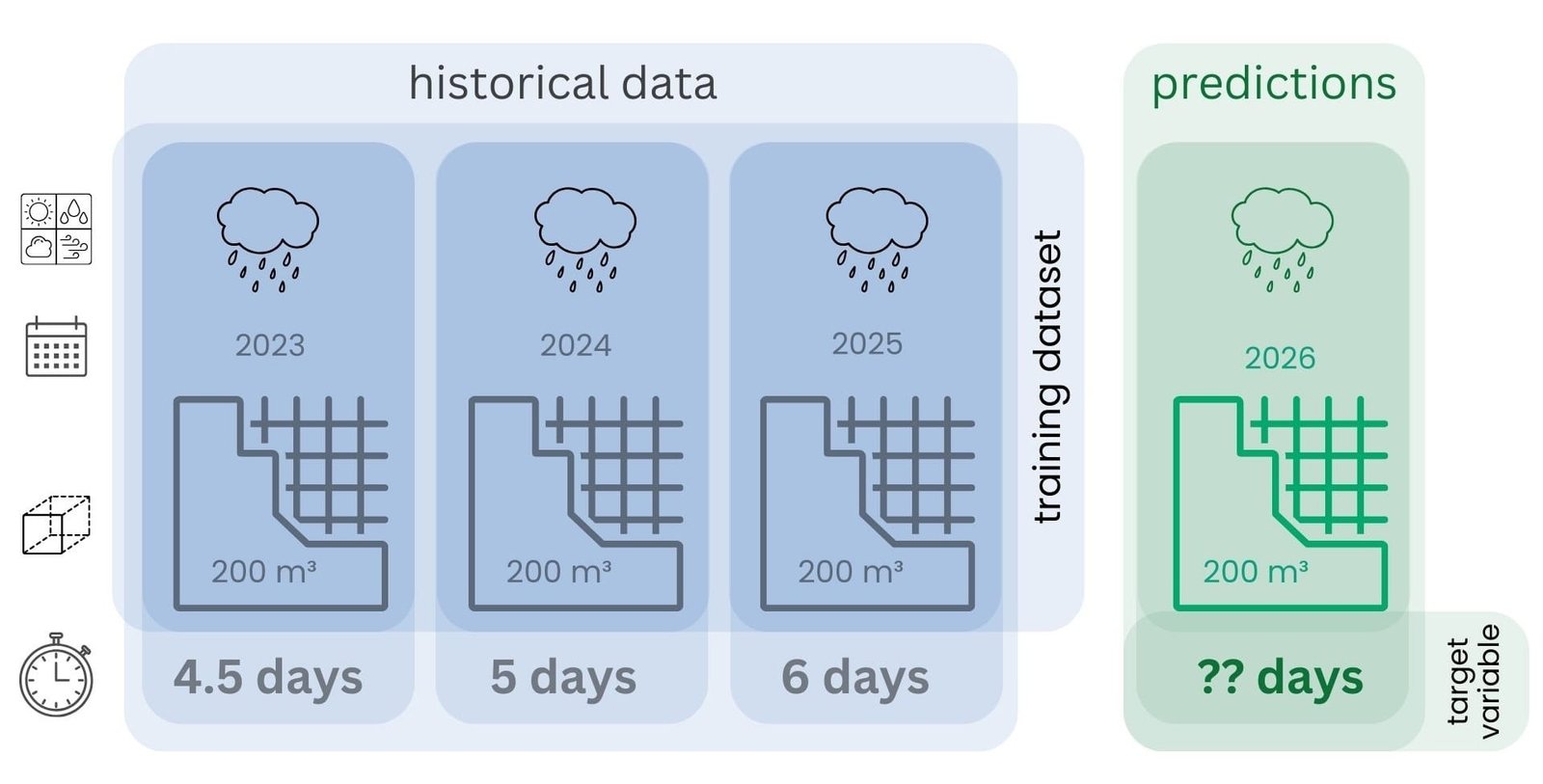
Рисунок 1
Fig.‎ 1.1-3 Historical data acts as a training data set to predict one of the values in the future.

In today’s business landscape, data analytics is becoming a critical component of effective project management, process optimization, and strategic decision making. The construction industry is gradually mastering four key levels of analytics, each of which answers a specific question and provides unique benefits (Fig.‎ 1.1-4):

  • Descriptive analytics – answers the question “what happened?” and provides historical data and reports on past events and results: over the past three years (2023-2025), it took 4.5 to 6 days to pour a 200 m² monolithic structure in rainy weather.
  • Diagnostic analytics – answers the question “why did this happen?” by identifying the causes of the problems: the analysis shows that the pouring time of the monolithic structure increased due to rainy weather, which slowed down the concrete curing process
  • Predictive analytics – future-oriented, predicts possible risks and lead times by answering the question “what will happen?”: based on historical data, it is predicted that pouring a similar 200 m² monolithic structure in rainy weather in 2026 will take approximately 5.5 days, taking into account all known factors and trends.
  • Prescriptive analytics – provides automated recommendations and answers the question “what to do?”, allowing companies to choose optimal actions: To optimize work, for example, it is recommended to: use special additives to accelerate concrete curing in high humidity conditions; plan pouring for periods with the lowest probability of precipitation; organize temporary shelters for the structure, which will reduce the work time to 4-4.5 days even in adverse weather conditions.
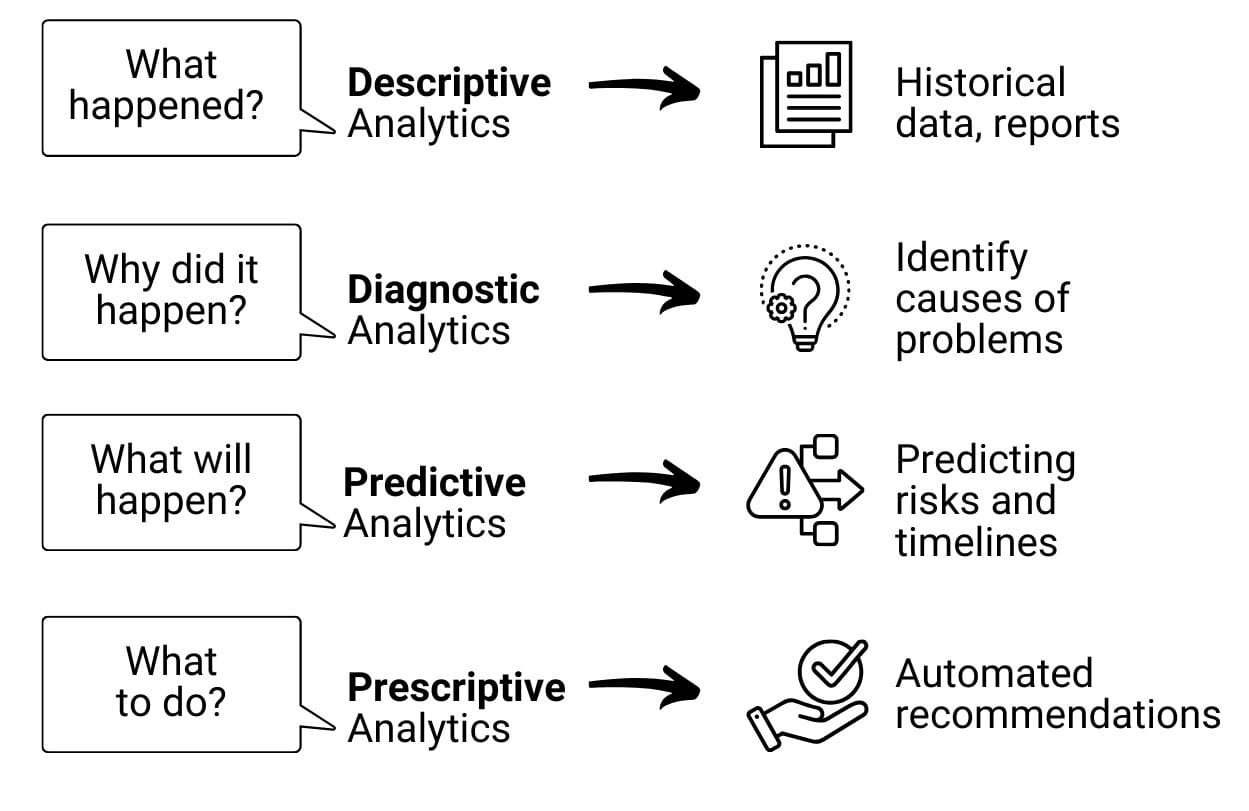
Рисунок 16
Fig.‎ 1.1-4 Basic types of analytics: from past description to automated decision making.

Full-fledged digital transformation, which implies a transition to system analytics and data-driven management, requires not just outsourcing, but the formation of a competent internal team. The key members of such a team should be product managers, data engineers, analysts and developers, who will work in close collaboration with business units (Fig.‎ 4.3-9). This collaboration is necessary to ask educated analytical questions and effectively parameterize business decision-making tasks. In an information society, data becomes not just an auxiliary tool, but the basis for forecasting and optimization.

In construction, digital transformation is fundamentally changing the way facilities are designed, managed and operated. This process is referred to as the digitalization of information – when all aspects of the construction process are digitized into a form suitable for analysis.

.

Leave a Reply

Change language

Post's Highlights

Stay updated: news and insights


We’re Here to Help

Fresh solutions are released through our social channels

UNLOCK THE POWER OF DATA
 IN CONSTRUCTION

Dive into the world of data-driven construction with this accessible guide, perfect for professionals and novices alike.
From the basics of data management to cutting-edge trends in digital transformation, this book
will be your comprehensive guide to using data in the construction industry.

Related posts 

Focus Areas

Search

Search
Sorry, no articles found.

✕

Don't miss the new solutions


✕
✕

Linux

macOS

Looking for the Linux or MAC version? Send us a quick message using the button below, and we’ll guide you through the process!

✕

📥 Download OnePager

Welcome to DataDrivenConstruction—where data meets innovation in the construction industry. Our One-Pager offers a concise overview of how our data-driven solutions can transform your projects, enhance efficiency, and drive sustainable growth. 

✕

🚀 Welcome to the future of data in construction!

You're taking your first step into the world of open data, working with normalized, structured data—the foundation of data analytics and modern automation tools.

By downloading, you agree to the DataDrivenConstruction terms of use 

Stay ahead with the latest updates on converters, tools, AI, LLM
and data analytics in construction — Subscribe now!

✕

🚀 Welcome to the future of data in construction!

You're taking your first step into the world of open data, working with normalized, structured data—the foundation of data analytics and modern automation tools.

By downloading, you agree to the DataDrivenConstruction terms of use 

Stay ahead with the latest updates on converters, tools, AI, LLM
and data analytics in construction — Subscribe now!

✕

🚀 Welcome to the future of data in construction!

You're taking your first step into the world of open data, working with normalized, structured data—the foundation of data analytics and modern automation tools.

By downloading, you agree to the DataDrivenConstruction terms of use 

Stay ahead with the latest updates on converters, tools, AI, LLM
and data analytics in construction — Subscribe now!

✕

🚀 Welcome to the future of data in construction!

You're taking your first step into the world of open data, working with normalized, structured data—the foundation of data analytics and modern automation tools.

By downloading, you agree to the DataDrivenConstruction terms of use 

Stay ahead with the latest updates on converters, tools, AI, LLM
and data analytics in construction — Subscribe now!

✕

🚀 Welcome to the future of data in construction!

You're taking your first step into the world of open data, working with normalized, structured data—the foundation of data analytics and modern automation tools.

By downloading, you agree to the DDC terms of use 

✕

🚀 Welcome to the future of data in construction!

You're taking your first step into the world of open data, working with normalized, structured data—the foundation of data analytics and modern automation tools.

By downloading, you agree to the DataDrivenConstruction terms of use 

Stay ahead with the latest updates on converters, tools, AI, LLM
and data analytics in construction — Subscribe now!

✕
DataDrivenConstruction offers workshops tested and practiced on global leaders in the construction industry to help your team navigate and leverage the power of data and artificial intelligence in your company's decision making.

Reserve your spot now to rethink your
approach to decision making!

✕


🚀 Welcome to the future of data in construction!

By downloading, you agree to the DataDrivenConstruction terms of use 

Stay ahead with the latest updates on converters, tools, AI, LLM
and data analytics in construction — Subscribe now!

✕
Have a question or need more information? Reach out to us directly!
Schedule a time to discuss your needs with our team.
Tailored sessions to help your team grow — let's plan together!
✕
Have you attended one of our workshops, read our book, or used our solutions? Share your thoughts with us!
Name
✕
Data Maturity Diagnostics

🧰 Data-Driven Readiness Check

This short assessment will help you identify your company's data management pain points and offer solutions to improve project efficiency. It takes only 1–2 minutes to complete and you will receive personalized recommendations tailored to your needs.

✕

Clean & Organized Data

Theoretical Chapters:

Practical Chapters:

What You'll Find on
DDC Solutions:

  • CAD/BIM to spreadsheet/database converters (Revit, AutoCAD, IFC, Microstation)
  • Ready-to-deploy n8n workflows for construction processes
  • ETL pipelines for data synchronization between systems
  • Customizable Python scripts for repetitive tasks
  • Intelligent data validation and error detection
  • Real-time dashboard connectors
  • Automated reporting systems
✕

Connect Everything

Theoretical Chapters:

Practical Chapters:

What You'll Find on
DDC Solutions:

  • CAD/BIM to spreadsheet/database converters (Revit, AutoCAD, IFC, Microstation)
  • Ready-to-deploy n8n workflows for construction processes
  • ETL pipelines for data synchronization between systems
  • Customizable Python scripts for repetitive tasks
  • Intelligent data validation and error detection
  • Real-time dashboard connectors
  • Automated reporting systems
✕

Add AI & LLM Brain

Theoretical Chapters:

Practical Chapters:

What You'll Find on
DDC Solutions:

  • CAD/BIM to spreadsheet/database converters (Revit, AutoCAD, IFC, Microstation)
  • Ready-to-deploy n8n workflows for construction processes
  • ETL pipelines for data synchronization between systems
  • Customizable Python scripts for repetitive tasks
  • Intelligent data validation and error detection
  • Real-time dashboard connectors
  • Automated reporting systems
003 Process as a tool for data-driven experience
This website uses cookies to improve your experience. By using this website you agree to our Data Protection Policy.
Read more
×