
061 Masterformat, OmniClass, Uniclass and CoClass the evolution of classification systems
4 February 2025
image129
064 Creating a database using LLM
7 February 2025

062 Data modeling conceptual, logical and physical model

Effective management of data (structured and categorized by us earlier) is impossible without a well thought-out storage and processing structure. To ensure access and consistency of information at the storage and processing stages, companies use data modeling – a methodology that allows designing tables, databases and links between them in accordance with business requirements.

Data modeling is the foundation on which any digital ecosystem is built. Without a description of systems, requirements, and data modeling, engineers and professionals creating data don’t know or understand where the data they create will be used.

Like building a building, where you can’t start laying bricks without a plan, creating a data warehouse system requires a clear understanding of what data will be used, how it will be linked, and who will work with it. Without a description of the processes and requirements, the engineers and professionals creating the data lose sight of where and how the data will be used in the future.

The data model serves as a bridge between business and IT. It allows formalizing requirements, structuring information and facilitating communication between stakeholders. In this sense, data modeling is similar to the work of an architect who, according to the customer’s plan, develops a building plan and then passes it to the builders – database administrators and developers – for implementation (database creation).

Thus, every construction company, in addition to structuring and categorizing elements and resources (Fig.‎ 4.2-11), must master the art of “building” databases (tables) and learn how to create links between them, as if connecting the bricks into a reliable and strong wall of knowledge from the company’s data. Key concepts in data modeling (Fig. 4.3-1) include:

  • Entities are objects about which data must be collected. In the early design phase, an entity can be a single element (e.g., “door”), and in the estimate model, it can be a group of elements organized by category (e.g., “interior doors”).
  • Attributes are characteristics of entities that describe important details: dimensions, properties, assembly costs, logistics, and other parameters.
  • Relationships (links) – show how entities interact with each other. They can be of one of the following types: “one to one”, “many to one”, “many to many”.
  • ER diagrams (Entity-Relationship diagrams) are visual diagrams that show entities, attributes, and the relationships between them. ER-diagrams can be conceptual, logical, and physical – each reflecting a different level of detail.
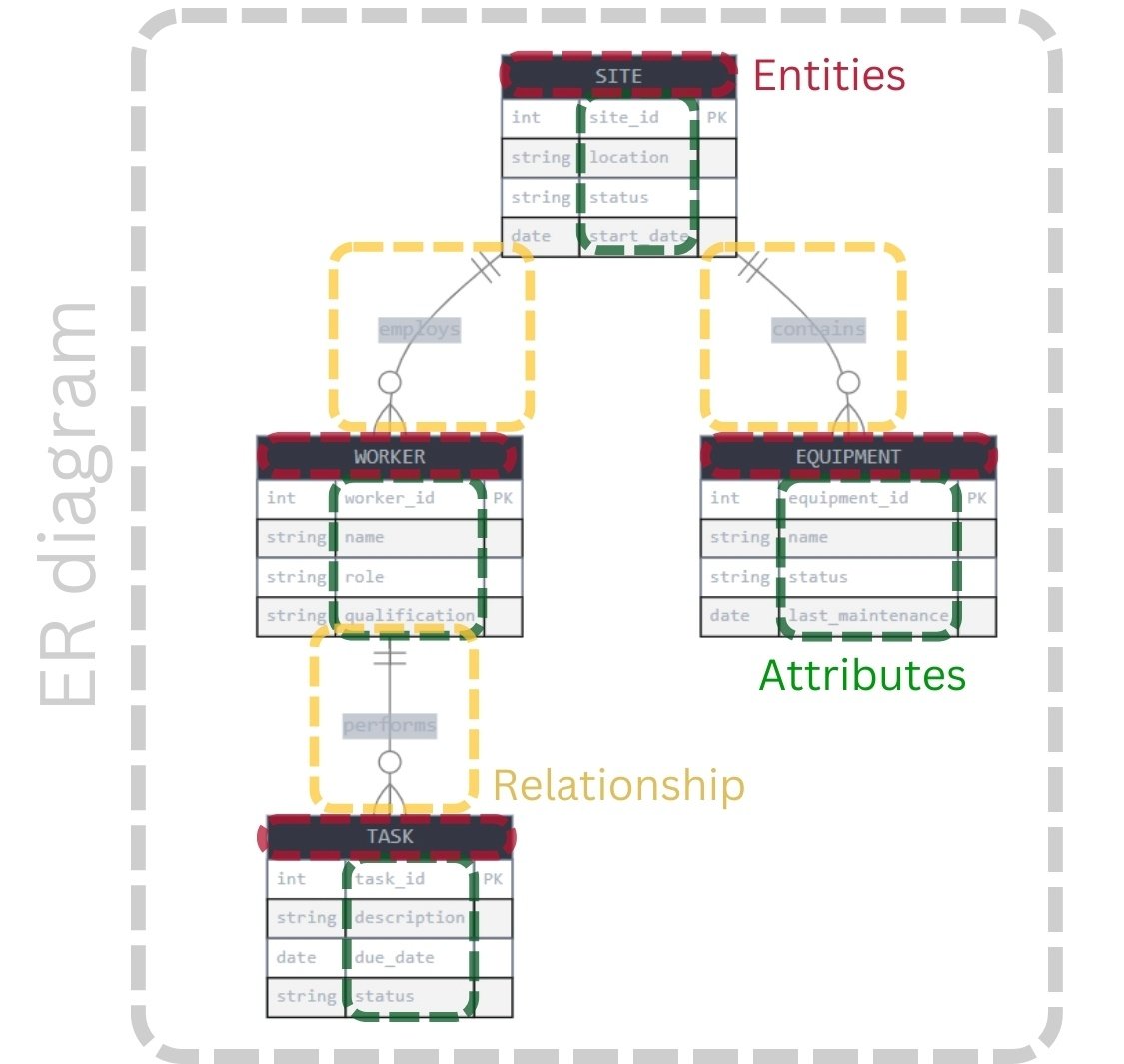
Рисунок 3
Fig. 4.3-1 ER diagram of a conceptual database structure with entities, attributes, and relationships.

The process of designing data and defining relationships between them is traditionally divided into three main models. Each of them performs certain functions, differing in the level of detail and degree of abstraction in representing the data structure:

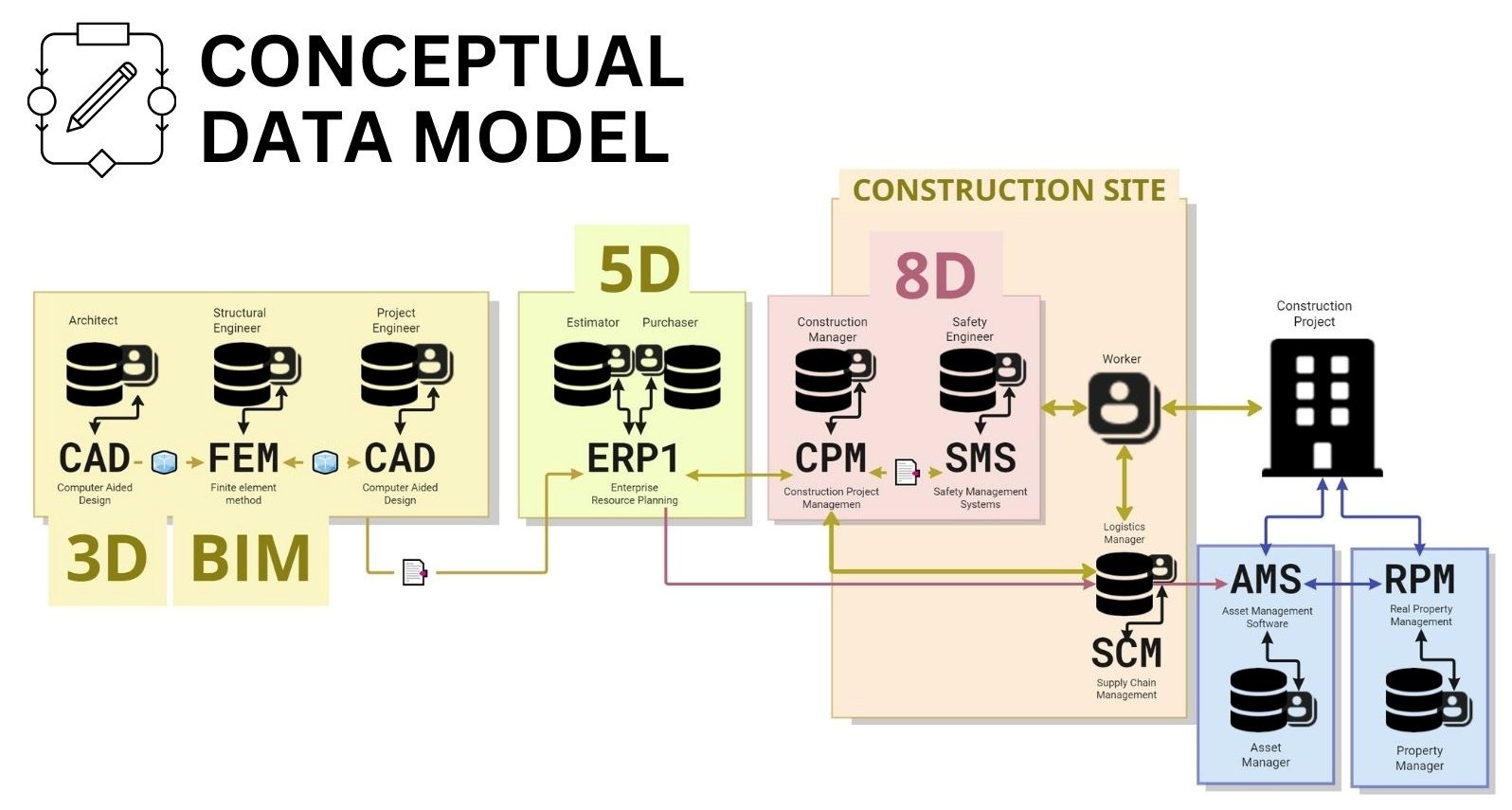
Conceptual data model: this model describes the basic entities and their relationships without going into attribute details. It is usually used in the initial stages of planning. At this stage we can sketch from databases and systems to show the relationship between different departments and specialists.
Picture 1
Fig.‎ 4.3-2 The conceptual diagram describes the content of the system: a high-level representation of the relationships, without technical details.

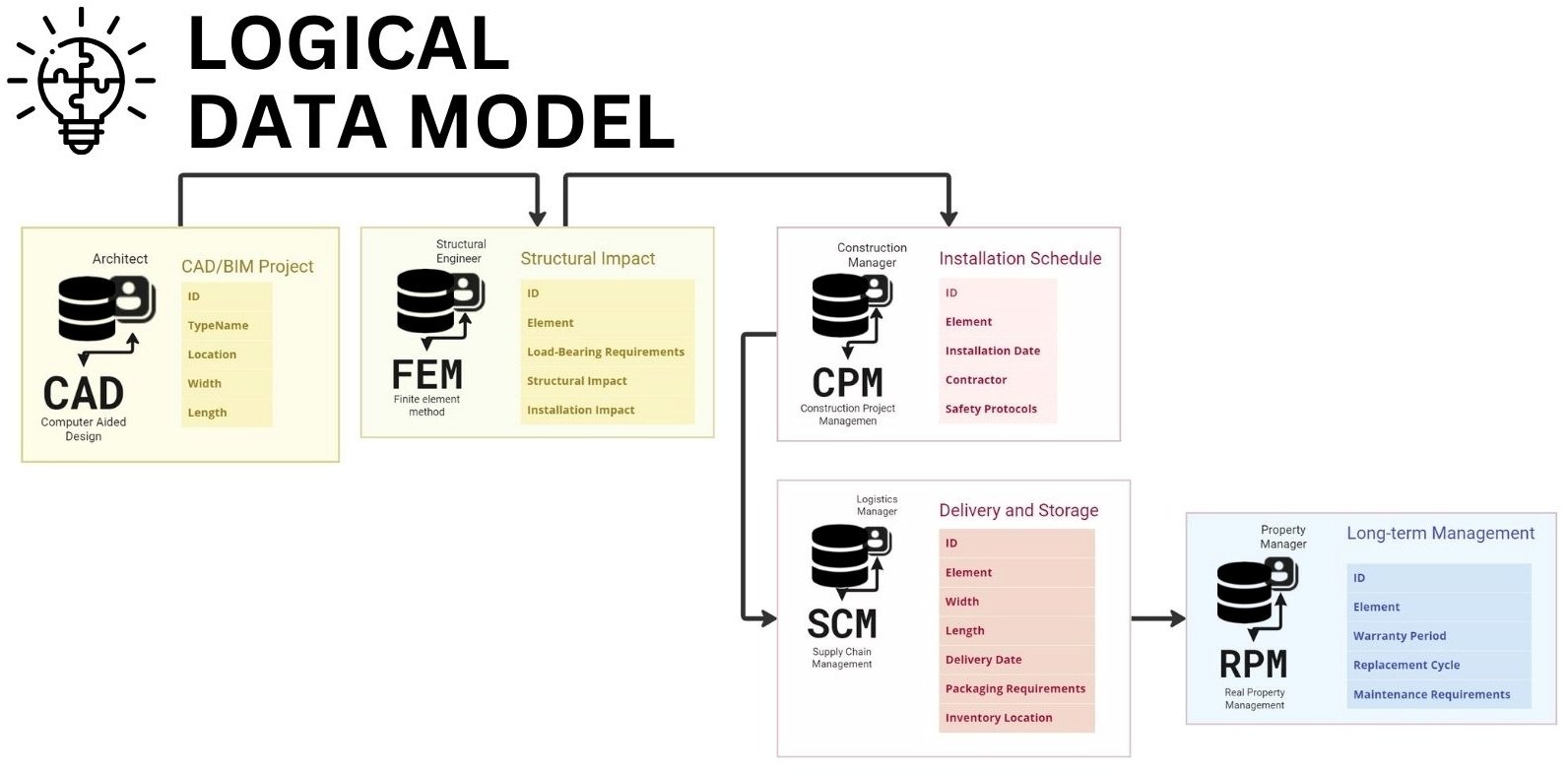
Logical Data Model: Based on the conceptual model, the logical data model includes detailed descriptions of entities, attributes, keys, and relationships, mapping business information and rules.
Picture 2
Fig. 4.3-3 Logical Data Model describes data types, relationships, and keys in detail, but without system implementation.

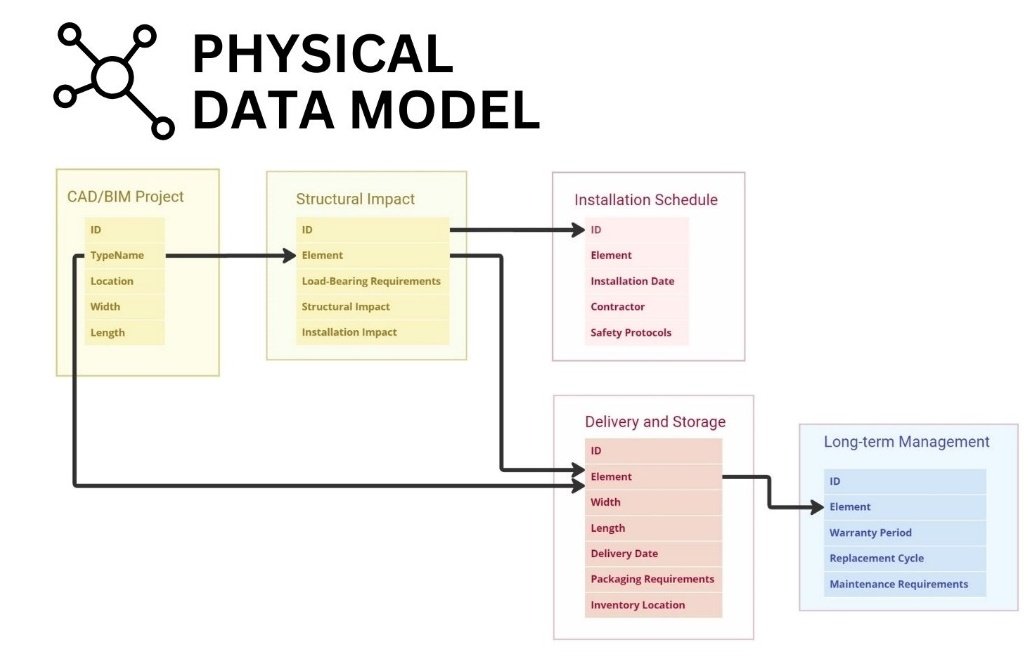
Physical Data Model: This model describes the necessary structures for implementing a database, including tables, columns, and relationships. It focuses on database performance, indexing strategies, and physical storage to optimize physical database deployment.
Picture 3
Fig. 4.3-4 The physical data model defines how the system will be implemented, including the tables and specific details of the database.

When designing databases and designing tabular relationships, understanding the levels of abstraction plays a key role in building an effective system architecture.

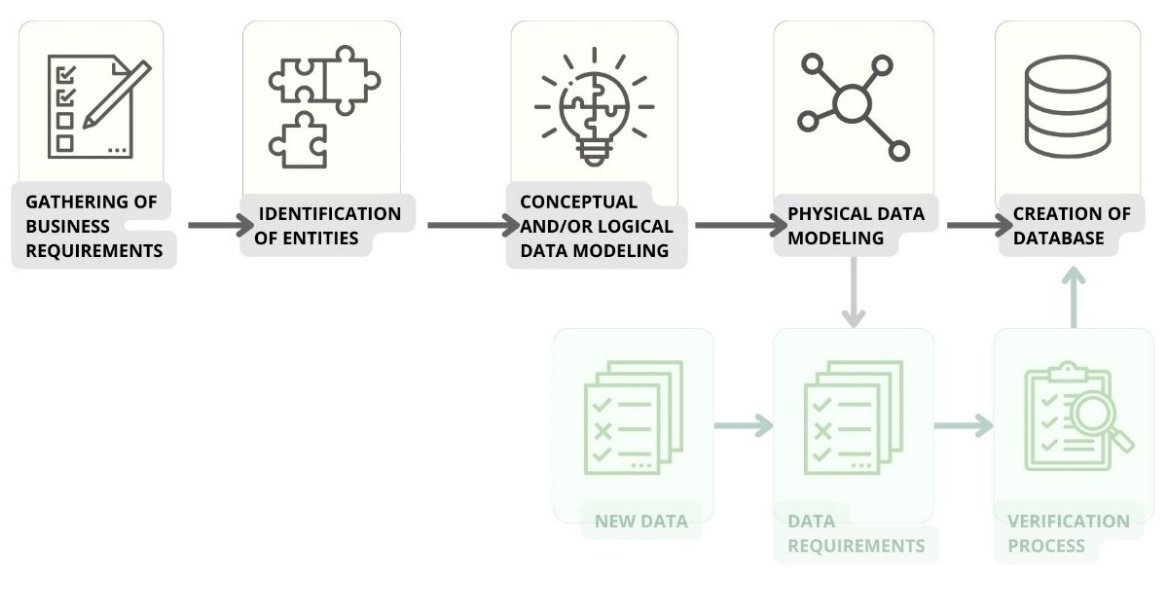
An effective data modeling methodology allows you to combine business objectives with technical implementation, making the entire process chain more transparent and manageable. Data modeling is not a one-time task, but a process involving sequential steps (Fig. 4.3-5):

  • Gathering business requirements: key objectives, goals and information flows are defined. This is the stage of active interaction with experts and users.
  • Entity identification: the main objects, categories and data types that are important to consider in the future system are highlighted.
  • Development of a conceptual and logical model: first the key entities and their relationships are captured, then the attributes, rules and detailed structure.
  • Physical modeling: the technical implementation of the model is designed: tables, fields, relationships, constraints, indexes.
  • Database creation: the final step is to implement the physical model in the selected DBMS, conduct testing and prepare for operation.
.

Picture 5
Fig. 4.3-5 Creating databases and data management systems for business processes begins with requirements generation and data modeling.

Properly designed data modeling processes allow for transparent information flows, which is especially important in complex projects such as construction project or site management. Let’s look at how moving from a conceptual model to a logical model and then to a physical model can help streamline processes.

.

Leave a Reply

Change language

Post's Highlights

Stay updated: news and insights


We’re Here to Help

Fresh solutions are released through our social channels

UNLOCK THE POWER OF DATA
 IN CONSTRUCTION

Dive into the world of data-driven construction with this accessible guide, perfect for professionals and novices alike.
From the basics of data management to cutting-edge trends in digital transformation, this book
will be your comprehensive guide to using data in the construction industry.

Related posts 

Focus Areas

Search

Search
Sorry, no articles found.

✕

Don't miss the new solutions


✕
✕

Linux

macOS

Looking for the Linux or MAC version? Send us a quick message using the button below, and we’ll guide you through the process!

✕

📥 Download OnePager

Welcome to DataDrivenConstruction—where data meets innovation in the construction industry. Our One-Pager offers a concise overview of how our data-driven solutions can transform your projects, enhance efficiency, and drive sustainable growth. 

✕

🚀 Welcome to the future of data in construction!

You're taking your first step into the world of open data, working with normalized, structured data—the foundation of data analytics and modern automation tools.

By downloading, you agree to the DataDrivenConstruction terms of use 

Stay ahead with the latest updates on converters, tools, AI, LLM
and data analytics in construction — Subscribe now!

✕

🚀 Welcome to the future of data in construction!

You're taking your first step into the world of open data, working with normalized, structured data—the foundation of data analytics and modern automation tools.

By downloading, you agree to the DataDrivenConstruction terms of use 

Stay ahead with the latest updates on converters, tools, AI, LLM
and data analytics in construction — Subscribe now!

✕

🚀 Welcome to the future of data in construction!

You're taking your first step into the world of open data, working with normalized, structured data—the foundation of data analytics and modern automation tools.

By downloading, you agree to the DataDrivenConstruction terms of use 

Stay ahead with the latest updates on converters, tools, AI, LLM
and data analytics in construction — Subscribe now!

✕

🚀 Welcome to the future of data in construction!

You're taking your first step into the world of open data, working with normalized, structured data—the foundation of data analytics and modern automation tools.

By downloading, you agree to the DataDrivenConstruction terms of use 

Stay ahead with the latest updates on converters, tools, AI, LLM
and data analytics in construction — Subscribe now!

✕

🚀 Welcome to the future of data in construction!

You're taking your first step into the world of open data, working with normalized, structured data—the foundation of data analytics and modern automation tools.

By downloading, you agree to the DDC terms of use 

✕

🚀 Welcome to the future of data in construction!

You're taking your first step into the world of open data, working with normalized, structured data—the foundation of data analytics and modern automation tools.

By downloading, you agree to the DataDrivenConstruction terms of use 

Stay ahead with the latest updates on converters, tools, AI, LLM
and data analytics in construction — Subscribe now!

✕
DataDrivenConstruction offers workshops tested and practiced on global leaders in the construction industry to help your team navigate and leverage the power of data and artificial intelligence in your company's decision making.

Reserve your spot now to rethink your
approach to decision making!

✕


🚀 Welcome to the future of data in construction!

By downloading, you agree to the DataDrivenConstruction terms of use 

Stay ahead with the latest updates on converters, tools, AI, LLM
and data analytics in construction — Subscribe now!

✕
Have a question or need more information? Reach out to us directly!
Schedule a time to discuss your needs with our team.
Tailored sessions to help your team grow — let's plan together!
✕
Have you attended one of our workshops, read our book, or used our solutions? Share your thoughts with us!
Name
✕
Data Maturity Diagnostics

🧰 Data-Driven Readiness Check

This short assessment will help you identify your company's data management pain points and offer solutions to improve project efficiency. It takes only 1–2 minutes to complete and you will receive personalized recommendations tailored to your needs.

✕

Clean & Organized Data

Theoretical Chapters:

Practical Chapters:

What You'll Find on
DDC Solutions:

  • CAD/BIM to spreadsheet/database converters (Revit, AutoCAD, IFC, Microstation)
  • Ready-to-deploy n8n workflows for construction processes
  • ETL pipelines for data synchronization between systems
  • Customizable Python scripts for repetitive tasks
  • Intelligent data validation and error detection
  • Real-time dashboard connectors
  • Automated reporting systems
✕

Connect Everything

Theoretical Chapters:

Practical Chapters:

What You'll Find on
DDC Solutions:

  • CAD/BIM to spreadsheet/database converters (Revit, AutoCAD, IFC, Microstation)
  • Ready-to-deploy n8n workflows for construction processes
  • ETL pipelines for data synchronization between systems
  • Customizable Python scripts for repetitive tasks
  • Intelligent data validation and error detection
  • Real-time dashboard connectors
  • Automated reporting systems
✕

Add AI & LLM Brain

Theoretical Chapters:

Practical Chapters:

What You'll Find on
DDC Solutions:

  • CAD/BIM to spreadsheet/database converters (Revit, AutoCAD, IFC, Microstation)
  • Ready-to-deploy n8n workflows for construction processes
  • ETL pipelines for data synchronization between systems
  • Customizable Python scripts for repetitive tasks
  • Intelligent data validation and error detection
  • Real-time dashboard connectors
  • Automated reporting systems
062 Data modeling conceptual, logical and physical model
This website uses cookies to improve your experience. By using this website you agree to our Data Protection Policy.
Read more
×