090 PMIS Intermediate between ERP and the construction site
7 March 2025
093 Next steps efficient use of project data
9 March 2025

092 The end of the era of closed ERP PMIS the construction industry needs new approaches

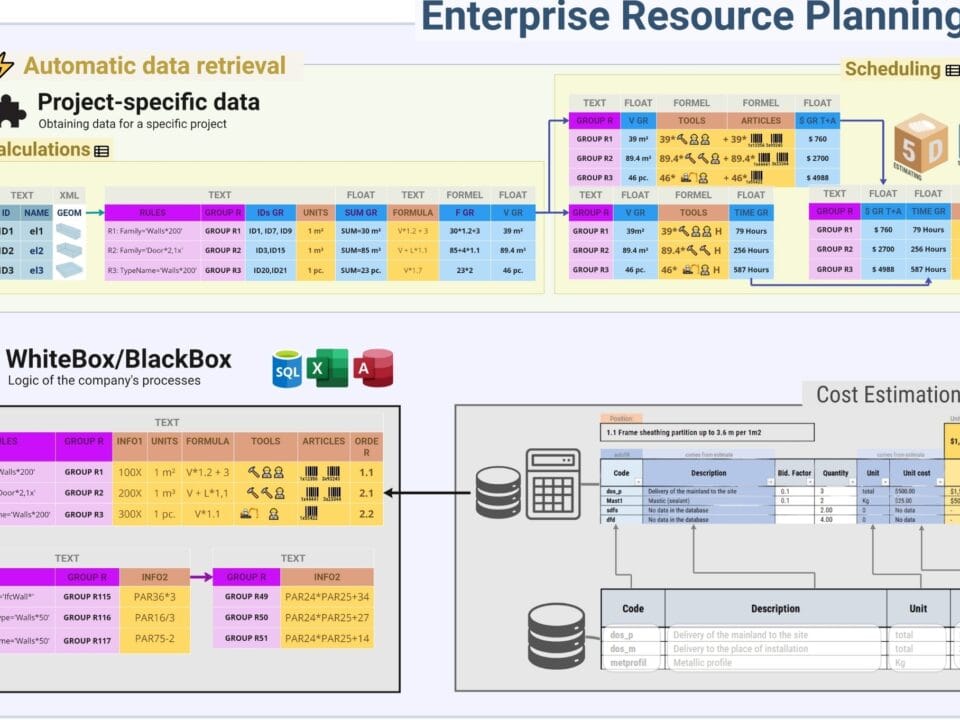
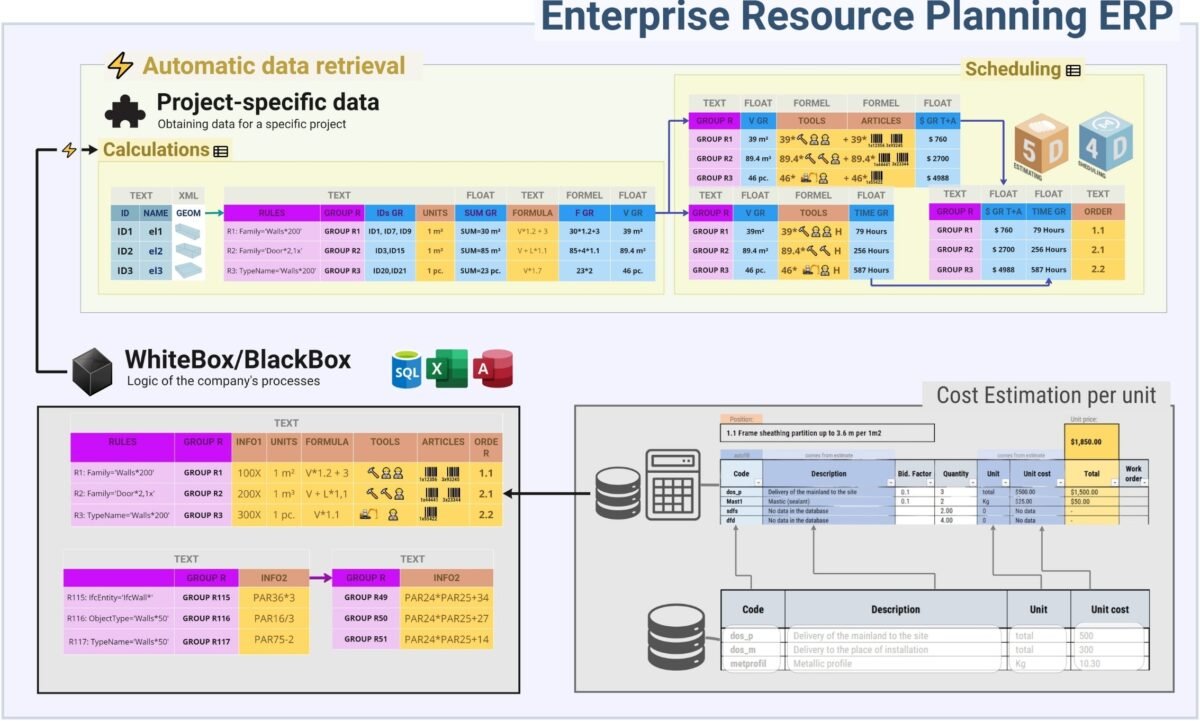
The use of bulky modular ERP/PMIS -systems consisting of tens of millions of lines of code makes any changes in them extremely difficult. At the same time, the transition to a new platform with modules already customized for the company, tens of thousands of articles in resource databases (Fig.‎ 5.1-3) and thousands of ready-made calculations (Fig.‎ 5.1-6) turns into a costly and time-consuming process. The more code and legacy architecture – the higher the level of internal inefficiencies, and each new project will only make things worse. In many companies, data migration and integration of new solutions become multi-year epics accompanied by constant rework and endless search for compromises. The result is often a return to old, familiar platforms, despite their limitations.

As highlighted in the German Black Book report (Bund der Steuerzahler Deutschland e.V., “Das Schwarzbuch,” 10 Oct. 2024) on systemic failures in construction data management, fragmentation of information and lack of a centralized approach to its management is a key cause of inefficiency. Without standardization and integration, data loses its value, becoming an archive rather than a management tool.

A major cause of data quality loss is inadequate planning and control of construction projects, which often leads to significant cost increases. The Black Book’s “Focus: The Cost Explosion” section analyzes the key factors contributing to these unintended consequences. These include inadequate needs analysis, lack of feasibility studies and uncoordinated planning leading to additional costs that could have been avoided.

In a mature IT ecosystem of a company, replacing an outdated system is comparable to replacing a load-bearing column in an already constructed building. It is not enough to simply remove the old one and install a new one – it is important to do it in such a way that the building remains stable, the ceilings do not collapse, and all communications continue to work. This is where the difficulty lies: any mistake can have serious consequences for the entire company’s system.

Nevertheless, developers of large ERP products for the construction industry continue to use the amount of written code as an argument in favor of their platform. At specialized conferences one can still hear phrases like: “It will take 150 man-years to recreate such a system“, despite the fact that most of the functionality of such systems hides databases and quite simple functions for working with tables, packed in a special fixed, user interface. In practice, the code volume of “150 man-years” turns into a burden rather than a competitive advantage. The more code – the higher the cost of support, the more difficult the adaptation to new conditions and the higher the entry threshold for new developers and clients.

Many modular building systems today resemble cumbersome and outdated “Frankenstein constructs” where any careless change can lead to failures. Each new module adds complexity to an already overloaded system, turning it into a labyrinth that only a few specialists can understand, making it even more difficult to maintain and modernize.

The complexity is also realized by the developers themselves, who periodically pause for refactoring – revising the architecture to take into account the emergence of new technologies. However, even if refactoring is done regularly, complexity inevitably grows. Architects of such systems get used to the growing complexity, but for new users and specialists it becomes an insurmountable barrier. As a result, all expertise is concentrated in the hands of a few developers, and the system ceases to be scalable. In the short term, such experts are useful, but in the long term, they become part of the problem.

Organizations will continue to integrate “small” data with their big data counterparts, and it is foolish for anyone to believe that one application – no matter how expensive or robust – can handle everything (SAS, “Data lake and data warehouse – know the difference”).

– Phil Simon, host of the Conversations About Collaboration podcast

A legitimate question arises: do we really need such cumbersome and closed systems for calculating the cost and timing of work in the form of tables, if other industries have long been able to handle similar tasks with analytical tools with open data and transparent logic?

Currently, closed modular platforms are still in demand in the construction industry, primarily due to the specifics of cost accounting (Fig.‎ 5.1-7). Such systems are often used to run “gray” or opaque schemes, allowing real costs to be hidden from the customer. However, as the industry matures digitally, primarily customers, and moves into the so-called “Uberized Era“, intermediaries, namely construction companies with their ERPs, will lose their importance in time and cost calculations. This will change the face of the construction industry forever. Read more in the last part of the book and in the chapter “Construction 5.0: How to make money when you can’t hide anymore”.

Thousands of legacy solutions accumulated over the last 30 years with thousands of man-years invested in development will start to disappear rapidly. The transition to open, transparent and flexible data management is inevitable. The only question is which companies will be able to adapt to these changes and which will remain hostage to the old model.

A similar situation is observed in the field of CAD (BIM -) tools, whose data today fill the volumetric parameters of design entities in ERP/PMIS -systems. Initially the idea of BIM (developed back in 2002 (ADSK, “Building Information Modeling,” 2002) was based on the concept of a single integrated database, but in practice today work with BIM requires a whole set of specialized programs and formats. What was supposed to simplify design and construction management has turned into another layer of proprietary solutions that complicate integration and reduce business flexibility.

.

Leave a Reply

Change language

Post's Highlights

Stay updated: news and insights


We’re Here to Help

Fresh solutions are released through our social channels

UNLOCK THE POWER OF DATA
 IN CONSTRUCTION

Dive into the world of data-driven construction with this accessible guide, perfect for professionals and novices alike.
From the basics of data management to cutting-edge trends in digital transformation, this book
will be your comprehensive guide to using data in the construction industry.

Related posts 

Focus Areas

Search

Search
Sorry, no articles found.

✕

Don't miss the new solutions


✕
✕

Linux

macOS

Looking for the Linux or MAC version? Send us a quick message using the button below, and we’ll guide you through the process!

✕

📥 Download OnePager

Welcome to DataDrivenConstruction—where data meets innovation in the construction industry. Our One-Pager offers a concise overview of how our data-driven solutions can transform your projects, enhance efficiency, and drive sustainable growth. 

✕

🚀 Welcome to the future of data in construction!

You're taking your first step into the world of open data, working with normalized, structured data—the foundation of data analytics and modern automation tools.

By downloading, you agree to the DataDrivenConstruction terms of use 

Stay ahead with the latest updates on converters, tools, AI, LLM
and data analytics in construction — Subscribe now!

✕

🚀 Welcome to the future of data in construction!

You're taking your first step into the world of open data, working with normalized, structured data—the foundation of data analytics and modern automation tools.

By downloading, you agree to the DataDrivenConstruction terms of use 

Stay ahead with the latest updates on converters, tools, AI, LLM
and data analytics in construction — Subscribe now!

✕

🚀 Welcome to the future of data in construction!

You're taking your first step into the world of open data, working with normalized, structured data—the foundation of data analytics and modern automation tools.

By downloading, you agree to the DataDrivenConstruction terms of use 

Stay ahead with the latest updates on converters, tools, AI, LLM
and data analytics in construction — Subscribe now!

✕

🚀 Welcome to the future of data in construction!

You're taking your first step into the world of open data, working with normalized, structured data—the foundation of data analytics and modern automation tools.

By downloading, you agree to the DataDrivenConstruction terms of use 

Stay ahead with the latest updates on converters, tools, AI, LLM
and data analytics in construction — Subscribe now!

✕

🚀 Welcome to the future of data in construction!

You're taking your first step into the world of open data, working with normalized, structured data—the foundation of data analytics and modern automation tools.

By downloading, you agree to the DDC terms of use 

✕

🚀 Welcome to the future of data in construction!

You're taking your first step into the world of open data, working with normalized, structured data—the foundation of data analytics and modern automation tools.

By downloading, you agree to the DataDrivenConstruction terms of use 

Stay ahead with the latest updates on converters, tools, AI, LLM
and data analytics in construction — Subscribe now!

✕
DataDrivenConstruction offers workshops tested and practiced on global leaders in the construction industry to help your team navigate and leverage the power of data and artificial intelligence in your company's decision making.

Reserve your spot now to rethink your
approach to decision making!

✕


🚀 Welcome to the future of data in construction!

By downloading, you agree to the DataDrivenConstruction terms of use 

Stay ahead with the latest updates on converters, tools, AI, LLM
and data analytics in construction — Subscribe now!

✕
Have a question or need more information? Reach out to us directly!
Schedule a time to discuss your needs with our team.
Tailored sessions to help your team grow — let's plan together!
✕
Have you attended one of our workshops, read our book, or used our solutions? Share your thoughts with us!
Name
✕
Data Maturity Diagnostics

🧰 Data-Driven Readiness Check

This short assessment will help you identify your company's data management pain points and offer solutions to improve project efficiency. It takes only 1–2 minutes to complete and you will receive personalized recommendations tailored to your needs.

✕

Clean & Organized Data

Theoretical Chapters:

Practical Chapters:

What You'll Find on
DDC Solutions:

  • CAD/BIM to spreadsheet/database converters (Revit, AutoCAD, IFC, Microstation)
  • Ready-to-deploy n8n workflows for construction processes
  • ETL pipelines for data synchronization between systems
  • Customizable Python scripts for repetitive tasks
  • Intelligent data validation and error detection
  • Real-time dashboard connectors
  • Automated reporting systems
✕

Connect Everything

Theoretical Chapters:

Practical Chapters:

What You'll Find on
DDC Solutions:

  • CAD/BIM to spreadsheet/database converters (Revit, AutoCAD, IFC, Microstation)
  • Ready-to-deploy n8n workflows for construction processes
  • ETL pipelines for data synchronization between systems
  • Customizable Python scripts for repetitive tasks
  • Intelligent data validation and error detection
  • Real-time dashboard connectors
  • Automated reporting systems
✕

Add AI & LLM Brain

Theoretical Chapters:

Practical Chapters:

What You'll Find on
DDC Solutions:

  • CAD/BIM to spreadsheet/database converters (Revit, AutoCAD, IFC, Microstation)
  • Ready-to-deploy n8n workflows for construction processes
  • ETL pipelines for data synchronization between systems
  • Customizable Python scripts for repetitive tasks
  • Intelligent data validation and error detection
  • Real-time dashboard connectors
  • Automated reporting systems
092 The end of the era of closed ERP PMIS the construction industry needs new approaches
This website uses cookies to improve your experience. By using this website you agree to our Data Protection Policy.
Read more
×