image60
156 Key concepts of machine learning
20 May 2025
Рисунок 2
158 Project cost and time prediction using linear regression
22 May 2025

157 An example of using machine learning to find project cost and schedule

Estimation of construction time and cost is one of the key processes in the activities of a construction company. Traditionally, such estimates are made by experts based on experience, reference books and regulatory databases. However, with digital transformation and increasing data availability, it is now possible to use machine learning (ML) models to improve the accuracy and automation of such estimates.

The introduction of machine learning into the process of calculating the cost and timing of construction not only makes it possible to increase the efficiency of planning, but also becomes a starting point for integrating intelligent models into other business processes – from risk management to optimizing logistics and procurement.

It is important to be able to quickly determine how long it will take to build a project and what its total cost will be. These questions about project time and cost have traditionally been at the forefront of the minds of both clients and construction companies since the birth of the construction industry.
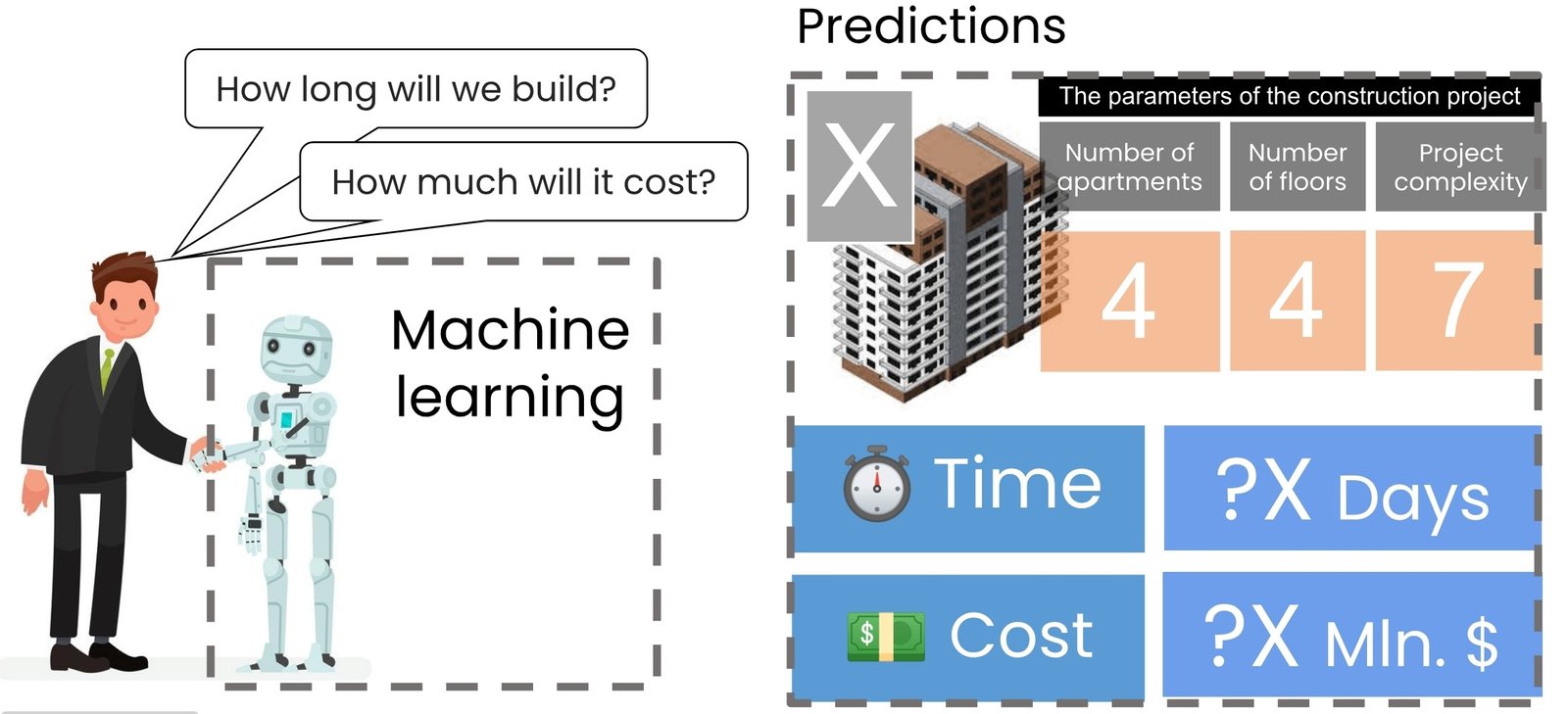
image154
Fig.‎ 9.3-1 In construction projects, the speed and quality of estimating construction time and cost are key success factors.

In the following example, key data from past projects will be extracted and used to develop a machine learning model, which will allow us to use the model to estimate the cost and timing of new construction projects with new parameters (Fig. 9.3-1).

Consider three projects with three key attributes: the number of apartments (where 100 apartments is equivalent to the number 10 for ease of visualization), the number of floors, and a conditional measure of construction complexity on a scale of 1 to 10, where 10 is the highest complexity score. In machine learning, the process of converting and simplifying values such as 100 to 10 or 50 to 5 is called “normalization”.

Normalization in machine learning is the process of bringing different numerical data to a common scale to facilitate its processing and analysis. This process is especially important when the data has different scales and units.

Suppose that the first project (Fig. 9.3-2) had 50 apartments (after normalization, 5), 7 floors and a complexity score of 2, which meant a relatively simple construction. The second project already had 80 apartments, 9 floors and a relatively complex project. Under these conditions, construction of the first and second apartment building took 270 and 330 days, and the total project cost was $4.5 million and $5.8 million, respectively.
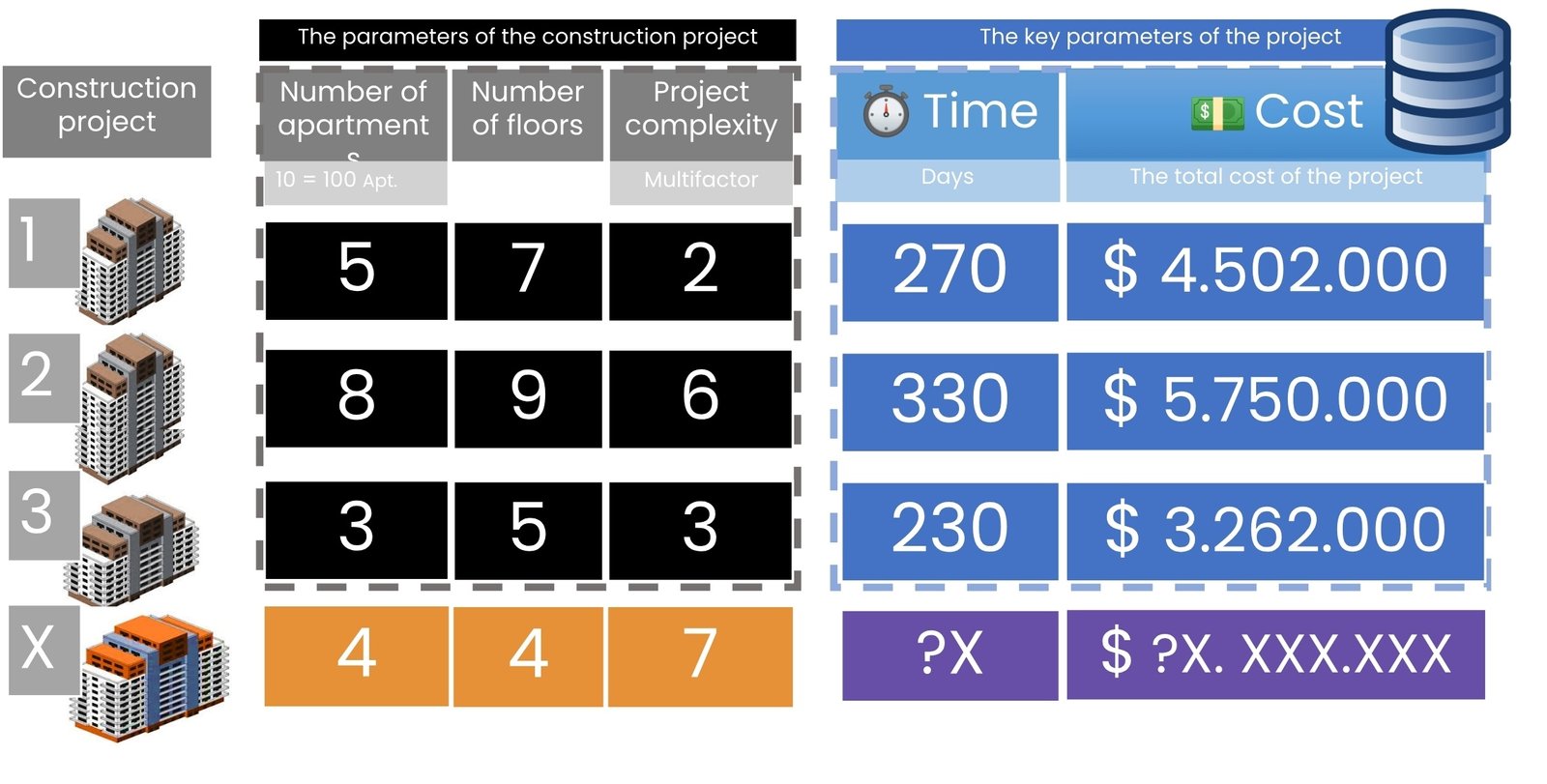
image96
Fig. 9.3-2 An example of a set of past projects that will be used to estimate the time and cost of future project X.

When building a machine learning model for such data, the main task is to identify critical attributes (or labels) for prediction, in this case, construction time and cost. With a small dataset, we will use information about previous construction projects to plan new ones: using machine learning algorithms, we have to predict the construction cost and duration of a new project X based on given attributes of the new project, such as 40 apartments, 4 floors, and a relative high project complexity of 7 (Fig.‎ 9.3-2). In a real-world setting, the number of input parameters can be much larger, ranging from several tens to hundreds of factors. These may include: type of construction materials, climatic zone, qualification level of contractors, availability of utilities, type of foundation, season of commencement of works, comments of foremen, etc.

To create a predictive machine learning model, we need to choose an algorithm to create it. An algorithm in machine learning is like a mathematical recipe that teaches the computer how to make predictions (mix in the right order of parameters) or make decisions based on data.

To analyze data on past construction projects and predict the timing and cost of future projects (Fig. 9.3-2), one popular machine learning algorithm can be used:

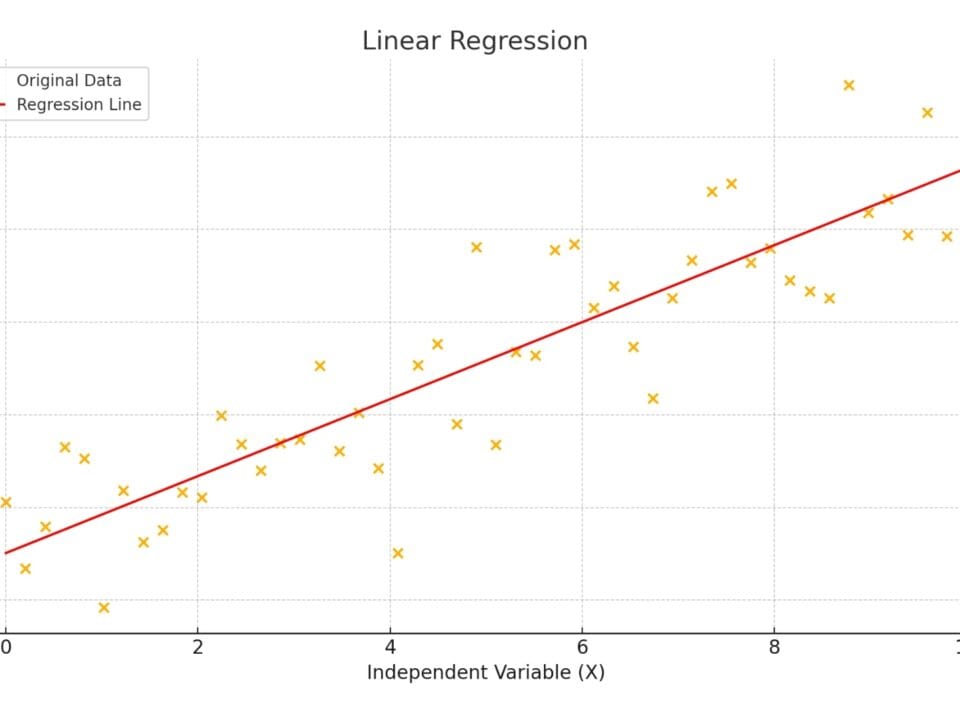
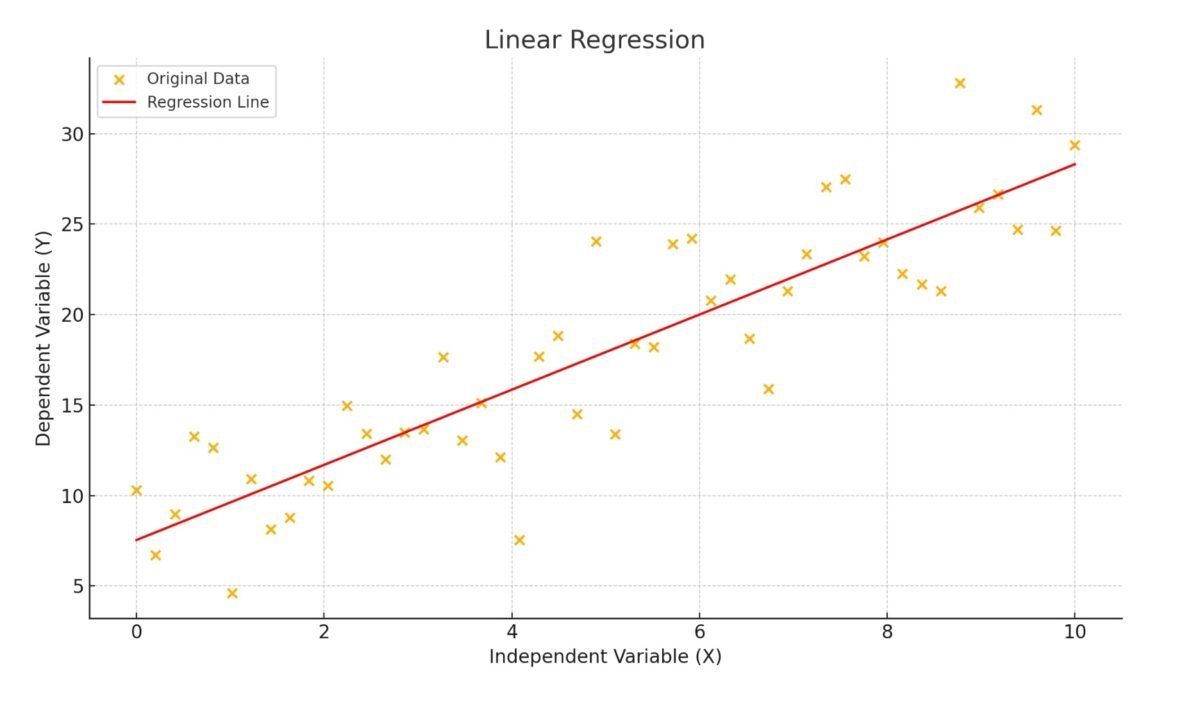
  • Linear regression (Linear regression): this algorithm tries to find a direct relationship between attributes, for example between the number of floors and the construction cost. The goal of the algorithm is to find a linear equation that best describes this relationship, which allows making predictions.
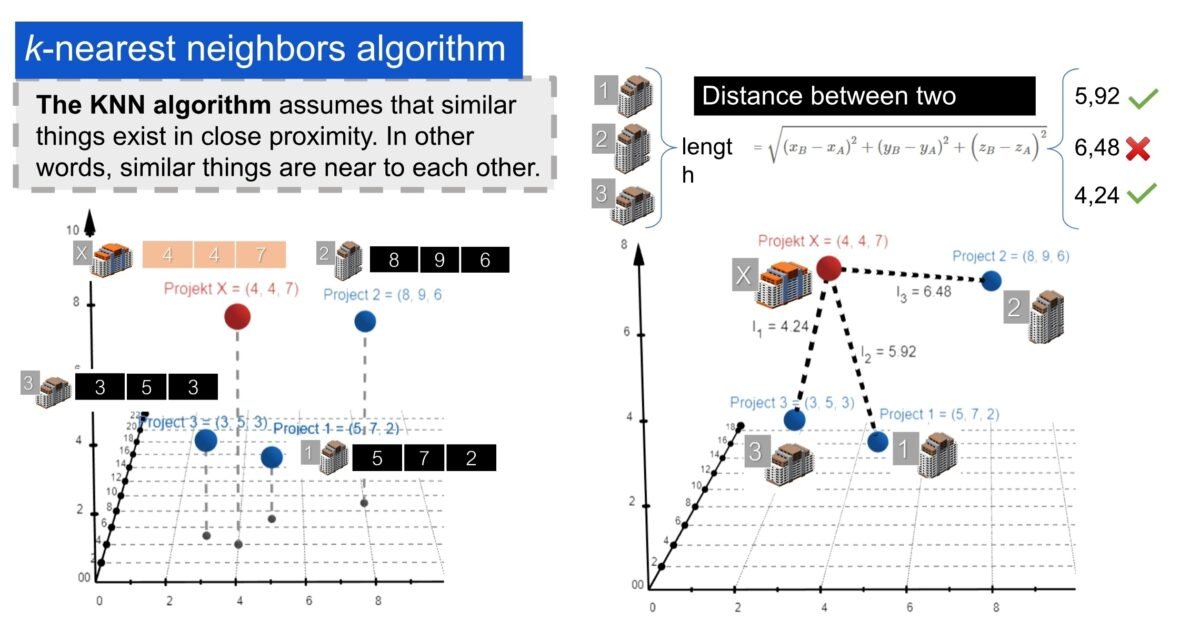
  • Algorithm k-nearest neighbors (k-NN): this algorithm compares a new project with past projects that were similar in size or complexity. The k-NN classifies the data based on which of the k (number) training examples are closest to it. In the context of regression, the result is the mean or median of the k nearest neighbors.
  • Decision Trees: is a predictive modeling model that divides data into subsets based on different conditions using a tree structure. Each node of the tree represents a condition or question leading to further division of the data, and each leaf represents the final prediction or outcome. The algorithm divides the data into smaller groups based on different characteristics, such as first by number of stories, then by complexity and so on, to make a prediction.

Let’s take a look at machine learning algorithms for estimating the cost of a new project using two popular algorithms as examples: linear regression and the K-nearest neighbors algorithm.

.

Leave a Reply

Change language

Post's Highlights

Stay updated: news and insights


We’re Here to Help

Fresh solutions are released through our social channels

UNLOCK THE POWER OF DATA
 IN CONSTRUCTION

Dive into the world of data-driven construction with this accessible guide, perfect for professionals and novices alike.
From the basics of data management to cutting-edge trends in digital transformation, this book
will be your comprehensive guide to using data in the construction industry.

Related posts 

Focus Areas

Search

Search
Sorry, no articles found.

✕

Don't miss the new solutions


✕
✕

Linux

macOS

Looking for the Linux or MAC version? Send us a quick message using the button below, and we’ll guide you through the process!

✕

📥 Download OnePager

Welcome to DataDrivenConstruction—where data meets innovation in the construction industry. Our One-Pager offers a concise overview of how our data-driven solutions can transform your projects, enhance efficiency, and drive sustainable growth. 

✕

🚀 Welcome to the future of data in construction!

You're taking your first step into the world of open data, working with normalized, structured data—the foundation of data analytics and modern automation tools.

By downloading, you agree to the DataDrivenConstruction terms of use 

Stay ahead with the latest updates on converters, tools, AI, LLM
and data analytics in construction — Subscribe now!

✕

🚀 Welcome to the future of data in construction!

You're taking your first step into the world of open data, working with normalized, structured data—the foundation of data analytics and modern automation tools.

By downloading, you agree to the DataDrivenConstruction terms of use 

Stay ahead with the latest updates on converters, tools, AI, LLM
and data analytics in construction — Subscribe now!

✕

🚀 Welcome to the future of data in construction!

You're taking your first step into the world of open data, working with normalized, structured data—the foundation of data analytics and modern automation tools.

By downloading, you agree to the DataDrivenConstruction terms of use 

Stay ahead with the latest updates on converters, tools, AI, LLM
and data analytics in construction — Subscribe now!

✕

🚀 Welcome to the future of data in construction!

You're taking your first step into the world of open data, working with normalized, structured data—the foundation of data analytics and modern automation tools.

By downloading, you agree to the DataDrivenConstruction terms of use 

Stay ahead with the latest updates on converters, tools, AI, LLM
and data analytics in construction — Subscribe now!

✕

🚀 Welcome to the future of data in construction!

You're taking your first step into the world of open data, working with normalized, structured data—the foundation of data analytics and modern automation tools.

By downloading, you agree to the DDC terms of use 

✕

🚀 Welcome to the future of data in construction!

You're taking your first step into the world of open data, working with normalized, structured data—the foundation of data analytics and modern automation tools.

By downloading, you agree to the DataDrivenConstruction terms of use 

Stay ahead with the latest updates on converters, tools, AI, LLM
and data analytics in construction — Subscribe now!

✕
DataDrivenConstruction offers workshops tested and practiced on global leaders in the construction industry to help your team navigate and leverage the power of data and artificial intelligence in your company's decision making.

Reserve your spot now to rethink your
approach to decision making!

✕


🚀 Welcome to the future of data in construction!

By downloading, you agree to the DataDrivenConstruction terms of use 

Stay ahead with the latest updates on converters, tools, AI, LLM
and data analytics in construction — Subscribe now!

✕
Have a question or need more information? Reach out to us directly!
Schedule a time to discuss your needs with our team.
Tailored sessions to help your team grow — let's plan together!
✕
Have you attended one of our workshops, read our book, or used our solutions? Share your thoughts with us!
Name
✕
Data Maturity Diagnostics

🧰 Data-Driven Readiness Check

This short assessment will help you identify your company's data management pain points and offer solutions to improve project efficiency. It takes only 1–2 minutes to complete and you will receive personalized recommendations tailored to your needs.

✕

Clean & Organized Data

Theoretical Chapters:

Practical Chapters:

What You'll Find on
DDC Solutions:

  • CAD/BIM to spreadsheet/database converters (Revit, AutoCAD, IFC, Microstation)
  • Ready-to-deploy n8n workflows for construction processes
  • ETL pipelines for data synchronization between systems
  • Customizable Python scripts for repetitive tasks
  • Intelligent data validation and error detection
  • Real-time dashboard connectors
  • Automated reporting systems
✕

Connect Everything

Theoretical Chapters:

Practical Chapters:

What You'll Find on
DDC Solutions:

  • CAD/BIM to spreadsheet/database converters (Revit, AutoCAD, IFC, Microstation)
  • Ready-to-deploy n8n workflows for construction processes
  • ETL pipelines for data synchronization between systems
  • Customizable Python scripts for repetitive tasks
  • Intelligent data validation and error detection
  • Real-time dashboard connectors
  • Automated reporting systems
✕

Add AI & LLM Brain

Theoretical Chapters:

Practical Chapters:

What You'll Find on
DDC Solutions:

  • CAD/BIM to spreadsheet/database converters (Revit, AutoCAD, IFC, Microstation)
  • Ready-to-deploy n8n workflows for construction processes
  • ETL pipelines for data synchronization between systems
  • Customizable Python scripts for repetitive tasks
  • Intelligent data validation and error detection
  • Real-time dashboard connectors
  • Automated reporting systems
157 An example of using machine learning to find project cost and schedule
This website uses cookies to improve your experience. By using this website you agree to our Data Protection Policy.
Read more
×