160 Next steps from storage to analysis and forecasting
24 May 2025
162 Data-driven approach in construction a new level of infrastructure
26 May 2025

161 Correlations instead of calculations the future of construction analytics

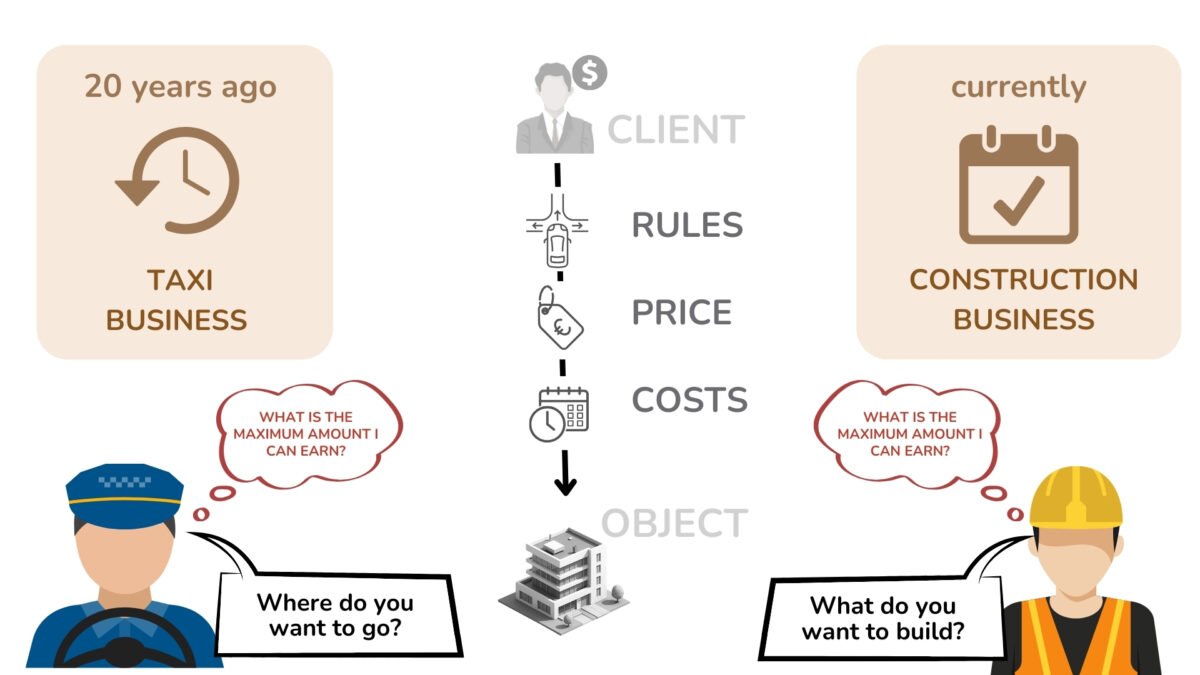
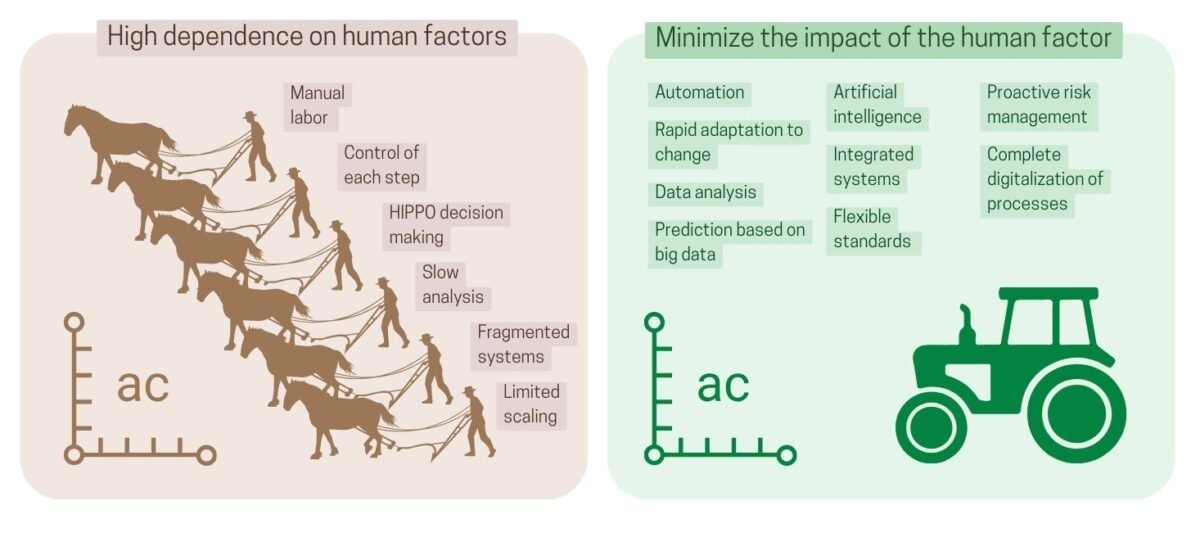
Due to the rapid digitalization of information (Fig. 1.1-5), modern construction is undergoing a fundamental transformation where data is becoming not just a tool but a strategic asset that can fundamentally change traditional approaches to project and business management.

For millennia, construction activities have relied on deterministic methods – precise calculations, detailing and strict control of parameters. In the first centuries AD, Roman engineers applied mathematical principles to the construction of aqueducts and bridges. In the Middle Ages, architects strived for ideal proportions of Gothic cathedrals, and in the industrialization of the 20th century, systems of standardized norms and regulations were formed, which became the basis for mass construction

Today, the vector of development is shifting from the search for strictly cause-and-effect relationships to probabilistic analysis, the search for correlations and hidden patterns. The industry is entering a new phase – data is becoming a key resource, and analytics based on it is replacing intuitive and locally optimized approaches.
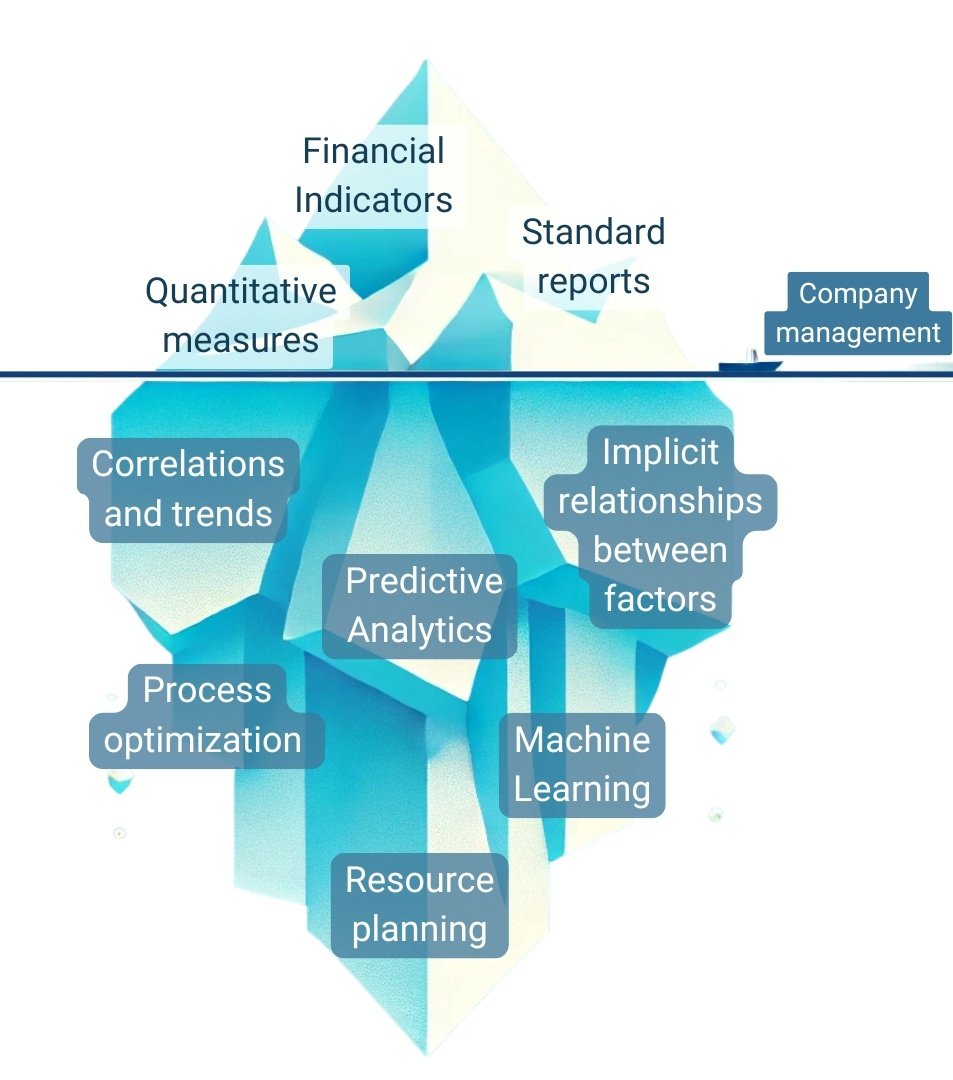
Рисунок 1
Fig.‎ 10.1-1 Hidden potential of construction data: existing calculations in the company are only the tip of the iceberg available for management to analyze.

A company’s information system is like an iceberg (Fig.‎ 10.1-1): only a small part of the data’s potential is visible to the company’s management, while the main value is hidden in the depths. It is important to evaluate data not only by its current use, but also by the opportunities it will unlock in the future. It is those companies that learn how to extract hidden patterns and create new insights from data that will create a sustainable competitive advantage

Finding hidden patterns and making sense of data is not just about working with numbers, but a creative process that requires abstract thinking and the ability to see the whole picture behind disparate elements. In this sense, the evolution of working with data can be compared to the evolution of the visual arts (Fig. 10.1-2).

The development of construction is remarkably similar to the progress of fine arts. In both cases, mankind has progressed from primitive methods to sophisticated visualization and analysis technologies. In prehistoric times, people used cave drawings and primitive tools to solve everyday tasks. During the Middle Ages and Renaissance, the level of sophistication in architecture and art increased dramatically. By the early Middle Ages, the tools of construction had evolved from a simple axe to extensive tool kits symbolizing the growth of technical knowledge.

The Age of Realism was the first revolution in the visual arts: artists learned to reproduce the smallest details, maximizing the verisimilitude of the image. In construction, the counterpart of this period was precise engineering techniques, detailed drawings and strictly regulated calculations, which became the basis of design practice for centuries.

Later, Impressionism changed the very perception of artistic reality: instead of literally rendering form, artists began to capture mood, light, and dynamics, aiming to reflect an overall impression rather than absolute accuracy. Similarly, machine learning in building analytics is moving away from rigid logical models to pattern recognition and probabilistic patterns that allow you to “see” hidden dependencies in the data that are inaccessible in classical analysis. This approach echoes Bauhaus’ ideas of minimalism and functionality, where meaning (function) is more important than form. Bauhaus sought to remove the superfluous, to abandon ornamentation for the sake of clarity, utilitarianism and mass appeal. Things had to be understandable and useful, without excess – aesthetics was born from the logic of design and purpose.

With the advent of photography in the late 19th century, art gained a new tool to capture reality with unprecedented accuracy and turned attitudes towards fine art upside down. Similarly, in construction, the industrial revolution in the 21st century is leading to the use of robotic technologies, lasers, IoT, RFID and concepts like Connected Construction, where the collection of individual parameters has evolved to a scalable intelligent capture of the full reality of a construction site.
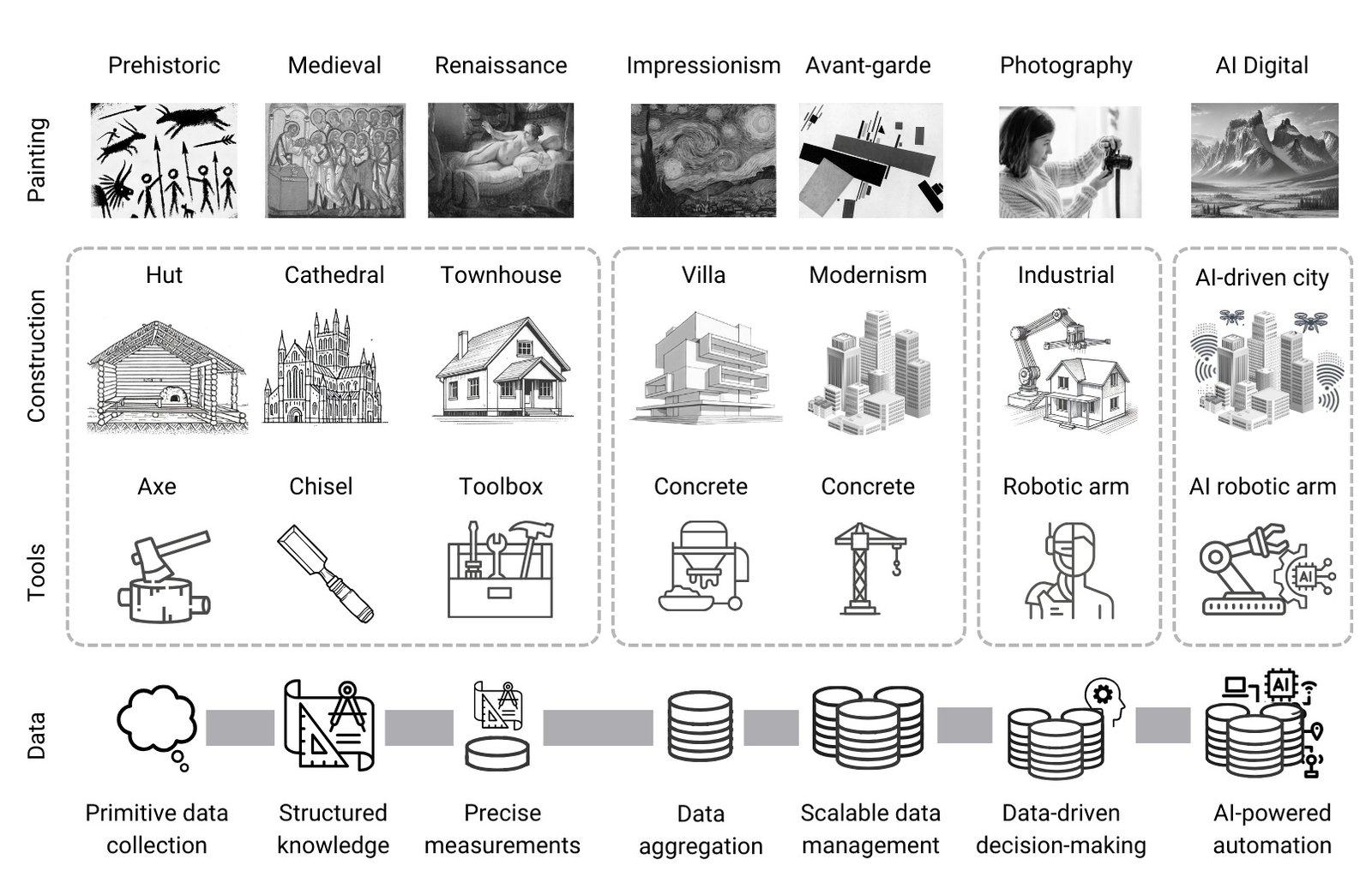
Рисунок 1
Fig.‎ 10.1-2 Era Evolutions the visual arts are consistent with developments in approaches to working with data in the construction industry.

Today, just as the visual arts are experiencing a rethinking with the arrival of AI tools and LLM, the construction industry is experiencing another quantum leap: intelligent systems driven by artificial intelligence (AI), LLM chats allow predicting, optimizing and generating solutions with minimal human intervention.

The role of data in design and management has changed radically. Whereas knowledge used to be transmitted verbally and empirical in nature – just as reality was captured by hand painted pictures until the 19th century – today the focus is on the complete digital capture of the construction “picture”. With the help of machine learning algorithms, this digital picture is transformed into an impressionistic representation of construction reality – not an exact replica, but a generalized, probabilistic understanding of the processes.

We are rapidly approaching an era in which the processes of designing, constructing and operating buildings will not just be augmented, but largely driven by artificial intelligence systems. Just as modern digital art is created without a paintbrush – using textual prompts and generative models – architectural and engineering solutions of the future will be shaped by key queries and parameters set by the user.

In the 21st century, access to data, its interpretation and the quality of analytics are becoming indispensable to the success of a project. And the value of data is determined not by its volume, but by the ability of specialists to analyze, verify and turn it into action.

.

Leave a Reply

Change language

Post's Highlights

Stay updated: news and insights


We’re Here to Help

Fresh solutions are released through our social channels

UNLOCK THE POWER OF DATA
 IN CONSTRUCTION

Dive into the world of data-driven construction with this accessible guide, perfect for professionals and novices alike.
From the basics of data management to cutting-edge trends in digital transformation, this book
will be your comprehensive guide to using data in the construction industry.

Related posts 

Focus Areas

Search

Search
Sorry, no articles found.

✕

Don't miss the new solutions


✕
✕

Linux

macOS

Looking for the Linux or MAC version? Send us a quick message using the button below, and we’ll guide you through the process!

✕

📥 Download OnePager

Welcome to DataDrivenConstruction—where data meets innovation in the construction industry. Our One-Pager offers a concise overview of how our data-driven solutions can transform your projects, enhance efficiency, and drive sustainable growth. 

✕

🚀 Welcome to the future of data in construction!

You're taking your first step into the world of open data, working with normalized, structured data—the foundation of data analytics and modern automation tools.

By downloading, you agree to the DataDrivenConstruction terms of use 

Stay ahead with the latest updates on converters, tools, AI, LLM
and data analytics in construction — Subscribe now!

✕

🚀 Welcome to the future of data in construction!

You're taking your first step into the world of open data, working with normalized, structured data—the foundation of data analytics and modern automation tools.

By downloading, you agree to the DataDrivenConstruction terms of use 

Stay ahead with the latest updates on converters, tools, AI, LLM
and data analytics in construction — Subscribe now!

✕

🚀 Welcome to the future of data in construction!

You're taking your first step into the world of open data, working with normalized, structured data—the foundation of data analytics and modern automation tools.

By downloading, you agree to the DataDrivenConstruction terms of use 

Stay ahead with the latest updates on converters, tools, AI, LLM
and data analytics in construction — Subscribe now!

✕

🚀 Welcome to the future of data in construction!

You're taking your first step into the world of open data, working with normalized, structured data—the foundation of data analytics and modern automation tools.

By downloading, you agree to the DataDrivenConstruction terms of use 

Stay ahead with the latest updates on converters, tools, AI, LLM
and data analytics in construction — Subscribe now!

✕

🚀 Welcome to the future of data in construction!

You're taking your first step into the world of open data, working with normalized, structured data—the foundation of data analytics and modern automation tools.

By downloading, you agree to the DDC terms of use 

✕

🚀 Welcome to the future of data in construction!

You're taking your first step into the world of open data, working with normalized, structured data—the foundation of data analytics and modern automation tools.

By downloading, you agree to the DataDrivenConstruction terms of use 

Stay ahead with the latest updates on converters, tools, AI, LLM
and data analytics in construction — Subscribe now!

✕
DataDrivenConstruction offers workshops tested and practiced on global leaders in the construction industry to help your team navigate and leverage the power of data and artificial intelligence in your company's decision making.

Reserve your spot now to rethink your
approach to decision making!

✕


🚀 Welcome to the future of data in construction!

By downloading, you agree to the DataDrivenConstruction terms of use 

Stay ahead with the latest updates on converters, tools, AI, LLM
and data analytics in construction — Subscribe now!

✕
Have a question or need more information? Reach out to us directly!
Schedule a time to discuss your needs with our team.
Tailored sessions to help your team grow — let's plan together!
✕
Have you attended one of our workshops, read our book, or used our solutions? Share your thoughts with us!
Name
✕
Data Maturity Diagnostics

🧰 Data-Driven Readiness Check

This short assessment will help you identify your company's data management pain points and offer solutions to improve project efficiency. It takes only 1–2 minutes to complete and you will receive personalized recommendations tailored to your needs.

✕

Clean & Organized Data

Theoretical Chapters:

Practical Chapters:

What You'll Find on
DDC Solutions:

  • CAD/BIM to spreadsheet/database converters (Revit, AutoCAD, IFC, Microstation)
  • Ready-to-deploy n8n workflows for construction processes
  • ETL pipelines for data synchronization between systems
  • Customizable Python scripts for repetitive tasks
  • Intelligent data validation and error detection
  • Real-time dashboard connectors
  • Automated reporting systems
✕

Connect Everything

Theoretical Chapters:

Practical Chapters:

What You'll Find on
DDC Solutions:

  • CAD/BIM to spreadsheet/database converters (Revit, AutoCAD, IFC, Microstation)
  • Ready-to-deploy n8n workflows for construction processes
  • ETL pipelines for data synchronization between systems
  • Customizable Python scripts for repetitive tasks
  • Intelligent data validation and error detection
  • Real-time dashboard connectors
  • Automated reporting systems
✕

Add AI & LLM Brain

Theoretical Chapters:

Practical Chapters:

What You'll Find on
DDC Solutions:

  • CAD/BIM to spreadsheet/database converters (Revit, AutoCAD, IFC, Microstation)
  • Ready-to-deploy n8n workflows for construction processes
  • ETL pipelines for data synchronization between systems
  • Customizable Python scripts for repetitive tasks
  • Intelligent data validation and error detection
  • Real-time dashboard connectors
  • Automated reporting systems
161 Correlations instead of calculations the future of construction analytics
This website uses cookies to improve your experience. By using this website you agree to our Data Protection Policy.
Read more
×