Picture 3
165 Unresolved problems of uberization as last chance to use time for transformation
30 May 2025
Рисунок 5
167 Laying the Digital Foundation 1-5 Steps to Digital Maturity
1 June 2025

166 From Theory to Practice A Roadmap for Digital Transformation in Construction

The construction industry is gradually entering a new phase of development, where familiar processes are increasingly being supplemented – and sometimes even replaced – by digital platforms and transparent interaction models. This presents companies not only with challenges, but also with significant opportunities. Those organizations that are already building a long-term digital strategy today will not only be able to maintain their position in the market, but also expand it by offering customers modern approaches and reliable, technologically backed solutions.

It is important to realize that knowledge of concepts and technologies is only a starting point. Managers and specialists face a practical question: where to start implementation and how to turn theoretical ideas into real value. In addition, the question increasingly arises: what will the business be based on if the traditional methods of costing and timing can be revised by the customer at any time.

The answer probably lies not so much in technology, but in the formation of a new professional culture where working with data is perceived as an integral part of everyday practice. It is the lack of attention to digital technologies and innovations that has inoculated the construction industry into the serious backwardness that has been observed over the last decades (A. G. a. C. Syverson, “The Strange and Awful Path of Productivity in the US Construction Sector,” 19 Jan. 2023).

According to McKinsey, R&D expenditures in the construction industry account for less than 1% of revenue, while in the automotive and aerospace industries this Fig. reaches 3.5-4.5%. Similarly, IT costs in construction remain at less than 1% of total revenue (McKinsey, “Imagining Construction’s Digital Future,” June 24, 2016).

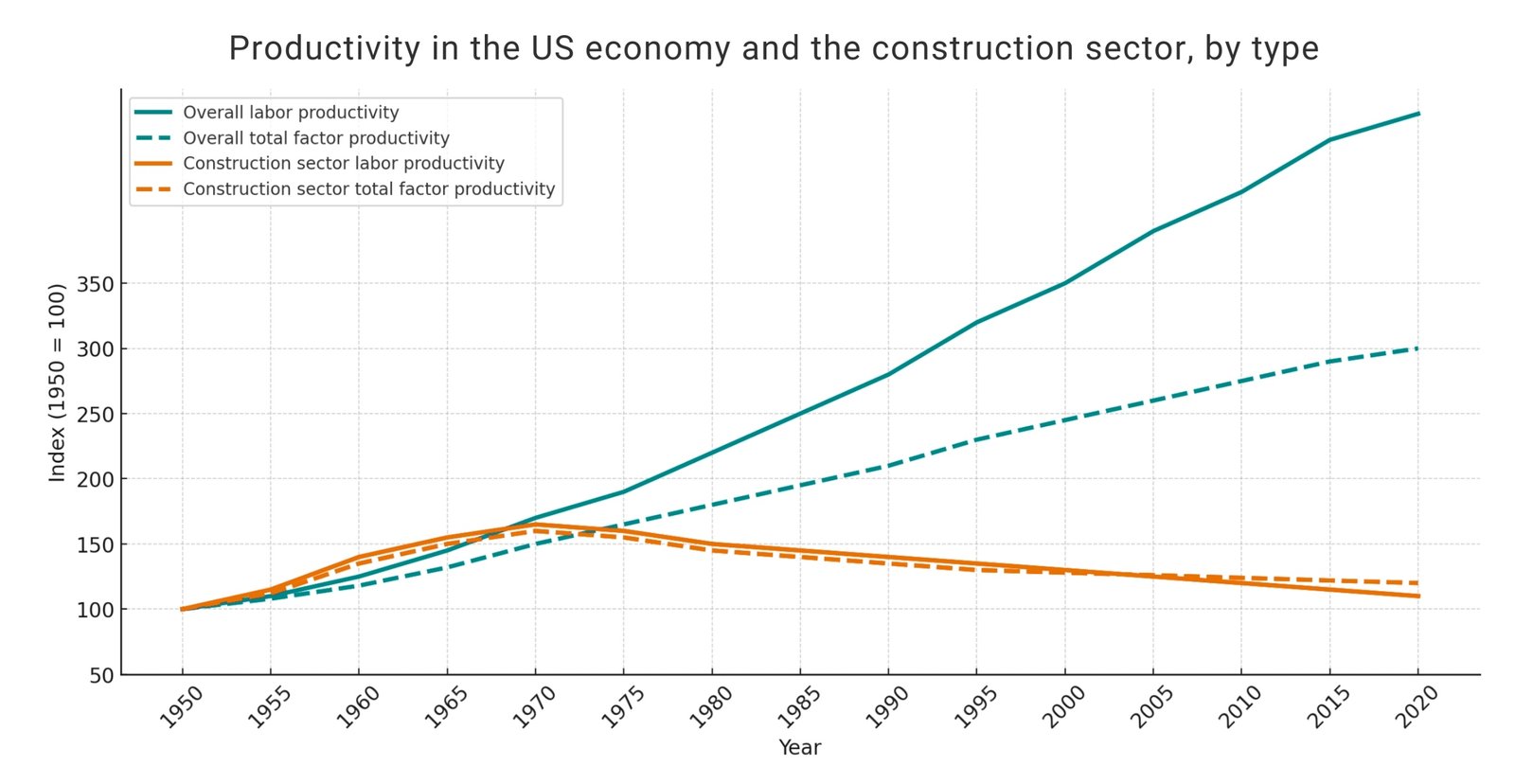
As a result, not only the level of automation, but also labor productivity, in construction is declining, and by 2020 a construction worker is producing less than half a century ago (Fig. 10.2-1)

Such productivity problems in the construction sector are common to most developed and developing countries (construction productivity has fallen in 16 out of 29 OECD countries (Fig. 2.2-1)), and point not only to a lack of technology, but also to the need for systemic changes in the very approaches to management, training and innovation.

The success of digital transformation depends not so much on the number and availability of tools, but rather on the ability of organizations to review their processes and develop a culture that is open to change. It is not the technology itself that is key, but the people and processes that ensure its effective use, support continuous learning and foster acceptance of new ideas.
.

Рисунок 1
Fig. 10.2-1 The paradox of labor productivity and total resource productivity in the U.S. economy and construction sector (1950-2020) (based on (A. G. a. C. Syverson, “The Strange and Awful Path of Productivity in the US Construction Sector,” 19 Jan. 2023)).

In the early parts of the book, the business environment model was compared to a forest ecosystem (Fig. 2.1-2, Fig. 1.2-4, Fig. 1.3-2). In a healthy forest, periodic fires, for all their destructive power, play a key role in long-term renewal. They clear the soil of old vegetation, return stored nutrients, and create space for new life. Some plant species have even evolved so that their seeds only open when exposed to high fire temperatures, a natural mechanism that provides the ideal time for germination.

Similarly in business, crises can play the role of “controlled burnout”, encouraging the emergence of new approaches and companies that are not tied to outdated systems. Such periods force the abandonment of inefficient practices, freeing up resources for innovation. Just as a forest after a fire starts with pioneer plants, so business after a crisis forms new, flexible processes that become the basis for a mature information environment.

Companies that manage to correctly interpret these “signal fires” and transform their disruptive energy into constructive change will reach a new level of performance – with more transparent, adaptive data processes that enhance the organization’s natural ability to renew and grow.

The growing influence of artificial intelligence and machine learning on the business environment is no longer in doubt. This is not just a temporary trend, but a strategic necessity. Companies that ignore AI, risk losing competitiveness in a market that increasingly encourages innovation and flexibility.

The future belongs to those who see AI not just as a tool, but as an opportunity to rethink every aspect of their business – from process optimization to management decision-making.

.

Leave a Reply

Change language

Post's Highlights

Stay updated: news and insights


We’re Here to Help

Fresh solutions are released through our social channels

UNLOCK THE POWER OF DATA
 IN CONSTRUCTION

Dive into the world of data-driven construction with this accessible guide, perfect for professionals and novices alike.
From the basics of data management to cutting-edge trends in digital transformation, this book
will be your comprehensive guide to using data in the construction industry.

Related posts 

Focus Areas

Search

Search
Sorry, no articles found.

✕

Don't miss the new solutions


✕
✕

Linux

macOS

Looking for the Linux or MAC version? Send us a quick message using the button below, and we’ll guide you through the process!

✕

📥 Download OnePager

Welcome to DataDrivenConstruction—where data meets innovation in the construction industry. Our One-Pager offers a concise overview of how our data-driven solutions can transform your projects, enhance efficiency, and drive sustainable growth. 

✕

🚀 Welcome to the future of data in construction!

You're taking your first step into the world of open data, working with normalized, structured data—the foundation of data analytics and modern automation tools.

By downloading, you agree to the DataDrivenConstruction terms of use 

Stay ahead with the latest updates on converters, tools, AI, LLM
and data analytics in construction — Subscribe now!

✕

🚀 Welcome to the future of data in construction!

You're taking your first step into the world of open data, working with normalized, structured data—the foundation of data analytics and modern automation tools.

By downloading, you agree to the DataDrivenConstruction terms of use 

Stay ahead with the latest updates on converters, tools, AI, LLM
and data analytics in construction — Subscribe now!

✕

🚀 Welcome to the future of data in construction!

You're taking your first step into the world of open data, working with normalized, structured data—the foundation of data analytics and modern automation tools.

By downloading, you agree to the DataDrivenConstruction terms of use 

Stay ahead with the latest updates on converters, tools, AI, LLM
and data analytics in construction — Subscribe now!

✕

🚀 Welcome to the future of data in construction!

You're taking your first step into the world of open data, working with normalized, structured data—the foundation of data analytics and modern automation tools.

By downloading, you agree to the DataDrivenConstruction terms of use 

Stay ahead with the latest updates on converters, tools, AI, LLM
and data analytics in construction — Subscribe now!

✕

🚀 Welcome to the future of data in construction!

You're taking your first step into the world of open data, working with normalized, structured data—the foundation of data analytics and modern automation tools.

By downloading, you agree to the DDC terms of use 

✕

🚀 Welcome to the future of data in construction!

You're taking your first step into the world of open data, working with normalized, structured data—the foundation of data analytics and modern automation tools.

By downloading, you agree to the DataDrivenConstruction terms of use 

Stay ahead with the latest updates on converters, tools, AI, LLM
and data analytics in construction — Subscribe now!

✕
DataDrivenConstruction offers workshops tested and practiced on global leaders in the construction industry to help your team navigate and leverage the power of data and artificial intelligence in your company's decision making.

Reserve your spot now to rethink your
approach to decision making!

✕


🚀 Welcome to the future of data in construction!

By downloading, you agree to the DataDrivenConstruction terms of use 

Stay ahead with the latest updates on converters, tools, AI, LLM
and data analytics in construction — Subscribe now!

✕
Have a question or need more information? Reach out to us directly!
Schedule a time to discuss your needs with our team.
Tailored sessions to help your team grow — let's plan together!
✕
Have you attended one of our workshops, read our book, or used our solutions? Share your thoughts with us!
Name
✕
Data Maturity Diagnostics

🧰 Data-Driven Readiness Check

This short assessment will help you identify your company's data management pain points and offer solutions to improve project efficiency. It takes only 1–2 minutes to complete and you will receive personalized recommendations tailored to your needs.

✕

Clean & Organized Data

Theoretical Chapters:

Practical Chapters:

What You'll Find on
DDC Solutions:

  • CAD/BIM to spreadsheet/database converters (Revit, AutoCAD, IFC, Microstation)
  • Ready-to-deploy n8n workflows for construction processes
  • ETL pipelines for data synchronization between systems
  • Customizable Python scripts for repetitive tasks
  • Intelligent data validation and error detection
  • Real-time dashboard connectors
  • Automated reporting systems
✕

Connect Everything

Theoretical Chapters:

Practical Chapters:

What You'll Find on
DDC Solutions:

  • CAD/BIM to spreadsheet/database converters (Revit, AutoCAD, IFC, Microstation)
  • Ready-to-deploy n8n workflows for construction processes
  • ETL pipelines for data synchronization between systems
  • Customizable Python scripts for repetitive tasks
  • Intelligent data validation and error detection
  • Real-time dashboard connectors
  • Automated reporting systems
✕

Add AI & LLM Brain

Theoretical Chapters:

Practical Chapters:

What You'll Find on
DDC Solutions:

  • CAD/BIM to spreadsheet/database converters (Revit, AutoCAD, IFC, Microstation)
  • Ready-to-deploy n8n workflows for construction processes
  • ETL pipelines for data synchronization between systems
  • Customizable Python scripts for repetitive tasks
  • Intelligent data validation and error detection
  • Real-time dashboard connectors
  • Automated reporting systems
166 From Theory to Practice A Roadmap for Digital Transformation in Construction
This website uses cookies to improve your experience. By using this website you agree to our Data Protection Policy.
Read more
×