
6D-8D from energy efficiency to safety assurance
22 February 2024
Construction ERP using calculations and estimates as an example
22 February 2024

CO2 estimation and calculation of carbon emissions in construction projects

Along with the topic of sustainability of building projects at the 6D stage, modern construction emphasizes the environmental sustainability of projects. One of the key aspects of which is the assessment and minimization of CO2 carbon emissions that occur at all stages of the building life cycle.

Estimating and calculating carbon emissions of construction projects is a process in which total carbon emissions are determined by multiplying the volume attribute of the entities or group of entity-elements used in the project by a suitable carbon emission factor for the category.

Incorporating carbon emissions into the evaluation of construction projects as a component of the broader Environmental, Social, and Governance (ESG) criteria introduces an additional layer to the comprehensive assessment of the project.

Environmental, Social and Governance (ESG) are a broad set of principles that can be used to assess the corporate governance, social and environmental impact of a business, both internally and externally.

ESG, initially developed in the early 2000s by financial funds to provide investors with insights into the broad environmental, social, and governance criteria, has evolved to become a key metric for evaluating both companies and projects.


To determine emissions by type or category of element we need to collect the CO2 emission factors resulting from the production of different building materials such as concrete, bricks, recycled steel and aluminum.

The following table uses data from the UK ICE 2015 and US EPA 2006 databases. For each material in this table, two emission attributes (in kilograms of CO2 per kilogram of product) and volume-to-weight conversion factors (in kilograms per cubic meter) are provided.
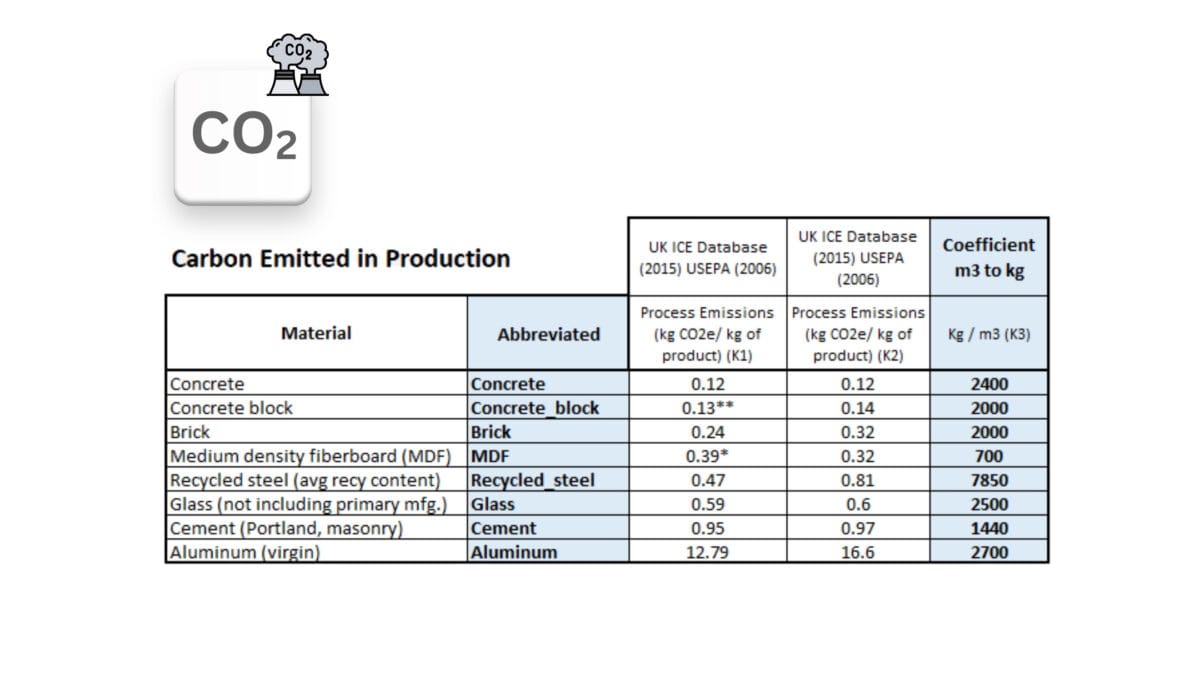
In order to calculate the total CO2 emissions of a project, it is necessary to define the attribute volume of each entity group. This can be done using the Quantity Take-Off (QTO) tools by obtaining attribute volumes in cubic meters, as detailed in the section "QTO Quantity Take-Off: Data Matching and Grouping". These volumes are then multiplied by the attribute “CO2 process emissions” factors for each material group.

Let's extract from the CAD (BIM) project automatically a table of volumes by element type by grouping all the data from the project, as we did in the previous chapters. Let's ask ChatGPT to do this.


❏ Text request to ChatGPT:

Please group the DataFrame table from CAD (BIM) of the project by the "Type Name" column parameter and show the number of items of each group and also summarize the "Volume" parameter for all items in the type. ⏎

➤ ChatGPT Answer:
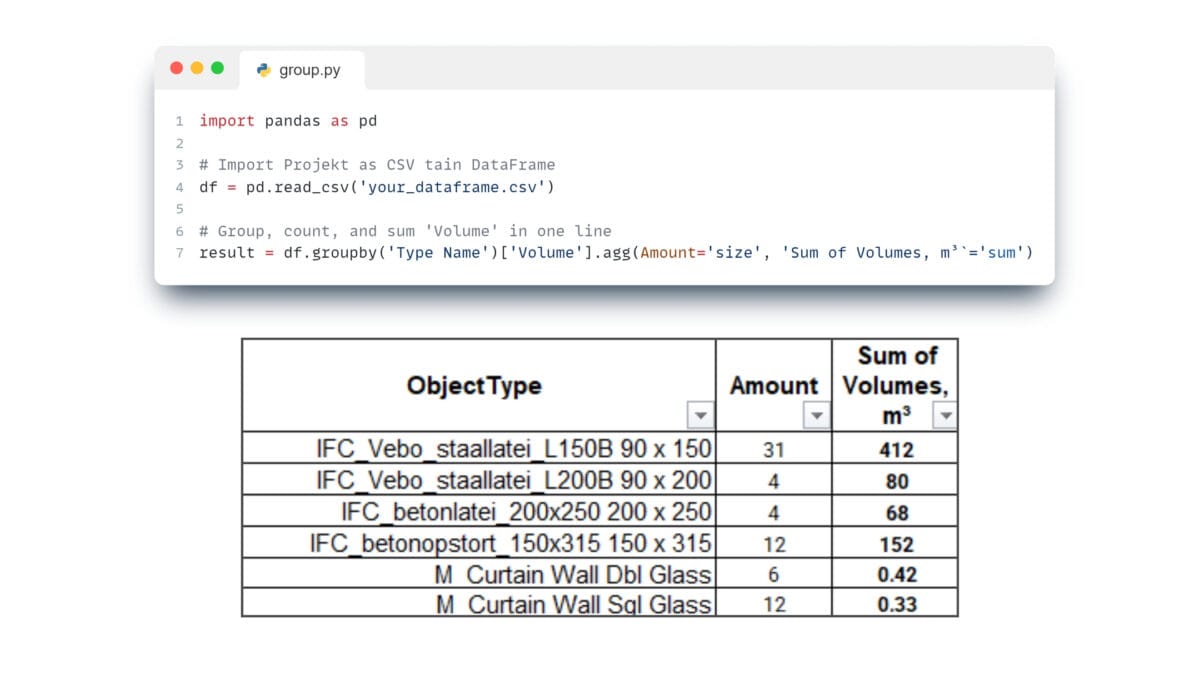
To automate the process of calculating the total emissions for the entire project, we only need to set up automatic mapping in the same table or specify manually the correspondence between element types and material types from the emission factor table.

A ready-made table with coefficients and formulas, as well as ready-made code for getting volumes from CAD (BIM) formats and automating CO2 calculations, can be found on GitHub by searching for "CO2_calculating-the-embodied-carbon".

Thus, the use of QTO and CAD (BIM) data to estimate carbon emissions in construction allows to automatically calculate the corresponding carbon dioxide emissions for different project variants with different materials, automatically selecting only those variants that meet the client's CO2 emission requirements.

Estimation of CO2 emissions by multiplying coefficients by volumes of grouped project elements is a typical example of a task in the processes of a construction company.

Similarly, by defining element group volumes, we can perform calculations for material control and logistics, quality monitoring and management, energy modelling and analysis, and a host of other tasks.


If the number of such calculation processes in a company starts to grow, the question arises as to whether it is necessary to build automation or use a specialized complex data management system (or data tables) to manage the rule tables and the projects themselves.

Medium to large companies in the construction industry, outsource such automation to ERP system development companies. Such companies use a single comprehensive system, known as a construction ERP (enterprise resource planning) system, to manage many different information layers, including material and resource calculations.

Leave a Reply

Change language

Post's Highlights

    Stay updated: news and insights


    We’re Here to Help

    Fresh solutions are released through our social channels

    UNLOCK THE POWER OF DATA
     IN CONSTRUCTION

    Dive into the world of data-driven construction with this accessible guide, perfect for professionals and novices alike.
    From the basics of data management to cutting-edge trends in digital transformation, this book
    will be your comprehensive guide to using data in the construction industry.

    Related posts 

    Focus Areas

    navigate
    • ALL THE CHAPTERS IN THIS PART
    • A PRACTICAL GUIDE TO IMPLEMENTING A DATA-DRIVEN APPROACH (8)
    • CLASSIFICATION AND INTEGRATION: A COMMON LANGUAGE FOR CONSTRUCTION DATA (8)
    • DATA FLOW WITHOUT MANUAL EFFORT: WHY ETL (8)
    • DATA INFRASTRUCTURE: FROM STORAGE FORMATS TO DIGITAL REPOSITORIES (8)
    • DATA UNIFICATION AND STRUCTURING (7)
    • SYSTEMATIZATION OF REQUIREMENTS AND VALIDATION OF INFORMATION (7)
    • COST CALCULATIONS AND ESTIMATES FOR CONSTRUCTION PROJECTS (6)
    • EMERGENCE OF BIM-CONCEPTS IN THE CONSTRUCTION INDUSTRY (6)
    • MACHINE LEARNING AND PREDICTIONS (6)
    • BIG DATA AND ITS ANALYSIS (5)
    • DATA ANALYTICS AND DATA-DRIVEN DECISION-MAKING (5)
    • DATA CONVERSION INTO A STRUCTURED FORM (5)
    • DESIGN PARAMETERIZATION AND USE OF LLM FOR CAD OPERATION (5)
    • GEOMETRY IN CONSTRUCTION: FROM LINES TO CUBIC METERS (5)
    • LLM AND THEIR ROLE IN DATA PROCESSING AND BUSINESS PROCESSES (5)
    • ORCHESTRATION OF ETL AND WORKFLOWS: PRACTICAL SOLUTIONS (5)
    • SURVIVAL STRATEGIES: BUILDING COMPETITIVE ADVANTAGE (5)
    • 4D-6D and Calculation of Carbon Dioxide Emissions (4)
    • CONSTRUCTION ERP AND PMIS SYSTEMS (4)
    • COST AND SCHEDULE FORECASTING USING MACHINE LEARNING (4)
    • DATA WAREHOUSE MANAGEMENT AND CHAOS PREVENTION (4)
    • EVOLUTION OF DATA USE IN THE CONSTRUCTION INDUSTRY (4)
    • IDE WITH LLM SUPPORT AND FUTURE PROGRAMMING CHANGES (4)
    • QUANTITY TAKE-OFF AND AUTOMATIC CREATION OF ESTIMATES AND SCHEDULES (4)
    • THE DIGITAL REVOLUTION AND THE EXPLOSION OF DATA (4)
    • Uncategorized (4)
    • CLOSED PROJECT FORMATS AND INTEROPERABILITY ISSUES (3)
    • MANAGEMENT SYSTEMS IN CONSTRUCTION (3)
    • AUTOMATIC ETL CONVEYOR (PIPELINE) (2)

    Search

    Search

    057 Speed of decision making depends on data quality

    Today’s design data architecture is undergoing fundamental changes. The industry is moving away from bulky, isolated models and closed formats towards more flexible, machine-readable structures focused on analytics, integration and process automation. However, the transition...

    060 A common language of construction the role of classifiers in digital transformation

    In the context of digitalization and automation of inspection and processing processes, a special role is played by classification systems elements – a kind of “digital dictionaries” that ensure uniformity in the description and parameterization...

    061 Masterformat, OmniClass, Uniclass and CoClass the evolution of classification systems

    Historically, construction element and work classifiers have evolved in three generations, each reflecting the level of available technology and the current needs of the industry in a particular time period (Fig. 4.2-8): First generation (early...

    Don't miss the new solutions


    Linux

    macOS

    Looking for the Linux or MAC version? Send us a quick message using the button below, and we’ll guide you through the process!


    📥 Download OnePager

    Welcome to DataDrivenConstruction—where data meets innovation in the construction industry. Our One-Pager offers a concise overview of how our data-driven solutions can transform your projects, enhance efficiency, and drive sustainable growth. 

    🚀 Welcome to the future of data in construction!

    You're taking your first step into the world of open data, working with normalized, structured data—the foundation of data analytics and modern automation tools.

    By downloading, you agree to the DataDrivenConstruction terms of use 

    Stay ahead with the latest updates on converters, tools, AI, LLM
    and data analytics in construction — Subscribe now!

    🚀 Welcome to the future of data in construction!

    You're taking your first step into the world of open data, working with normalized, structured data—the foundation of data analytics and modern automation tools.

    By downloading, you agree to the DataDrivenConstruction terms of use 

    Stay ahead with the latest updates on converters, tools, AI, LLM
    and data analytics in construction — Subscribe now!

    🚀 Welcome to the future of data in construction!

    You're taking your first step into the world of open data, working with normalized, structured data—the foundation of data analytics and modern automation tools.

    By downloading, you agree to the DataDrivenConstruction terms of use 

    Stay ahead with the latest updates on converters, tools, AI, LLM
    and data analytics in construction — Subscribe now!

    🚀 Welcome to the future of data in construction!

    You're taking your first step into the world of open data, working with normalized, structured data—the foundation of data analytics and modern automation tools.

    By downloading, you agree to the DataDrivenConstruction terms of use 

    Stay ahead with the latest updates on converters, tools, AI, LLM
    and data analytics in construction — Subscribe now!

    🚀 Welcome to the future of data in construction!

    You're taking your first step into the world of open data, working with normalized, structured data—the foundation of data analytics and modern automation tools.

    By downloading, you agree to the DDC terms of use 

    🚀 Welcome to the future of data in construction!

    You're taking your first step into the world of open data, working with normalized, structured data—the foundation of data analytics and modern automation tools.

    By downloading, you agree to the DataDrivenConstruction terms of use 

    Stay ahead with the latest updates on converters, tools, AI, LLM
    and data analytics in construction — Subscribe now!

    DataDrivenConstruction offers workshops tested and practiced on global leaders in the construction industry to help your team navigate and leverage the power of data and artificial intelligence in your company's decision making.

    Reserve your spot now to rethink your
    approach to decision making!


    🚀 Welcome to the future of data in construction!

    By downloading, you agree to the DataDrivenConstruction terms of use 

    Stay ahead with the latest updates on converters, tools, AI, LLM
    and data analytics in construction — Subscribe now!

    Have a question or need more information? Reach out to us directly!
    Schedule a time to discuss your needs with our team.
    Tailored sessions to help your team grow — let's plan together!
    Have you attended one of our workshops, read our book, or used our solutions? Share your thoughts with us!
    Name
    Data Maturity Diagnostics

    🧰 Data-Driven Readiness Check

    This short assessment will help you identify your company's data management pain points and offer solutions to improve project efficiency. It takes only 1–2 minutes to complete and you will receive personalized recommendations tailored to your needs.

    Clean & Organized Data

    Theoretical Chapters:

    Practical Chapters:

    What You'll Find on
    DDC Solutions:

    • CAD/BIM to spreadsheet/database converters (Revit, AutoCAD, IFC, Microstation)
    • Ready-to-deploy n8n workflows for construction processes
    • ETL pipelines for data synchronization between systems
    • Customizable Python scripts for repetitive tasks
    • Intelligent data validation and error detection
    • Real-time dashboard connectors
    • Automated reporting systems

    Connect Everything

    Theoretical Chapters:

    Practical Chapters:

    What You'll Find on
    DDC Solutions:

    • CAD/BIM to spreadsheet/database converters (Revit, AutoCAD, IFC, Microstation)
    • Ready-to-deploy n8n workflows for construction processes
    • ETL pipelines for data synchronization between systems
    • Customizable Python scripts for repetitive tasks
    • Intelligent data validation and error detection
    • Real-time dashboard connectors
    • Automated reporting systems

    Add AI & LLM Brain

    Theoretical Chapters:

    Practical Chapters:

    What You'll Find on
    DDC Solutions:

    • CAD/BIM to spreadsheet/database converters (Revit, AutoCAD, IFC, Microstation)
    • Ready-to-deploy n8n workflows for construction processes
    • ETL pipelines for data synchronization between systems
    • Customizable Python scripts for repetitive tasks
    • Intelligent data validation and error detection
    • Real-time dashboard connectors
    • Automated reporting systems
    CO2 estimation and calculation of carbon emissions in construction projects
    This website uses cookies to improve your experience. By using this website you agree to our Data Protection Policy.
    Read more
    ×