014 Data silos and their impact on company performance
15 December 2024
🌑 Why Semantic Ontology and IFC May Not Be the Future of Construction
17 December 2024

015 Duplication, and lack of data quality as a consequence of disunity

Due to the problem of data silos, managers are forced to spend considerable time searching for and reconciling data. To hedge against quality problems, companies create complex information management structures in which a vertical of managers is responsible for searching, verifying, and reconciling data. However, this approach only increases bureaucracy and slows down decision-making. The more data there is, the more difficult it is to analyze and interpret, especially if there is no uniform standard for its storage and processing.

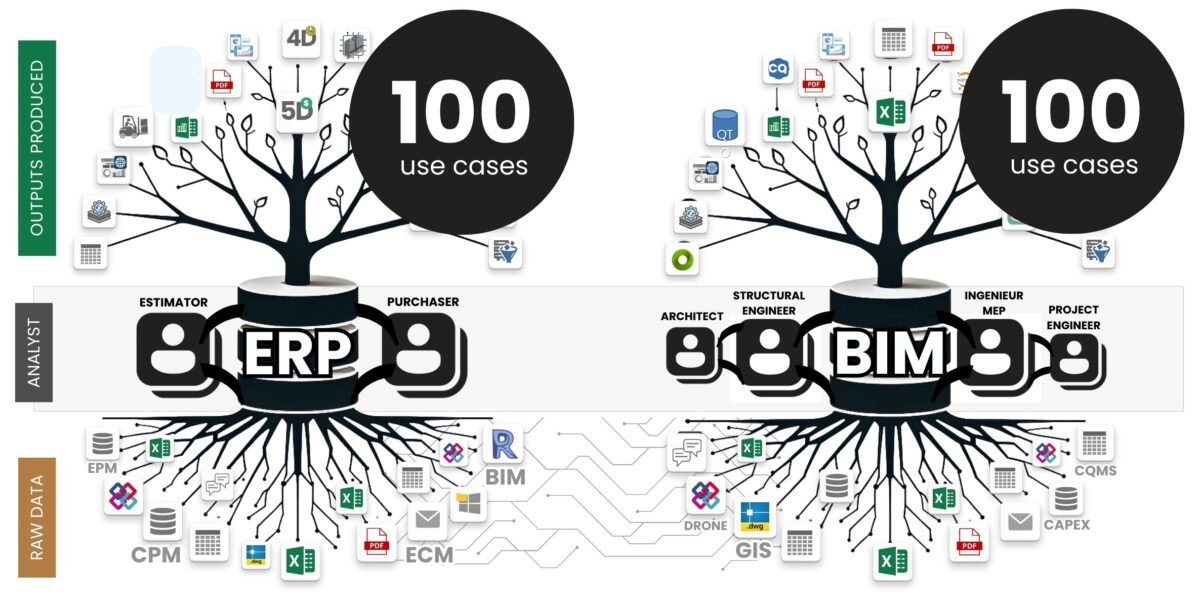
With the plethora of software applications and systems that have been growing like mushrooms after rain in the last decade, the problem of silos and inappropriate data quality has become increasingly important to end users. The same data, but with different values, can now be found in different systems and applications (Fig. 2.1-6). This leads to difficulties for end users when trying to determine which version of data is relevant and correct among the many available. This leads to errors in analysis and ultimately decision making.

To insure against problems with finding the right data, company managers create a multi-level bureaucracy of verification managers. Their task is to be able to quickly find, check and send the necessary data in the form of tables and reports, navigating the maze of disparate systems.

image63
Fig. 2.1-6 In trying to find the right data, managers must ensure the quality and legal reliability of data between different systems.

In practice, however, this model creates new complexities. When data is managed manually and information is scattered across many unrelated decisions, every attempt to obtain accurate and up-to-date information through a pyramid of decision-makers (Fig. 2.1-7) becomes a bottleneck – time-consuming and error-prone.

The situation is exacerbated by the avalanche of digital solutions. The software market continues to be flooded with new tools that seem promising. But without a clear data management strategy, these solutions do not integrate into a unified system, but instead create additional layers of complexity and duplication. As a result, instead of simplifying processes, companies find themselves in an even more fragmented and chaotic information environment.

image136
Fig. 2.1-7 The complexity of systems and the variety of data formats lead to a loss of consistency in the construction process.

All of these problems associated with managing a multitude of disparate solutions sooner or later bring company management to an important realization: it’s not about the volume of data or finding the next “one-size-fits-all” tool to process it. The real reason lies in the quality of the data and how the organization creates, receives, stores and uses it.

The key to sustainable success is not in chasing new “magic” applications, but in building a data culture within the company. This means treating data as a strategic asset and making data quality, integrity and relevance a priority at all levels of the organization.

The solution to the quality vs. quantity dilemma lies in the creation of a unified data structure that eliminates duplication, eliminates inconsistencies and unifies information flows. This architecture provides a single, reliable source of data upon which to make informed, accurate and timely decisions.

Otherwise, as is still often the case, companies continue to rely on subjective opinions and intuitive assessments of HiPPO experts rather than on reliable facts. In the construction industry, where expertise traditionally plays a significant role, this is particularly noticeable.

.

Leave a Reply

Change language

Post's Highlights

Stay updated: news and insights


We’re Here to Help

Fresh solutions are released through our social channels

UNLOCK THE POWER OF DATA
 IN CONSTRUCTION

Dive into the world of data-driven construction with this accessible guide, perfect for professionals and novices alike.
From the basics of data management to cutting-edge trends in digital transformation, this book
will be your comprehensive guide to using data in the construction industry.

Related posts 

Focus Areas

Search

Search
Sorry, no articles found.

✕

Don't miss the new solutions


✕
✕

Linux

macOS

Looking for the Linux or MAC version? Send us a quick message using the button below, and we’ll guide you through the process!

✕

📥 Download OnePager

Welcome to DataDrivenConstruction—where data meets innovation in the construction industry. Our One-Pager offers a concise overview of how our data-driven solutions can transform your projects, enhance efficiency, and drive sustainable growth. 

✕

🚀 Welcome to the future of data in construction!

You're taking your first step into the world of open data, working with normalized, structured data—the foundation of data analytics and modern automation tools.

By downloading, you agree to the DataDrivenConstruction terms of use 

Stay ahead with the latest updates on converters, tools, AI, LLM
and data analytics in construction — Subscribe now!

✕

🚀 Welcome to the future of data in construction!

You're taking your first step into the world of open data, working with normalized, structured data—the foundation of data analytics and modern automation tools.

By downloading, you agree to the DataDrivenConstruction terms of use 

Stay ahead with the latest updates on converters, tools, AI, LLM
and data analytics in construction — Subscribe now!

✕

🚀 Welcome to the future of data in construction!

You're taking your first step into the world of open data, working with normalized, structured data—the foundation of data analytics and modern automation tools.

By downloading, you agree to the DataDrivenConstruction terms of use 

Stay ahead with the latest updates on converters, tools, AI, LLM
and data analytics in construction — Subscribe now!

✕

🚀 Welcome to the future of data in construction!

You're taking your first step into the world of open data, working with normalized, structured data—the foundation of data analytics and modern automation tools.

By downloading, you agree to the DataDrivenConstruction terms of use 

Stay ahead with the latest updates on converters, tools, AI, LLM
and data analytics in construction — Subscribe now!

✕

🚀 Welcome to the future of data in construction!

You're taking your first step into the world of open data, working with normalized, structured data—the foundation of data analytics and modern automation tools.

By downloading, you agree to the DDC terms of use 

✕

🚀 Welcome to the future of data in construction!

You're taking your first step into the world of open data, working with normalized, structured data—the foundation of data analytics and modern automation tools.

By downloading, you agree to the DataDrivenConstruction terms of use 

Stay ahead with the latest updates on converters, tools, AI, LLM
and data analytics in construction — Subscribe now!

✕
DataDrivenConstruction offers workshops tested and practiced on global leaders in the construction industry to help your team navigate and leverage the power of data and artificial intelligence in your company's decision making.

Reserve your spot now to rethink your
approach to decision making!

✕


🚀 Welcome to the future of data in construction!

By downloading, you agree to the DataDrivenConstruction terms of use 

Stay ahead with the latest updates on converters, tools, AI, LLM
and data analytics in construction — Subscribe now!

✕
Have a question or need more information? Reach out to us directly!
Schedule a time to discuss your needs with our team.
Tailored sessions to help your team grow — let's plan together!
✕
Have you attended one of our workshops, read our book, or used our solutions? Share your thoughts with us!
Name
✕
Data Maturity Diagnostics

🧰 Data-Driven Readiness Check

This short assessment will help you identify your company's data management pain points and offer solutions to improve project efficiency. It takes only 1–2 minutes to complete and you will receive personalized recommendations tailored to your needs.

✕

Clean & Organized Data

Theoretical Chapters:

Practical Chapters:

What You'll Find on
DDC Solutions:

  • CAD/BIM to spreadsheet/database converters (Revit, AutoCAD, IFC, Microstation)
  • Ready-to-deploy n8n workflows for construction processes
  • ETL pipelines for data synchronization between systems
  • Customizable Python scripts for repetitive tasks
  • Intelligent data validation and error detection
  • Real-time dashboard connectors
  • Automated reporting systems
✕

Connect Everything

Theoretical Chapters:

Practical Chapters:

What You'll Find on
DDC Solutions:

  • CAD/BIM to spreadsheet/database converters (Revit, AutoCAD, IFC, Microstation)
  • Ready-to-deploy n8n workflows for construction processes
  • ETL pipelines for data synchronization between systems
  • Customizable Python scripts for repetitive tasks
  • Intelligent data validation and error detection
  • Real-time dashboard connectors
  • Automated reporting systems
✕

Add AI & LLM Brain

Theoretical Chapters:

Practical Chapters:

What You'll Find on
DDC Solutions:

  • CAD/BIM to spreadsheet/database converters (Revit, AutoCAD, IFC, Microstation)
  • Ready-to-deploy n8n workflows for construction processes
  • ETL pipelines for data synchronization between systems
  • Customizable Python scripts for repetitive tasks
  • Intelligent data validation and error detection
  • Real-time dashboard connectors
  • Automated reporting systems
015 Duplication, and lack of data quality as a consequence of disunity
This website uses cookies to improve your experience. By using this website you agree to our Data Protection Policy.
Read more
×