The post-BIM world. Transition to data and processes and whether the construction industry needs semantics, formats and interoperability 
19 December 2024
Picture 4
019 Redundant code and closed systems as a barrier to productivity improvement
21 December 2024

018 The Fourth Industrial Revolution (Industry 4.0) and the Fifth Industrial Revolution (Industry 5.0) in the construction industry

Technological and economic stages are theoretical concepts used to describe and analyze the evolution of society and economy at different stages of development. At the same time, different researchers and experts may interpret them in different ways.

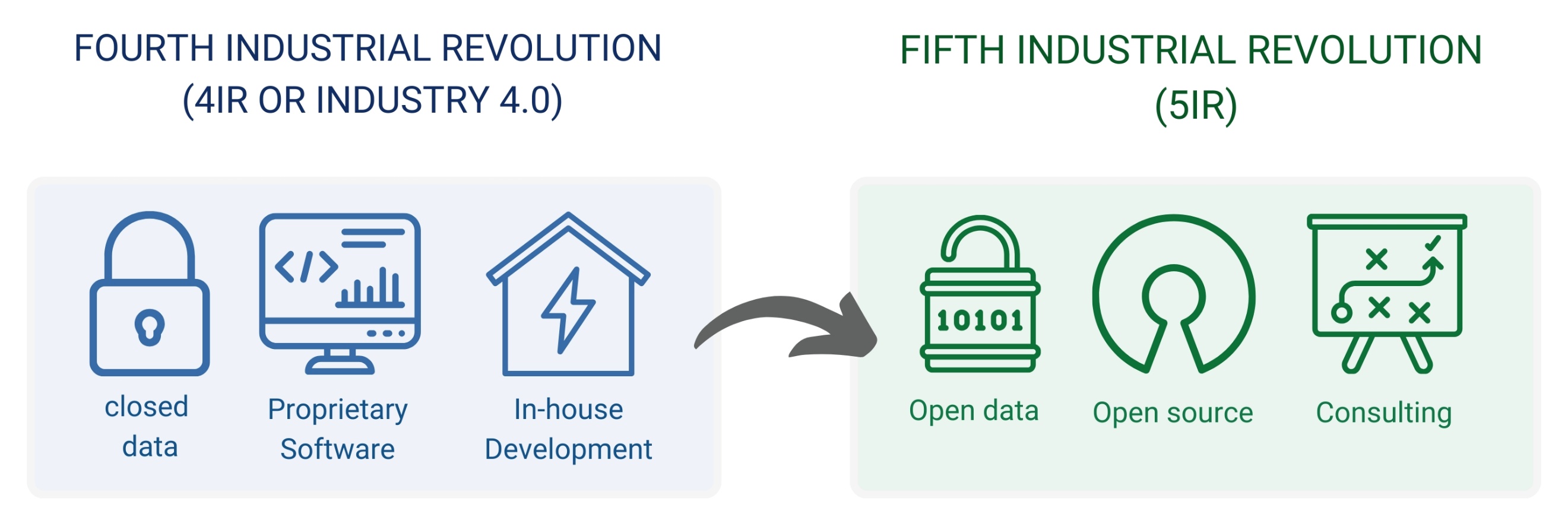
The fourth industrial revolution (4IR or Industry 4.0) is related to information technology, automation, digitalization and globalization. One of its key elements is the creation of proprietary software solutions, i.e. specialized digital products designed for specific tasks and companies. These solutions often become an important part of the IT infrastructure, but they are poorly scalable without additional modifications.

The Fifth Industrial Revolution (5IR) is now at an earlier stage of conceptualization and development than 4IR. Its core principles include increased personalization of products and services. 5IR is a movement towards more adaptable, flexible and personalized economic activity with a focus on personalization, consulting and service-oriented models. A key aspect of the fifth economic mode is the use of data for decision-making, which is virtually impossible without the use of open data and open tools (Fig. 2.1-12).
Picture 3

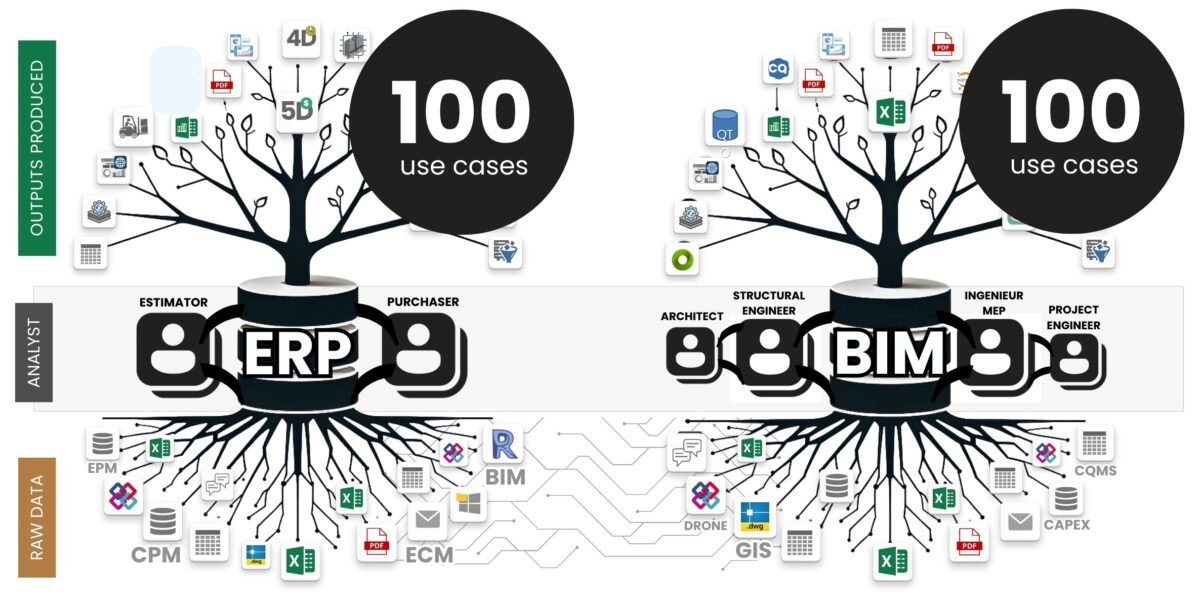
Fig.‎ 2.1-12 The fourth pattern focuses on solutions, while the fifth pattern focuses on personalization and data.

Creating an application for companies in the construction industry for use in ten or one hundred organizations does not guarantee its successful scaling to other companies, regions or countries without significant modifications and enhancements. The likelihood of successfully scaling such solutions remains low, as each organization has unique processes, requirements and conditions that may require personalized adaptations.

It is important to understand that already today successful integration of technological solutions implies a deeply personalized approach to each process, project and company. This means that even after developing a universal framework, tool or program, it will require detailed adaptation and customization to meet the unique requirements and conditions of each specific company and project.

According to the PwC report “Decoding the Fifth Industrial Revolution“ (ZCS, “Decoding the Fifth Industrial Revolution,”), about 50% of senior executives in various industries this year rely on the integration of advanced technologies and human expertise. This approach allows them to quickly adapt to changes in product design or customer requirements, creating personalized production.

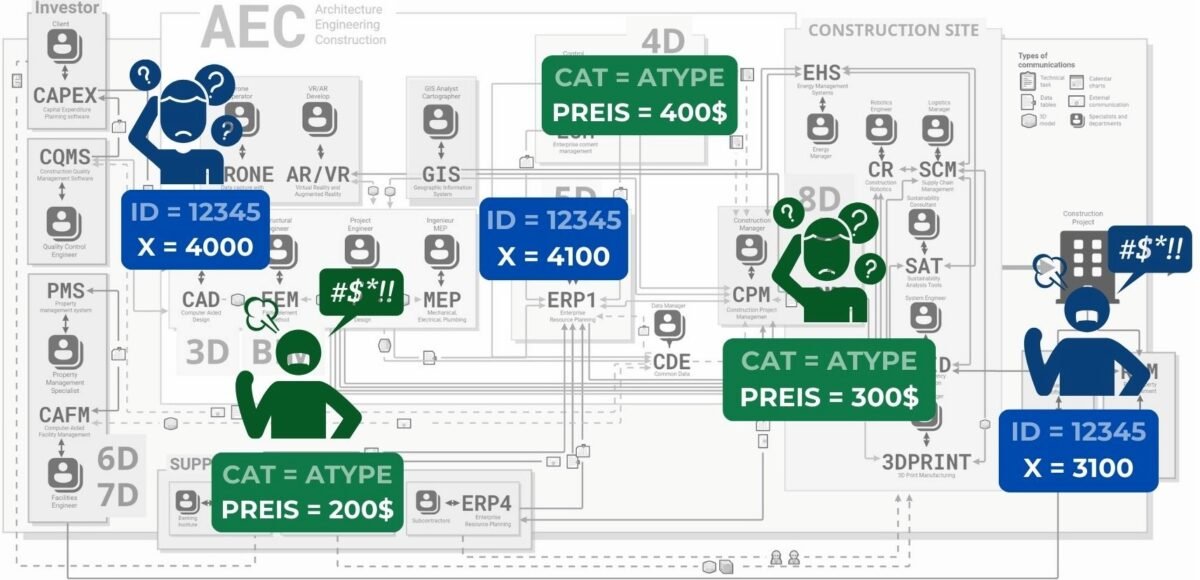
Each process requires the development of a unique function or application, which, given the size of the global construction industry and the diversity of projects, leads to the existence of a huge number of business cases, representing each time a unique Pipeline logic (Fig.‎ 2.1-13). Each such case has its own peculiarities and requires a customized approach. We will look in more detail at the variety of possible solutions to the same analytical problem in the context of different approaches in the chapter devoted to machine learning and the parsing of the Titanic dataset (Fig.‎ 9.2-9).

Pipeline in the context of digital processes is a sequence of activities, processes and tools that enable an automated or structured flow of data and work through the different phases of the project lifecycle.
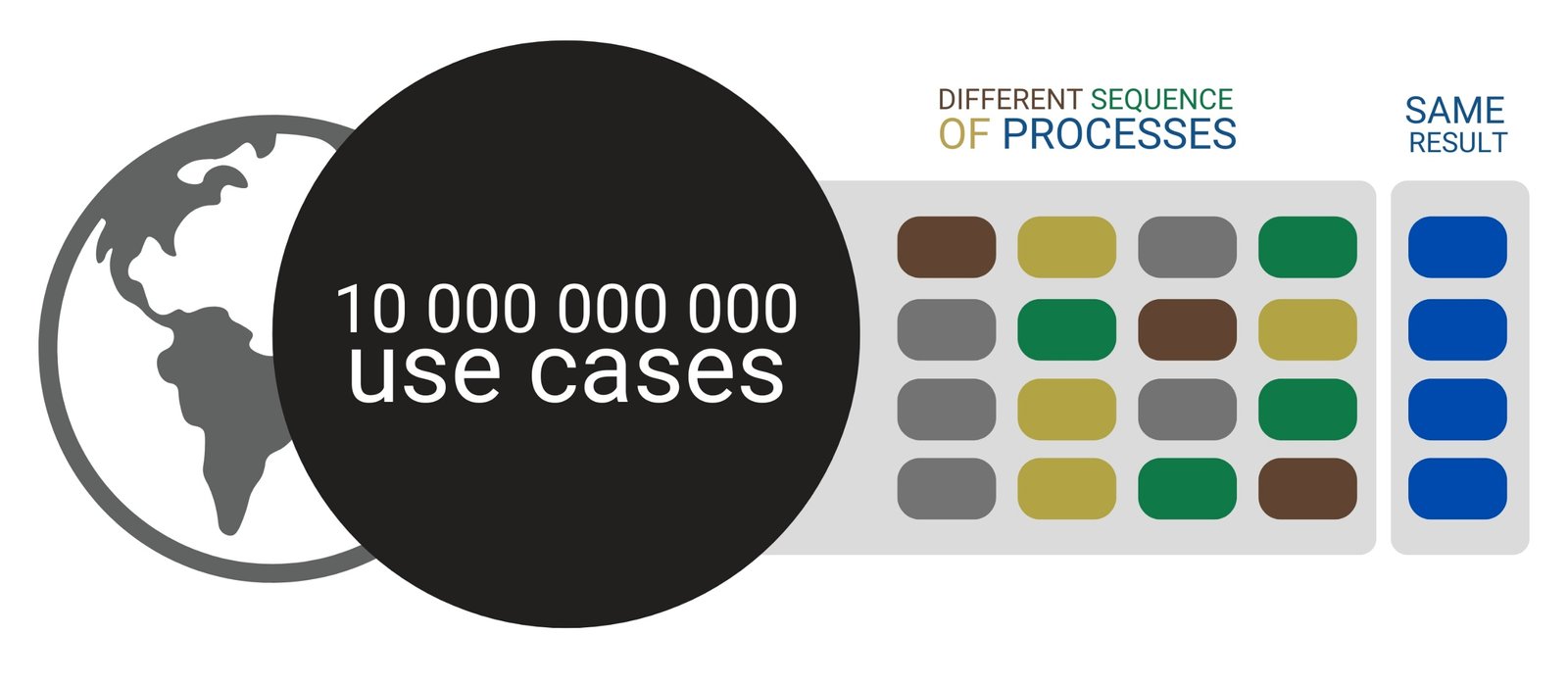
image6

Fig.‎ 2.1-13 The individuality and variability of business cases makes attempts to create scalable closed platforms and tools impossible.

Our lives have already changed in many ways under the influence of digital transformation, and today we can talk about the advent of a new stage in the economic development of the construction industry. In this “new economy”, competition will be organized according to different rules: the one who is able to efficiently turn public knowledge and open data into demanded products and services gains a key advantage in the conditions of the fifth industrial revolution.

As noted by economist Kate Maskus in the book “Private Rights and Public Problems: The Global Intellectual Property Economy in the 21st Century” 2012(M. K, Private Rights and Public Problems: The Global Economics of, Peterson Inst. for Intern. Economics,, 2012), “we live in a global knowledge economy, and the future belongs to those who know how to turn scientific discoveries into commodities”.

The transition to the fifth economic mode implies a shift in focus from closed IT solutions to open standards and platforms. Companies will begin to move away from traditional software products in favor of service-oriented models, where data, rather than proprietary technologies, will become the main asset.

Harvard Business School 2024 study (F. N. a. Y. Z. Harvard Business School: Manuel Hoffmann, “The Value of Open Source Software,” 24 Jan. 2024)shows the huge economic value of open source software (Open Source Software, OSS). According to the study, OSS is present in 96% of all software codes, and some commercial software consists of 99.9% OSS components. Without OSS, companies would spend 3.5 times more on software.

Building company ecosystems, following global trends, will gradually shift to the fifth economic paradigm, where data-centric analytics and consulting services will become a higher priority than isolated closed solutions with rigidly defined use cases.

The digitalization era will change the balance of power in the industry: instead of relying on vendor solutions, companies will base their competitiveness on their ability to leverage data. As a result, the construction industry will move from legacy rigid systems to flexible, adaptive ecosystems where open standards and interoperable tools will be the foundation of project management. The end of the era of application vendor dominance will create a new environment where value will not be defined by possession of closed source code and specialized connectors, but by the ability to turn data into a strategic advantage.

.

.

.

Leave a Reply

Change language

Post's Highlights

Stay updated: news and insights


We’re Here to Help

Fresh solutions are released through our social channels

UNLOCK THE POWER OF DATA
 IN CONSTRUCTION

Dive into the world of data-driven construction with this accessible guide, perfect for professionals and novices alike.
From the basics of data management to cutting-edge trends in digital transformation, this book
will be your comprehensive guide to using data in the construction industry.

Related posts 

Focus Areas

Search

Search
Sorry, no articles found.

✕

Don't miss the new solutions


✕
✕

Linux

macOS

Looking for the Linux or MAC version? Send us a quick message using the button below, and we’ll guide you through the process!

✕

📥 Download OnePager

Welcome to DataDrivenConstruction—where data meets innovation in the construction industry. Our One-Pager offers a concise overview of how our data-driven solutions can transform your projects, enhance efficiency, and drive sustainable growth. 

✕

🚀 Welcome to the future of data in construction!

You're taking your first step into the world of open data, working with normalized, structured data—the foundation of data analytics and modern automation tools.

By downloading, you agree to the DataDrivenConstruction terms of use 

Stay ahead with the latest updates on converters, tools, AI, LLM
and data analytics in construction — Subscribe now!

✕

🚀 Welcome to the future of data in construction!

You're taking your first step into the world of open data, working with normalized, structured data—the foundation of data analytics and modern automation tools.

By downloading, you agree to the DataDrivenConstruction terms of use 

Stay ahead with the latest updates on converters, tools, AI, LLM
and data analytics in construction — Subscribe now!

✕

🚀 Welcome to the future of data in construction!

You're taking your first step into the world of open data, working with normalized, structured data—the foundation of data analytics and modern automation tools.

By downloading, you agree to the DataDrivenConstruction terms of use 

Stay ahead with the latest updates on converters, tools, AI, LLM
and data analytics in construction — Subscribe now!

✕

🚀 Welcome to the future of data in construction!

You're taking your first step into the world of open data, working with normalized, structured data—the foundation of data analytics and modern automation tools.

By downloading, you agree to the DataDrivenConstruction terms of use 

Stay ahead with the latest updates on converters, tools, AI, LLM
and data analytics in construction — Subscribe now!

✕

🚀 Welcome to the future of data in construction!

You're taking your first step into the world of open data, working with normalized, structured data—the foundation of data analytics and modern automation tools.

By downloading, you agree to the DDC terms of use 

✕

🚀 Welcome to the future of data in construction!

You're taking your first step into the world of open data, working with normalized, structured data—the foundation of data analytics and modern automation tools.

By downloading, you agree to the DataDrivenConstruction terms of use 

Stay ahead with the latest updates on converters, tools, AI, LLM
and data analytics in construction — Subscribe now!

✕
DataDrivenConstruction offers workshops tested and practiced on global leaders in the construction industry to help your team navigate and leverage the power of data and artificial intelligence in your company's decision making.

Reserve your spot now to rethink your
approach to decision making!

✕


🚀 Welcome to the future of data in construction!

By downloading, you agree to the DataDrivenConstruction terms of use 

Stay ahead with the latest updates on converters, tools, AI, LLM
and data analytics in construction — Subscribe now!

✕
Have a question or need more information? Reach out to us directly!
Schedule a time to discuss your needs with our team.
Tailored sessions to help your team grow — let's plan together!
✕
Have you attended one of our workshops, read our book, or used our solutions? Share your thoughts with us!
Name
✕
Data Maturity Diagnostics

🧰 Data-Driven Readiness Check

This short assessment will help you identify your company's data management pain points and offer solutions to improve project efficiency. It takes only 1–2 minutes to complete and you will receive personalized recommendations tailored to your needs.

✕

Clean & Organized Data

Theoretical Chapters:

Practical Chapters:

What You'll Find on
DDC Solutions:

  • CAD/BIM to spreadsheet/database converters (Revit, AutoCAD, IFC, Microstation)
  • Ready-to-deploy n8n workflows for construction processes
  • ETL pipelines for data synchronization between systems
  • Customizable Python scripts for repetitive tasks
  • Intelligent data validation and error detection
  • Real-time dashboard connectors
  • Automated reporting systems
✕

Connect Everything

Theoretical Chapters:

Practical Chapters:

What You'll Find on
DDC Solutions:

  • CAD/BIM to spreadsheet/database converters (Revit, AutoCAD, IFC, Microstation)
  • Ready-to-deploy n8n workflows for construction processes
  • ETL pipelines for data synchronization between systems
  • Customizable Python scripts for repetitive tasks
  • Intelligent data validation and error detection
  • Real-time dashboard connectors
  • Automated reporting systems
✕

Add AI & LLM Brain

Theoretical Chapters:

Practical Chapters:

What You'll Find on
DDC Solutions:

  • CAD/BIM to spreadsheet/database converters (Revit, AutoCAD, IFC, Microstation)
  • Ready-to-deploy n8n workflows for construction processes
  • ETL pipelines for data synchronization between systems
  • Customizable Python scripts for repetitive tasks
  • Intelligent data validation and error detection
  • Real-time dashboard connectors
  • Automated reporting systems
018 The Fourth Industrial Revolution (Industry 4.0) and the Fifth Industrial Revolution (Industry 5.0) in the construction industry
This website uses cookies to improve your experience. By using this website you agree to our Data Protection Policy.
Read more
×