Рисунок 11
021 Integrated storage systems enable the transition to AI agents
23 December 2024
023 Next steps turning chaos into a manageable system
25 December 2024

022 From data collection to decision-making the road to automation

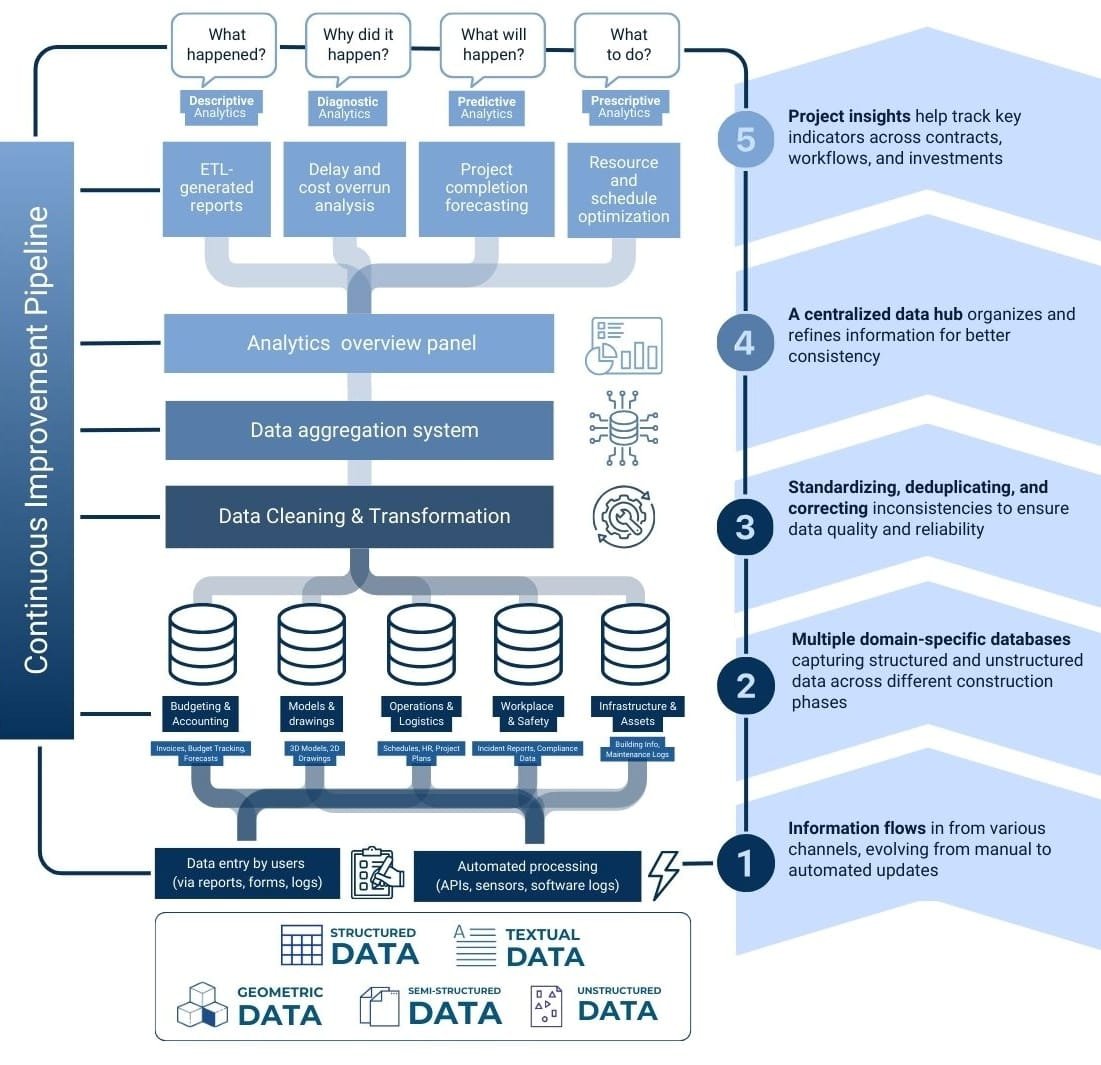
In later parts of the book, we will look in detail at how specialists interact with each other and how data becomes the basis for decision making, automation, and operational efficiency. Fig. 2.2-5 provides an example diagram showing the sequence of data processing steps in a data-centric approach. This diagram illustrates the Continuous Improvement Pipeline), parts of which will be discussed in detail later in the book.
.

Рисунок 17
Fig. 2.2-5 An example of a continuous data improvement pipeline: the flow of data processing and analysis in construction projects.

The system describing the business processes of a medium-sized company is built on a multi-level principle. It includes: data collection, cleaning, aggregation, analytical processing, and decision-making based on the results. We will study all these stages later in the book – both in a theoretical context and through practical examples:

At the first level, data entry takes place (Fig.‎ 3.1-1). Information is received both manually (through reports, forms, logs) and in an automated form (from API, sensors, software systems). Data can be of different structure: geometric, text, unstructured. At this stage there is a need for standardization, structuring and unification of information flows.

The next level is data processing and transformation. It includes the processes of cleaning, removing duplicates, correcting errors, and preparing information for further analysis (Fig. 4.2-5). This stage is critical because the quality of analytics directly depends on the cleanliness and accuracy of the data.

The data is then entered into specialized tables, dataframes or databases divided by functional areas: budgeting and accounting, models and drawings, logistics, security and infrastructure. This division allows for easy access and cross-analysis of information.

The data is then aggregated and displayed in an analytics dashboard (showcase). Here, the methods of descriptive, diagnostic, predictive and prescriptive analytics are applied. This helps answer key questions (Fig. 1.1-4): what happened, why it happened, what will happen in the future, and what actions need to be taken. For example, the system can identify delays, predict project completion, or optimize resources.

Finally, the last level generates analytical conclusions and key indicators that help to monitor contract fulfillment, manage investments and improve business processes (Fig.‎ 7.4-2). This information becomes the basis for decision-making and the company’s development strategy.

Similarly, data goes from being collected to being used in strategic management. In the following parts of the book, we will look at each stage in detail, focusing on data types, data processing techniques, analytics tools and real-life cases of how these approaches are used in the construction industry.

.

Leave a Reply

Change language

Post's Highlights

Stay updated: news and insights


We’re Here to Help

Fresh solutions are released through our social channels

UNLOCK THE POWER OF DATA
 IN CONSTRUCTION

Dive into the world of data-driven construction with this accessible guide, perfect for professionals and novices alike.
From the basics of data management to cutting-edge trends in digital transformation, this book
will be your comprehensive guide to using data in the construction industry.

Related posts 

Focus Areas

Search

Search
Sorry, no articles found.

✕

Don't miss the new solutions


✕
✕

Linux

macOS

Looking for the Linux or MAC version? Send us a quick message using the button below, and we’ll guide you through the process!

✕

📥 Download OnePager

Welcome to DataDrivenConstruction—where data meets innovation in the construction industry. Our One-Pager offers a concise overview of how our data-driven solutions can transform your projects, enhance efficiency, and drive sustainable growth. 

✕

🚀 Welcome to the future of data in construction!

You're taking your first step into the world of open data, working with normalized, structured data—the foundation of data analytics and modern automation tools.

By downloading, you agree to the DataDrivenConstruction terms of use 

Stay ahead with the latest updates on converters, tools, AI, LLM
and data analytics in construction — Subscribe now!

✕

🚀 Welcome to the future of data in construction!

You're taking your first step into the world of open data, working with normalized, structured data—the foundation of data analytics and modern automation tools.

By downloading, you agree to the DataDrivenConstruction terms of use 

Stay ahead with the latest updates on converters, tools, AI, LLM
and data analytics in construction — Subscribe now!

✕

🚀 Welcome to the future of data in construction!

You're taking your first step into the world of open data, working with normalized, structured data—the foundation of data analytics and modern automation tools.

By downloading, you agree to the DataDrivenConstruction terms of use 

Stay ahead with the latest updates on converters, tools, AI, LLM
and data analytics in construction — Subscribe now!

✕

🚀 Welcome to the future of data in construction!

You're taking your first step into the world of open data, working with normalized, structured data—the foundation of data analytics and modern automation tools.

By downloading, you agree to the DataDrivenConstruction terms of use 

Stay ahead with the latest updates on converters, tools, AI, LLM
and data analytics in construction — Subscribe now!

✕

🚀 Welcome to the future of data in construction!

You're taking your first step into the world of open data, working with normalized, structured data—the foundation of data analytics and modern automation tools.

By downloading, you agree to the DDC terms of use 

✕

🚀 Welcome to the future of data in construction!

You're taking your first step into the world of open data, working with normalized, structured data—the foundation of data analytics and modern automation tools.

By downloading, you agree to the DataDrivenConstruction terms of use 

Stay ahead with the latest updates on converters, tools, AI, LLM
and data analytics in construction — Subscribe now!

✕
DataDrivenConstruction offers workshops tested and practiced on global leaders in the construction industry to help your team navigate and leverage the power of data and artificial intelligence in your company's decision making.

Reserve your spot now to rethink your
approach to decision making!

✕


🚀 Welcome to the future of data in construction!

By downloading, you agree to the DataDrivenConstruction terms of use 

Stay ahead with the latest updates on converters, tools, AI, LLM
and data analytics in construction — Subscribe now!

✕
Have a question or need more information? Reach out to us directly!
Schedule a time to discuss your needs with our team.
Tailored sessions to help your team grow — let's plan together!
✕
Have you attended one of our workshops, read our book, or used our solutions? Share your thoughts with us!
Name
✕
Data Maturity Diagnostics

🧰 Data-Driven Readiness Check

This short assessment will help you identify your company's data management pain points and offer solutions to improve project efficiency. It takes only 1–2 minutes to complete and you will receive personalized recommendations tailored to your needs.

✕

Clean & Organized Data

Theoretical Chapters:

Practical Chapters:

What You'll Find on
DDC Solutions:

  • CAD/BIM to spreadsheet/database converters (Revit, AutoCAD, IFC, Microstation)
  • Ready-to-deploy n8n workflows for construction processes
  • ETL pipelines for data synchronization between systems
  • Customizable Python scripts for repetitive tasks
  • Intelligent data validation and error detection
  • Real-time dashboard connectors
  • Automated reporting systems
✕

Connect Everything

Theoretical Chapters:

Practical Chapters:

What You'll Find on
DDC Solutions:

  • CAD/BIM to spreadsheet/database converters (Revit, AutoCAD, IFC, Microstation)
  • Ready-to-deploy n8n workflows for construction processes
  • ETL pipelines for data synchronization between systems
  • Customizable Python scripts for repetitive tasks
  • Intelligent data validation and error detection
  • Real-time dashboard connectors
  • Automated reporting systems
✕

Add AI & LLM Brain

Theoretical Chapters:

Practical Chapters:

What You'll Find on
DDC Solutions:

  • CAD/BIM to spreadsheet/database converters (Revit, AutoCAD, IFC, Microstation)
  • Ready-to-deploy n8n workflows for construction processes
  • ETL pipelines for data synchronization between systems
  • Customizable Python scripts for repetitive tasks
  • Intelligent data validation and error detection
  • Real-time dashboard connectors
  • Automated reporting systems
022 From data collection to decision-making the road to automation
This website uses cookies to improve your experience. By using this website you agree to our Data Protection Policy.
Read more
×