
image105
058 Data standardization and integration
1 February 2025
Рисунок 1
060 A common language of construction the role of classifiers in digital transformation
3 February 2025

059 Digital interoperability starts with requirements

As the number of digital systems within companies grows, so does the need for data consistency between them. Managers responsible for different IT systems often find themselves unable to keep up with the increasing volume of information and the variety of formats. In such circumstances, they are forced to ask specialists to create data in a form suitable for use in other applications and platforms.

This, in turn, requires engineers and data generation staff to adapt to a multitude of requirements, often without transparency and a clear understanding of where and how the data will be applied in the future. The lack of standardized approaches to handling information leads to inefficiencies and increased costs during the verification phase, which is often manual due to the complexity and non-standardized nature of the data.

The issue of data standardization is not just a matter of convenience or automation. It is a direct financial loss. According to a 2016 IBM report, the annual loss from poor data quality in the US is $3.1 trillion (Harvard Business Review, “Bad Data Costs the U.S. $3 Trillion Per Year,” September 22, 2016). Additionally, studies by MIT and other analytical consulting firms show that the cost of poor data quality can be as high as 15-25% of a company’s revenue (Delpha, “Impacts of Data Quality,” 1 Jan. 2025).

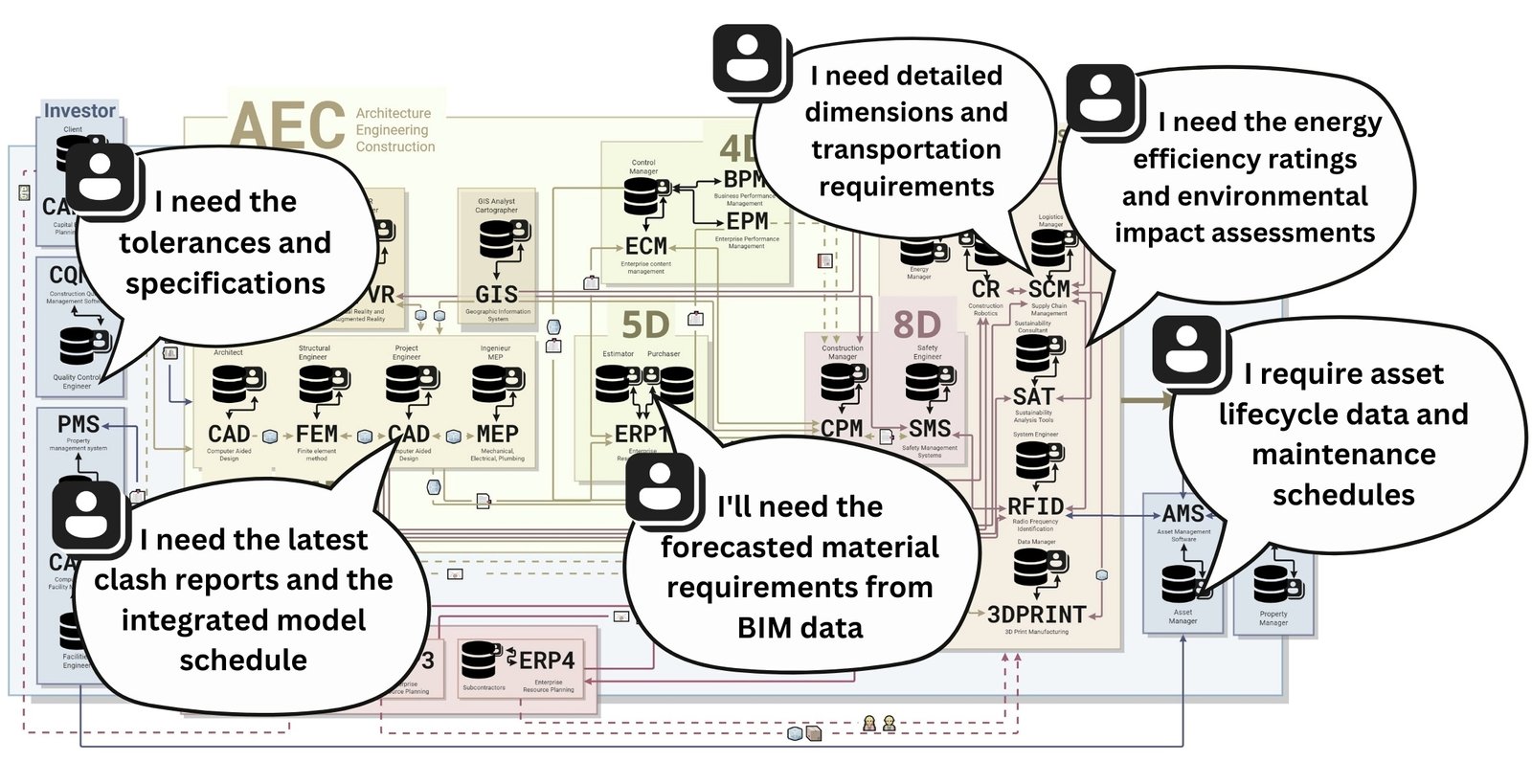
Under these conditions, it becomes critical to have clearly defined data requirements and descriptions of what parameters, in what format and with what level of detail should be included in the created objects. Without formalizing these requirements, it is impossible to guarantee the quality and compatibility of data between systems and project stages (Fig.‎ 4.2-4).

image86
Fig.‎ 4.2-4 Business is based on the interaction of different roles, each of which requires certain parameters and values that are critical to accomplishing business objectives.

In order to formulate the correct data requirements, you need to understand the business processes at the data level. Construction projects vary in type, scope, and number of participants, and each system – be it modeling (CAD (BIM)), scheduling (ERP 4D), costing (ERP 5D), or logistics (SCM) – requires its own unique parameters for inputs (input entity-elements).

Depending on these needs, business managers must either design new data structures to meet the requirements or adapt existing tables and databases. The quality of the data created will directly depend on how precisely and correctly the requirements are formulated (Fig.‎ 4.2-5).

.

image12
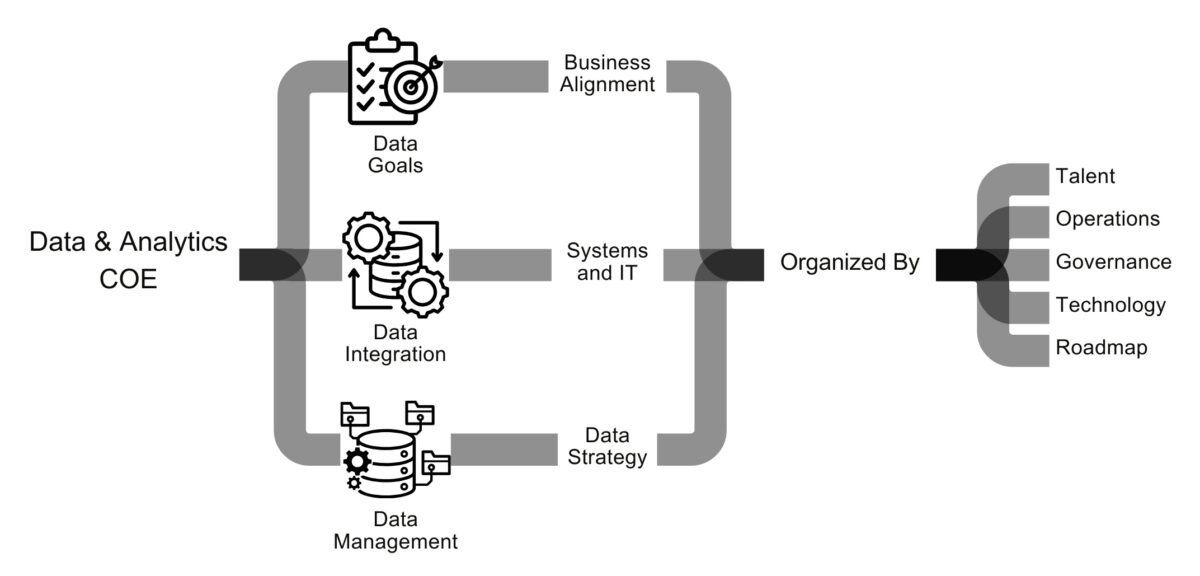
Fig. 4.2-5 Data quality depends on the quality of the requirements that are created for specific data use cases.

Since each system has its own specific data requirements, the first step in formulating general requirements should be to categorize all elements involved in business processes. This means the need to categorize objects into classes and groups of classes corresponding to specific systems or application tasks. For each such group, separate requirements for data structure, attributes and quality are developed.

In practice, however, the implementation of this approach faces a major challenge: the lack of a common language for grouping data. Disparate classifications, duplicate identifiers and incompatible formats result in each company, each software and even each project forming its own, isolated data models and classes. The result is a digital “Tower of Babel” where transferring information between systems requires multiple conversions to the right data models and classes, often done manually. This barrier can only be overcome by moving to universal classifiers and standardized sets of requirements.

.

Leave a Reply

Change language

Post's Highlights

Stay updated: news and insights


We’re Here to Help

Fresh solutions are released through our social channels

UNLOCK THE POWER OF DATA
 IN CONSTRUCTION

Dive into the world of data-driven construction with this accessible guide, perfect for professionals and novices alike.
From the basics of data management to cutting-edge trends in digital transformation, this book
will be your comprehensive guide to using data in the construction industry.

Related posts 

Focus Areas

Search

Search
Sorry, no articles found.

✕

Don't miss the new solutions


✕
✕

Linux

macOS

Looking for the Linux or MAC version? Send us a quick message using the button below, and we’ll guide you through the process!

✕

📥 Download OnePager

Welcome to DataDrivenConstruction—where data meets innovation in the construction industry. Our One-Pager offers a concise overview of how our data-driven solutions can transform your projects, enhance efficiency, and drive sustainable growth. 

✕

🚀 Welcome to the future of data in construction!

You're taking your first step into the world of open data, working with normalized, structured data—the foundation of data analytics and modern automation tools.

By downloading, you agree to the DataDrivenConstruction terms of use 

Stay ahead with the latest updates on converters, tools, AI, LLM
and data analytics in construction — Subscribe now!

✕

🚀 Welcome to the future of data in construction!

You're taking your first step into the world of open data, working with normalized, structured data—the foundation of data analytics and modern automation tools.

By downloading, you agree to the DataDrivenConstruction terms of use 

Stay ahead with the latest updates on converters, tools, AI, LLM
and data analytics in construction — Subscribe now!

✕

🚀 Welcome to the future of data in construction!

You're taking your first step into the world of open data, working with normalized, structured data—the foundation of data analytics and modern automation tools.

By downloading, you agree to the DataDrivenConstruction terms of use 

Stay ahead with the latest updates on converters, tools, AI, LLM
and data analytics in construction — Subscribe now!

✕

🚀 Welcome to the future of data in construction!

You're taking your first step into the world of open data, working with normalized, structured data—the foundation of data analytics and modern automation tools.

By downloading, you agree to the DataDrivenConstruction terms of use 

Stay ahead with the latest updates on converters, tools, AI, LLM
and data analytics in construction — Subscribe now!

✕

🚀 Welcome to the future of data in construction!

You're taking your first step into the world of open data, working with normalized, structured data—the foundation of data analytics and modern automation tools.

By downloading, you agree to the DDC terms of use 

✕

🚀 Welcome to the future of data in construction!

You're taking your first step into the world of open data, working with normalized, structured data—the foundation of data analytics and modern automation tools.

By downloading, you agree to the DataDrivenConstruction terms of use 

Stay ahead with the latest updates on converters, tools, AI, LLM
and data analytics in construction — Subscribe now!

✕
DataDrivenConstruction offers workshops tested and practiced on global leaders in the construction industry to help your team navigate and leverage the power of data and artificial intelligence in your company's decision making.

Reserve your spot now to rethink your
approach to decision making!

✕


🚀 Welcome to the future of data in construction!

By downloading, you agree to the DataDrivenConstruction terms of use 

Stay ahead with the latest updates on converters, tools, AI, LLM
and data analytics in construction — Subscribe now!

✕
Have a question or need more information? Reach out to us directly!
Schedule a time to discuss your needs with our team.
Tailored sessions to help your team grow — let's plan together!
✕
Have you attended one of our workshops, read our book, or used our solutions? Share your thoughts with us!
Name
✕
Data Maturity Diagnostics

🧰 Data-Driven Readiness Check

This short assessment will help you identify your company's data management pain points and offer solutions to improve project efficiency. It takes only 1–2 minutes to complete and you will receive personalized recommendations tailored to your needs.

✕

Clean & Organized Data

Theoretical Chapters:

Practical Chapters:

What You'll Find on
DDC Solutions:

  • CAD/BIM to spreadsheet/database converters (Revit, AutoCAD, IFC, Microstation)
  • Ready-to-deploy n8n workflows for construction processes
  • ETL pipelines for data synchronization between systems
  • Customizable Python scripts for repetitive tasks
  • Intelligent data validation and error detection
  • Real-time dashboard connectors
  • Automated reporting systems
✕

Connect Everything

Theoretical Chapters:

Practical Chapters:

What You'll Find on
DDC Solutions:

  • CAD/BIM to spreadsheet/database converters (Revit, AutoCAD, IFC, Microstation)
  • Ready-to-deploy n8n workflows for construction processes
  • ETL pipelines for data synchronization between systems
  • Customizable Python scripts for repetitive tasks
  • Intelligent data validation and error detection
  • Real-time dashboard connectors
  • Automated reporting systems
✕

Add AI & LLM Brain

Theoretical Chapters:

Practical Chapters:

What You'll Find on
DDC Solutions:

  • CAD/BIM to spreadsheet/database converters (Revit, AutoCAD, IFC, Microstation)
  • Ready-to-deploy n8n workflows for construction processes
  • ETL pipelines for data synchronization between systems
  • Customizable Python scripts for repetitive tasks
  • Intelligent data validation and error detection
  • Real-time dashboard connectors
  • Automated reporting systems
059 Digital interoperability starts with requirements
This website uses cookies to improve your experience. By using this website you agree to our Data Protection Policy.
Read more
×