image70
068 Structured Requirements and RegEx regular expressions
10 February 2025
image100
070 Verification of data and results of verification
13 February 2025

069 Data collection for the verification process

Before starting validation, it is important to make sure that the data are available in a form suitable for the validation process. This means not just having the information available, but preparing it: the data must be collected and transformed from unstructured, loosely structured, textual, and geometric formats into a structured form. This process is described in detail in the previous chapters, where methods for transforming different types of data were discussed. As a result of all transformations, the incoming data takes the form of open structured tables (Fig.‎ 4.1-2, Fig.‎ 4.1-9, Fig.‎ 4.1-13).

With the requirements and structured tables with the necessary parameters and boundary values (Fig.‎ 4.4-9), we can start validating the data – either as a single automated process (Pipeline) or as a step-by-step validation of each incoming document.

In order to start the check, it is required either to receive a new file as input or to fix the current state of the data – to create a snapshot or export current and incoming data, or to set up a connection to an external or internal database. In the example under consideration, such a snapshot is created by automatically converting CAD data from into a structured format recorded at, say, 23:00:00 on Friday, March 29, 2024, after all designers have gone home.
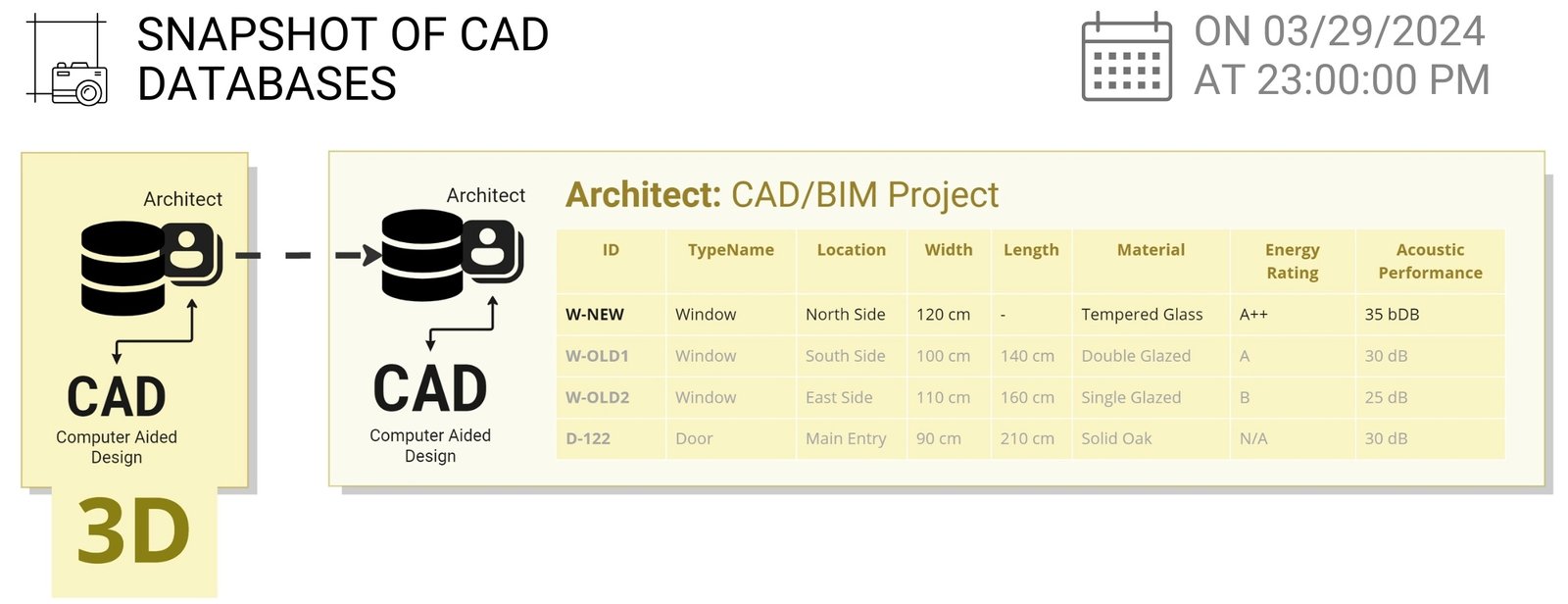
image177
Fig. 4.4-10 CAD database snapshot (BIM) showing the current attribute information for a new entity of class “Window” in the current version of the project model.

Thanks to the reverse engineering tools discussed in the chapter “Translating CAD data (BIM) into a structured form”, this information from different CAD (BIM) tools and editors can be organized into separate tables (Fig.‎ 4.4-11) or combined into one common table connecting different sections of the project (Fig.‎ 9.1-10).

Such table – database displays unique identifiers of windows and doors (ID attribute), type names (TypeName), dimensions (Width, Length), materials (Material), as well as indicators of energy and acoustic efficiency, and other characteristics. Such a table filled in CAD program (BIM) is collected by a design engineer from various departments and documents, forming an information model of the project.
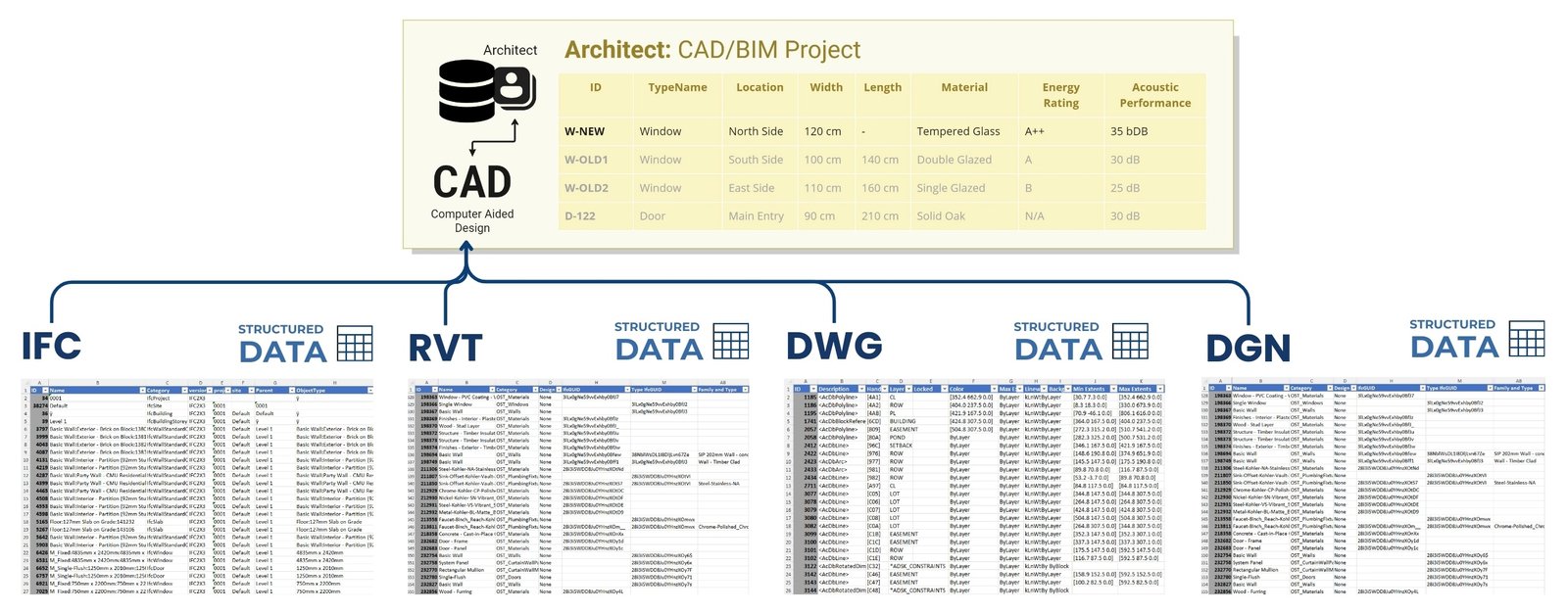
image106
Fig. 4.4-11 Structured data from CAD systems can be a two-dimensional table with columns denoting attributes of elements.

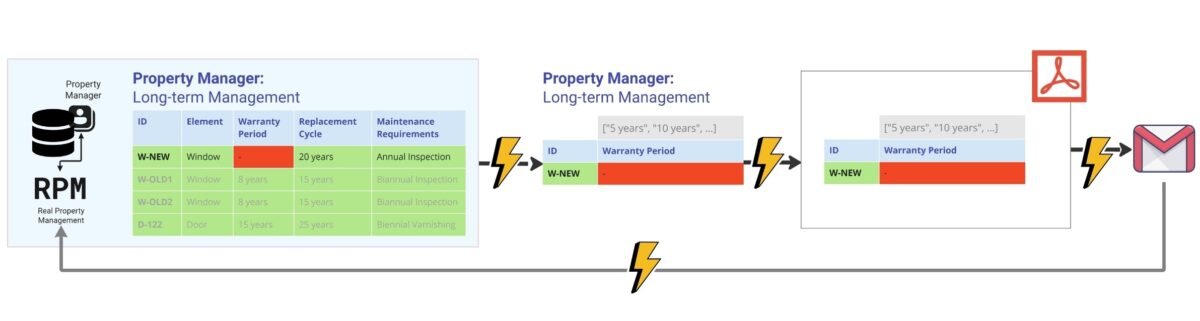
Real CAD (BIM) projects include tens or hundreds of thousands of elements (Fig.‎ 9.1-10). Elements within CAD formats are automatically categorized by type and category, from windows and doors to slabs, floors and walls. Unique identifiers (e.g., native ID, which is set automatically by the CAD solution) or type attributes (Type Name, Type, Family) allow the same object to be tracked in different systems. For example, a new window on the north wall of a building can be uniquely identified through a single ID “W-NEW” in all relevant systems of the organization.

While entity names and identifiers should be consistent across all systems, the set of attributes and values associated with these entities can vary significantly depending on the context of use. Architects, structural engineers, construction, logistics, and real estate operations professionals perceive the same elements in different ways. Each of them relies on their own classifiers, standards and objectives: some consider the window from a purely aesthetic point of view, evaluating its shape and proportions, while others consider it from an engineering or operational point of view, analyzing thermal conductivity, installation method, weight or maintenance requirements. Therefore, when modeling data and describing elements, it is important to take into account the versatility of their use and ensure consistency of data while taking into account industry specifics.

For each role in the company’s processes there are specialized databases with their own user interface – from design and calculations to logistics, installation and building operation (Fig.‎ 4.4-12). Each such system is managed by a professional team of specialists through a special user interface or through database queries, where the sum of all decisions made on the entered values at the end of the chain is followed by the system manager or department manager, who is responsible for the legal validity and quality of the entered data before their counterparties serving other systems.
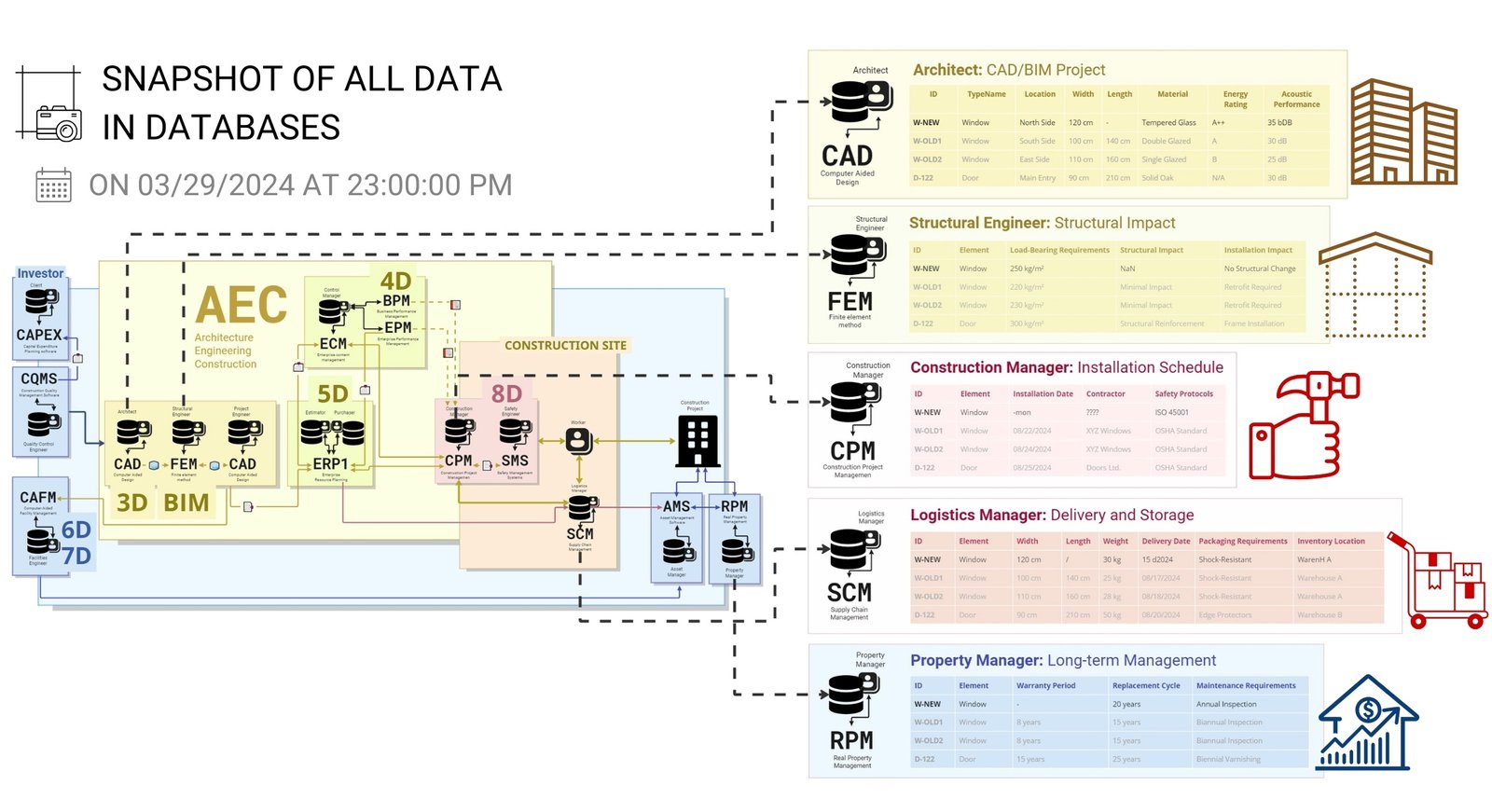
image134
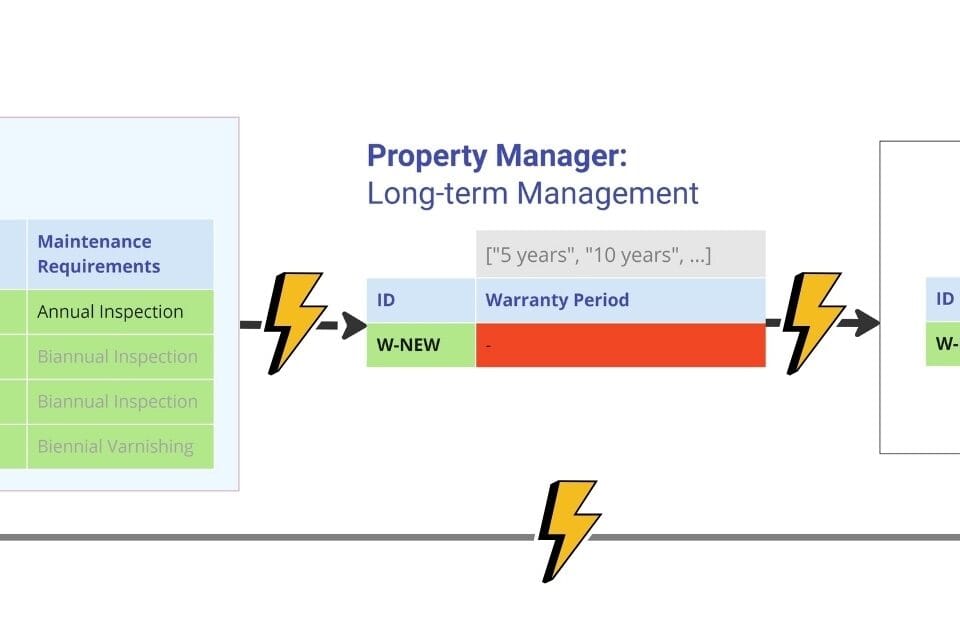
Fig. 4.4-12 The same entity has the same identifier in different systems, but different attributes that are important only in that system.

Once we have organized the collection of structured requirements and data at the logical and physical level, it remains for us to set up a process to automatically validate the data from different incoming documents and different systems against the previously collected requirements.

.

Leave a Reply

Change language

Post's Highlights

Stay updated: news and insights


We’re Here to Help

Fresh solutions are released through our social channels

UNLOCK THE POWER OF DATA
 IN CONSTRUCTION

Dive into the world of data-driven construction with this accessible guide, perfect for professionals and novices alike.
From the basics of data management to cutting-edge trends in digital transformation, this book
will be your comprehensive guide to using data in the construction industry.

Related posts 

Focus Areas

Sorry, no articles found.

✕

Don't miss the new solutions


✕
✕

Linux

macOS

Looking for the Linux or MAC version? Send us a quick message using the button below, and we’ll guide you through the process!

✕

📥 Download OnePager

Welcome to DataDrivenConstruction—where data meets innovation in the construction industry. Our One-Pager offers a concise overview of how our data-driven solutions can transform your projects, enhance efficiency, and drive sustainable growth. 

✕

🚀 Welcome to the future of data in construction!

You're taking your first step into the world of open data, working with normalized, structured data—the foundation of data analytics and modern automation tools.

By downloading, you agree to the DataDrivenConstruction terms of use 

Stay ahead with the latest updates on converters, tools, AI, LLM
and data analytics in construction — Subscribe now!

✕

🚀 Welcome to the future of data in construction!

You're taking your first step into the world of open data, working with normalized, structured data—the foundation of data analytics and modern automation tools.

By downloading, you agree to the DataDrivenConstruction terms of use 

Stay ahead with the latest updates on converters, tools, AI, LLM
and data analytics in construction — Subscribe now!

✕

🚀 Welcome to the future of data in construction!

You're taking your first step into the world of open data, working with normalized, structured data—the foundation of data analytics and modern automation tools.

By downloading, you agree to the DataDrivenConstruction terms of use 

Stay ahead with the latest updates on converters, tools, AI, LLM
and data analytics in construction — Subscribe now!

✕

🚀 Welcome to the future of data in construction!

You're taking your first step into the world of open data, working with normalized, structured data—the foundation of data analytics and modern automation tools.

By downloading, you agree to the DataDrivenConstruction terms of use 

Stay ahead with the latest updates on converters, tools, AI, LLM
and data analytics in construction — Subscribe now!

✕

🚀 Welcome to the future of data in construction!

You're taking your first step into the world of open data, working with normalized, structured data—the foundation of data analytics and modern automation tools.

By downloading, you agree to the DDC terms of use 

✕

🚀 Welcome to the future of data in construction!

You're taking your first step into the world of open data, working with normalized, structured data—the foundation of data analytics and modern automation tools.

By downloading, you agree to the DataDrivenConstruction terms of use 

Stay ahead with the latest updates on converters, tools, AI, LLM
and data analytics in construction — Subscribe now!

✕
DataDrivenConstruction offers workshops tested and practiced on global leaders in the construction industry to help your team navigate and leverage the power of data and artificial intelligence in your company's decision making.

Reserve your spot now to rethink your
approach to decision making!

✕


🚀 Welcome to the future of data in construction!

By downloading, you agree to the DataDrivenConstruction terms of use 

Stay ahead with the latest updates on converters, tools, AI, LLM
and data analytics in construction — Subscribe now!

✕
Have a question or need more information? Reach out to us directly!
Schedule a time to discuss your needs with our team.
Tailored sessions to help your team grow — let's plan together!
✕
Have you attended one of our workshops, read our book, or used our solutions? Share your thoughts with us!
Name
✕
Data Maturity Diagnostics

🧰 Data-Driven Readiness Check

This short assessment will help you identify your company's data management pain points and offer solutions to improve project efficiency. It takes only 1–2 minutes to complete and you will receive personalized recommendations tailored to your needs.

✕

Clean & Organized Data

Theoretical Chapters:

Practical Chapters:

What You'll Find on
DDC Solutions:

  • CAD/BIM to spreadsheet/database converters (Revit, AutoCAD, IFC, Microstation)
  • Ready-to-deploy n8n workflows for construction processes
  • ETL pipelines for data synchronization between systems
  • Customizable Python scripts for repetitive tasks
  • Intelligent data validation and error detection
  • Real-time dashboard connectors
  • Automated reporting systems
✕

Connect Everything

Theoretical Chapters:

Practical Chapters:

What You'll Find on
DDC Solutions:

  • CAD/BIM to spreadsheet/database converters (Revit, AutoCAD, IFC, Microstation)
  • Ready-to-deploy n8n workflows for construction processes
  • ETL pipelines for data synchronization between systems
  • Customizable Python scripts for repetitive tasks
  • Intelligent data validation and error detection
  • Real-time dashboard connectors
  • Automated reporting systems
✕

Add AI & LLM Brain

Theoretical Chapters:

Practical Chapters:

What You'll Find on
DDC Solutions:

  • CAD/BIM to spreadsheet/database converters (Revit, AutoCAD, IFC, Microstation)
  • Ready-to-deploy n8n workflows for construction processes
  • ETL pipelines for data synchronization between systems
  • Customizable Python scripts for repetitive tasks
  • Intelligent data validation and error detection
  • Real-time dashboard connectors
  • Automated reporting systems
069 Data collection for the verification process
This website uses cookies to improve your experience. By using this website you agree to our Data Protection Policy.
Read more
×