
Рисунок 1
134 Data atoms the foundation of effective information management
24 April 2025
Picture 4
136 Big Data Storage Analyzing Popular Formats and Their Effectiveness
27 April 2025

135 Information storage files or data

Data warehouses allow companies to collect and combine information from different systems, creating a single center for subsequent analytics. Collected historical data enables not only deeper analysis of processes, but also the identification of patterns that can affect business performance.

Let’s say a company is working on several projects at the same time. An engineer wants to understand how much concrete has been poured and how much is still to be purchased. In a traditional approach, he would have to manually search the server and open several estimate tables, compare them with the certificates of completed work and check the current stock balances. This takes hours, if not days. Even with ETL processes and automatic scripts, the task remains semi-manual: the engineer still has to manually specify the path to folders or specific files on the server. This reduces the overall effect of automation, as it continues to take up valuable work time.

When switching to data management, instead of working with the server file system, the engineer gets access to a unified storage structure where information is updated in real time. A single query – in the form of a code, SQL -query or even a call to an LLM -agent – can instantly provide accurate data on current balances, volumes of work performed and upcoming deliveries, if the data has been prepared in advance and combined in a data warehouse where there is no need to wander through folders, open dozens of files and manually compare values.

For a long time construction companies used PDF -documents, DWG -drawings, RVT -models and hundreds and thousands of Excel -tables and other disparate formats, which are stored in certain folders on the company’s servers, making it difficult to find information, check and analyze it. As a result, the files left after projects are completed are most often moved back to the server into archival storage folders, which are practically not used in the future. Such traditional file-based data storage loses relevance with increasing data flow due to its vulnerability to human error.

A file is just an isolated container in which data is stored. Files are created for people, not systems, so they require manual opening, reading and interpretation. An example would be an Excel -table, a PDF -document, or a CAD -drawing that needs to be specifically opened in a certain tool to access the desired information. Without structured retrieval and processing, the information in it remains unused.

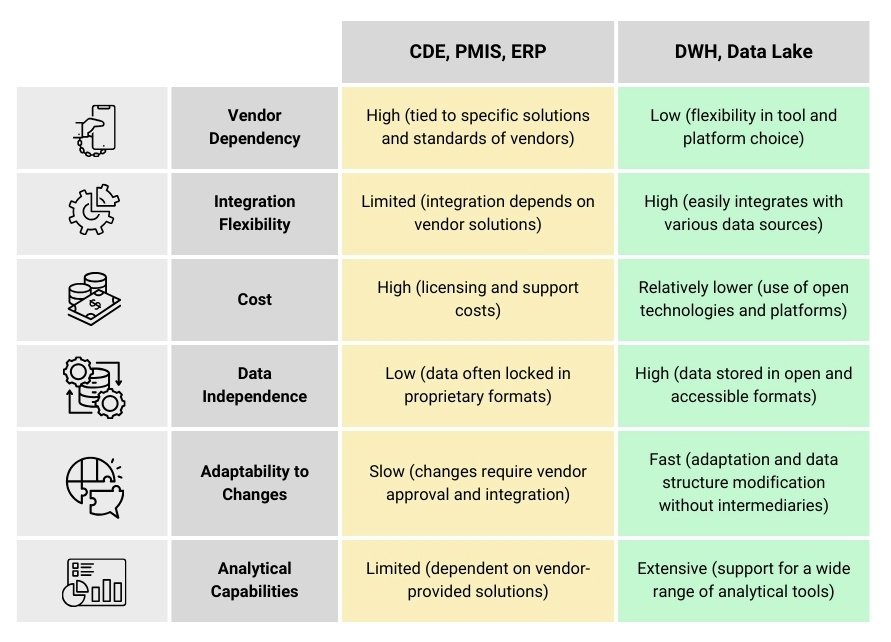
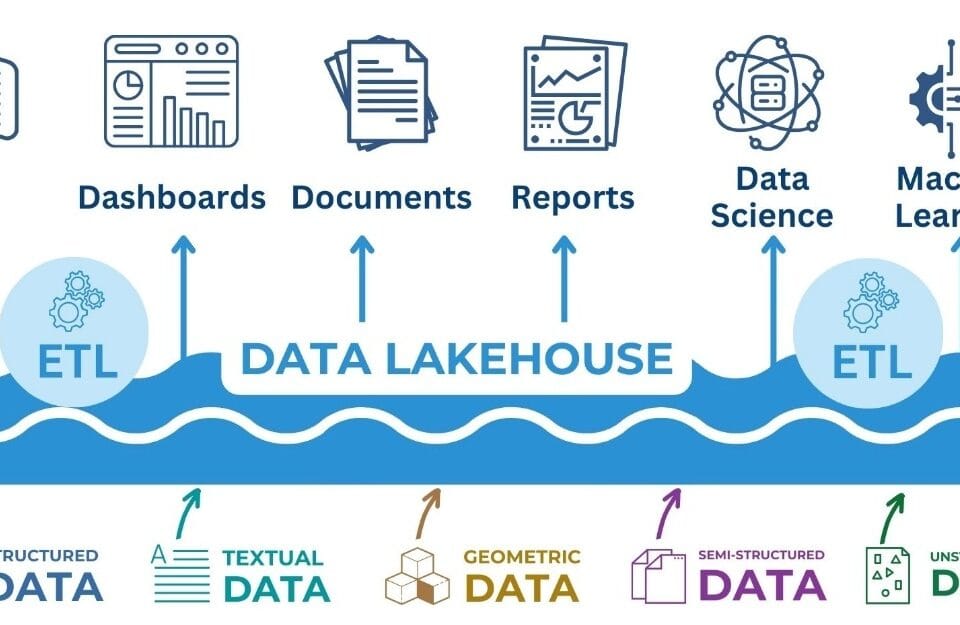
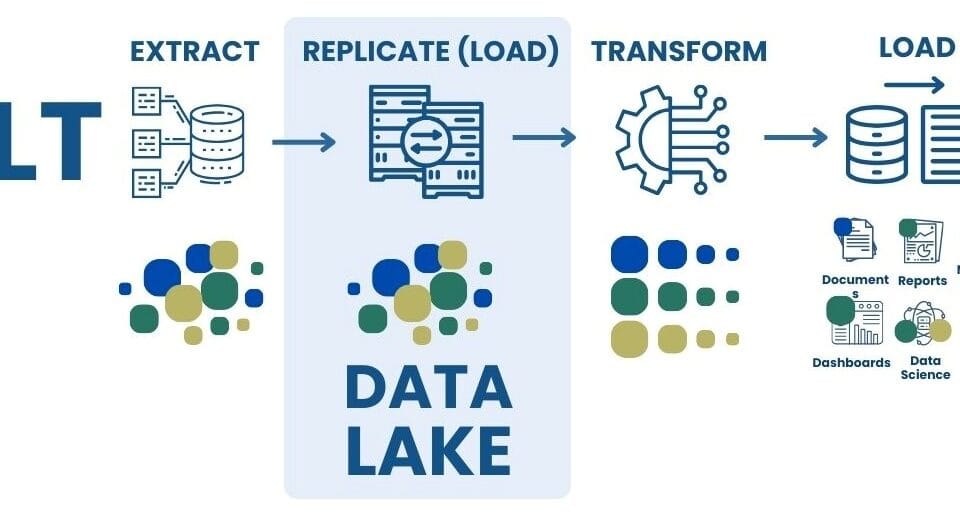
Data, in turn, is machine-readable information that is linked, updated, and analyzed automatically. In a single data warehouse (e.g., database, DWH or Data Lake), information is represented as tables, records, and relationships. This enables uniform storage, automated queries, value analysis, and real-time reporting.

Using data instead of files (Fig.‎ 8.1-1) makes it possible to eliminate the manual search process and unify processing. Companies that have already implemented such an approach gain a competitive advantage due to the speed of access to information and the ability to quickly integrate it into business processes.

The shift from file-based to data-driven is an inevitable change that will shape the future of the construction industry.

Every company in the construction industry will face a key choice: continue to store information in disparate files and silos that must be read by humans using special programs or transform it in the first stages of processing into structured data, creating a single integrated digital foundation for automated project management.
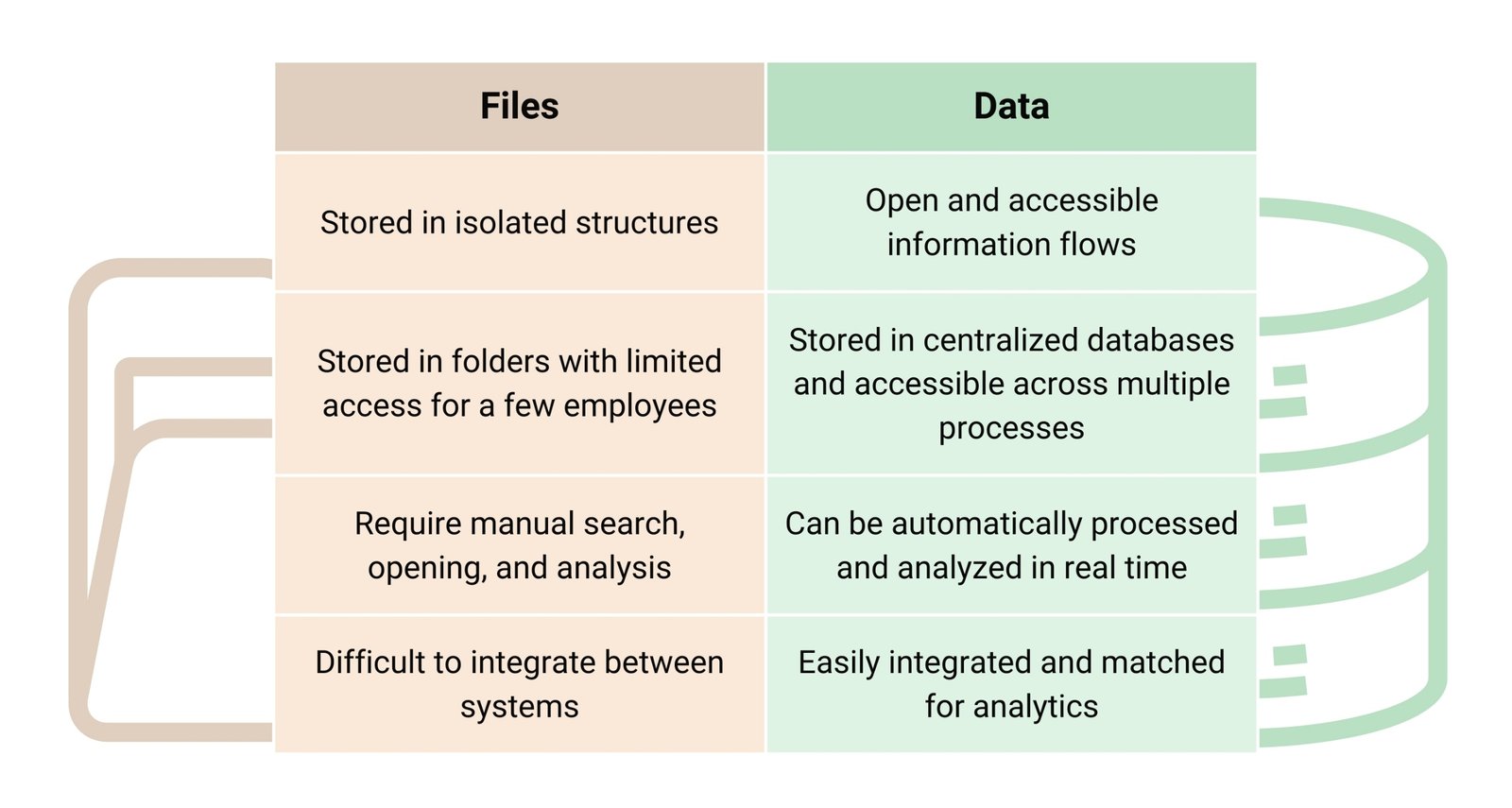
Рисунок 18
Fig. 8.1-1 Evolution of information flow: from isolated files to integrated data.

With the explosion of information, traditional methods of storing and processing files are becoming less and less efficient. In the construction industry, as in other sectors, it is no longer sufficient to rely on disparate file folders with different file formats or unconnected databases.

Companies seeking to remain competitive in the digital age will inevitably shift to integrated digital platforms, utilize big data technologies and automated analytics systems.

Moving from file storage to data will require a rethinking of information management approaches and a conscious choice of formats suitable for further integration into centralized repositories. This choice will determine how efficiently data can be processed, how quickly it can be accessed, and how easily it can be integrated into a company’s digital processes.

.

Leave a Reply

Change language

Post's Highlights

Stay updated: news and insights


We’re Here to Help

Fresh solutions are released through our social channels

UNLOCK THE POWER OF DATA
 IN CONSTRUCTION

Dive into the world of data-driven construction with this accessible guide, perfect for professionals and novices alike.
From the basics of data management to cutting-edge trends in digital transformation, this book
will be your comprehensive guide to using data in the construction industry.

Related posts 

Focus Areas

Sorry, no articles found.

✕

Don't miss the new solutions


✕
✕

Linux

macOS

Looking for the Linux or MAC version? Send us a quick message using the button below, and we’ll guide you through the process!

✕

📥 Download OnePager

Welcome to DataDrivenConstruction—where data meets innovation in the construction industry. Our One-Pager offers a concise overview of how our data-driven solutions can transform your projects, enhance efficiency, and drive sustainable growth. 

✕

🚀 Welcome to the future of data in construction!

You're taking your first step into the world of open data, working with normalized, structured data—the foundation of data analytics and modern automation tools.

By downloading, you agree to the DataDrivenConstruction terms of use 

Stay ahead with the latest updates on converters, tools, AI, LLM
and data analytics in construction — Subscribe now!

✕

🚀 Welcome to the future of data in construction!

You're taking your first step into the world of open data, working with normalized, structured data—the foundation of data analytics and modern automation tools.

By downloading, you agree to the DataDrivenConstruction terms of use 

Stay ahead with the latest updates on converters, tools, AI, LLM
and data analytics in construction — Subscribe now!

✕

🚀 Welcome to the future of data in construction!

You're taking your first step into the world of open data, working with normalized, structured data—the foundation of data analytics and modern automation tools.

By downloading, you agree to the DataDrivenConstruction terms of use 

Stay ahead with the latest updates on converters, tools, AI, LLM
and data analytics in construction — Subscribe now!

✕

🚀 Welcome to the future of data in construction!

You're taking your first step into the world of open data, working with normalized, structured data—the foundation of data analytics and modern automation tools.

By downloading, you agree to the DataDrivenConstruction terms of use 

Stay ahead with the latest updates on converters, tools, AI, LLM
and data analytics in construction — Subscribe now!

✕

🚀 Welcome to the future of data in construction!

You're taking your first step into the world of open data, working with normalized, structured data—the foundation of data analytics and modern automation tools.

By downloading, you agree to the DDC terms of use 

✕

🚀 Welcome to the future of data in construction!

You're taking your first step into the world of open data, working with normalized, structured data—the foundation of data analytics and modern automation tools.

By downloading, you agree to the DataDrivenConstruction terms of use 

Stay ahead with the latest updates on converters, tools, AI, LLM
and data analytics in construction — Subscribe now!

✕
DataDrivenConstruction offers workshops tested and practiced on global leaders in the construction industry to help your team navigate and leverage the power of data and artificial intelligence in your company's decision making.

Reserve your spot now to rethink your
approach to decision making!

✕


🚀 Welcome to the future of data in construction!

By downloading, you agree to the DataDrivenConstruction terms of use 

Stay ahead with the latest updates on converters, tools, AI, LLM
and data analytics in construction — Subscribe now!

✕
Have a question or need more information? Reach out to us directly!
Schedule a time to discuss your needs with our team.
Tailored sessions to help your team grow — let's plan together!
✕
Have you attended one of our workshops, read our book, or used our solutions? Share your thoughts with us!
Name
✕
Data Maturity Diagnostics

🧰 Data-Driven Readiness Check

This short assessment will help you identify your company's data management pain points and offer solutions to improve project efficiency. It takes only 1–2 minutes to complete and you will receive personalized recommendations tailored to your needs.

✕

Clean & Organized Data

Theoretical Chapters:

Practical Chapters:

What You'll Find on
DDC Solutions:

  • CAD/BIM to spreadsheet/database converters (Revit, AutoCAD, IFC, Microstation)
  • Ready-to-deploy n8n workflows for construction processes
  • ETL pipelines for data synchronization between systems
  • Customizable Python scripts for repetitive tasks
  • Intelligent data validation and error detection
  • Real-time dashboard connectors
  • Automated reporting systems
✕

Connect Everything

Theoretical Chapters:

Practical Chapters:

What You'll Find on
DDC Solutions:

  • CAD/BIM to spreadsheet/database converters (Revit, AutoCAD, IFC, Microstation)
  • Ready-to-deploy n8n workflows for construction processes
  • ETL pipelines for data synchronization between systems
  • Customizable Python scripts for repetitive tasks
  • Intelligent data validation and error detection
  • Real-time dashboard connectors
  • Automated reporting systems
✕

Add AI & LLM Brain

Theoretical Chapters:

Practical Chapters:

What You'll Find on
DDC Solutions:

  • CAD/BIM to spreadsheet/database converters (Revit, AutoCAD, IFC, Microstation)
  • Ready-to-deploy n8n workflows for construction processes
  • ETL pipelines for data synchronization between systems
  • Customizable Python scripts for repetitive tasks
  • Intelligent data validation and error detection
  • Real-time dashboard connectors
  • Automated reporting systems
135 Information storage files or data
This website uses cookies to improve your experience. By using this website you agree to our Data Protection Policy.
Read more
×