
Data quality verification was always the bottleneck in CAD-BIM.
Not modeling. Not even standards. The real problem was checking.
Verifying the compliance of thousands of elements with hundreds of requirements — and then generating a clear PDF report that the project team can actually understand. This is exactly what used to take weeks of work time for specialists on each project.
An AI agent doesn’t have these problems. The era of manual verification is over.
What I Did
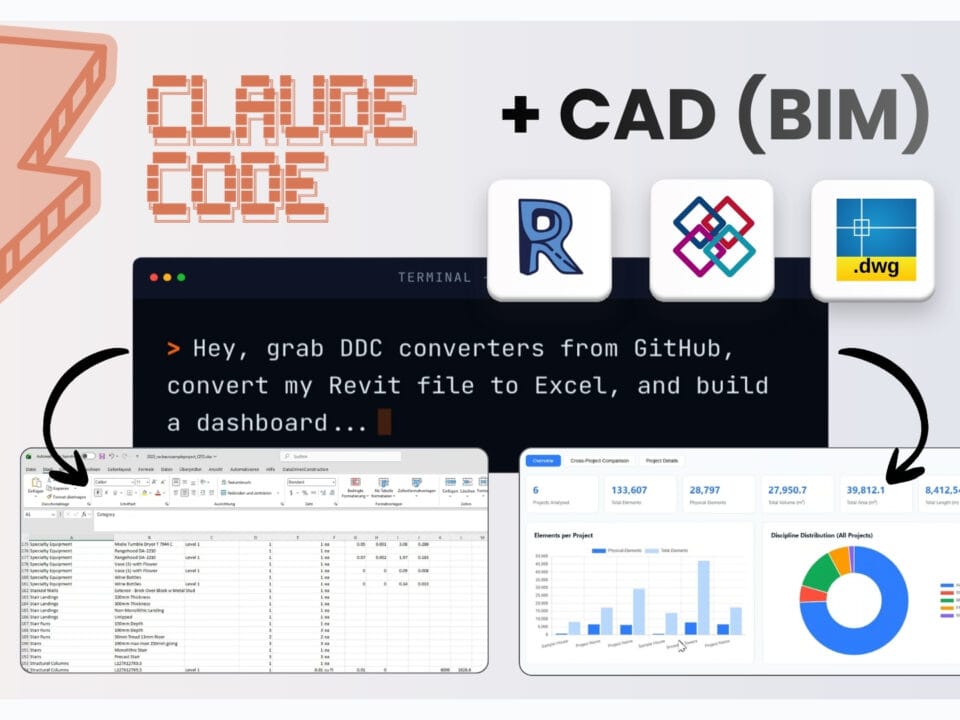
I gave an AI coding agent (Claude Code) 15 requirement files written in 8 different formats and asked it to validate different CAD-BIM models against all of them.
Solibri Configs
BEP
Excel Matrices
Classification Tables
Custom Rules
PDF Standards
JSON Schemas
One prompt. The agent parsed every format, extracted the rules, validated every element across 4 CAD-BIM models (Revit and IFC), and generated structured compliance reports.
Identical results regardless of input format.
Why It Works
Because once you strip away the packaging, every single requirement asks the same three questions:
Column 1
What entity?
Column 2
Which attribute?
Column 3
What constraint?
That’s it. Three columns. The AI agent sees this pattern instantly — and runs checks at a scale no human team can match.
The Core Insight
The verification bottleneck was never a technology problem. It was a format problem. And AI agents don’t care about formats. They care about structure. And the structure was always the same.
Your Data Is a Database
Your Revit project is a database. Your IFC file is a database.
You can extract it. Legally. Through reverse engineering: I’ve done it with Revit (.rvt), IFC, DWG, and DGN. The data is always there. The vendors just don’t want you to think of it that way.
- 📊 Your cost estimate — a database
- 📅 Your schedule — a database
- 📑 Your classification system — a database
- 📋 Your requirements — a table with three columns
Now imagine how easy it is to query a database using a table with three columns.
Once you start treating construction data as databases (dataframes and tables), you no longer need proprietary tools to verify and process them.
The industry doesn’t need more standards and formats. It needs to recognize that all its data already shares the same structure.
Learn More
More on this approach — and why construction data is simpler than we’ve been told — in the book Data-Driven Construction.