RAG and ETL working with CAD/BIM projects in 2025
28 January 2025
Рисунок 1
056 CAD solution vendors move to structured data
30 January 2025

055 Translation of CAD data (BIM) into a structured form

Structuring and categorizing CAD data (BIM) is more challenging because data stored from CAD (BIM) databases are almost always in closed or complex parametric formats, often combining geometric data elements (semi-structured) and metainformation elements (semi-structured or structured data) simultaneously.

Native data formats in CAD (BIM) systems are usually protected and inaccessible for direct use, unless specialized software or API – interfaces of the developer himself (Fig.‎ 4.1-10). Such data isolation forms closed storage silos that limit the free exchange of information and inhibit the creation of end-to-end digital processes in the company.
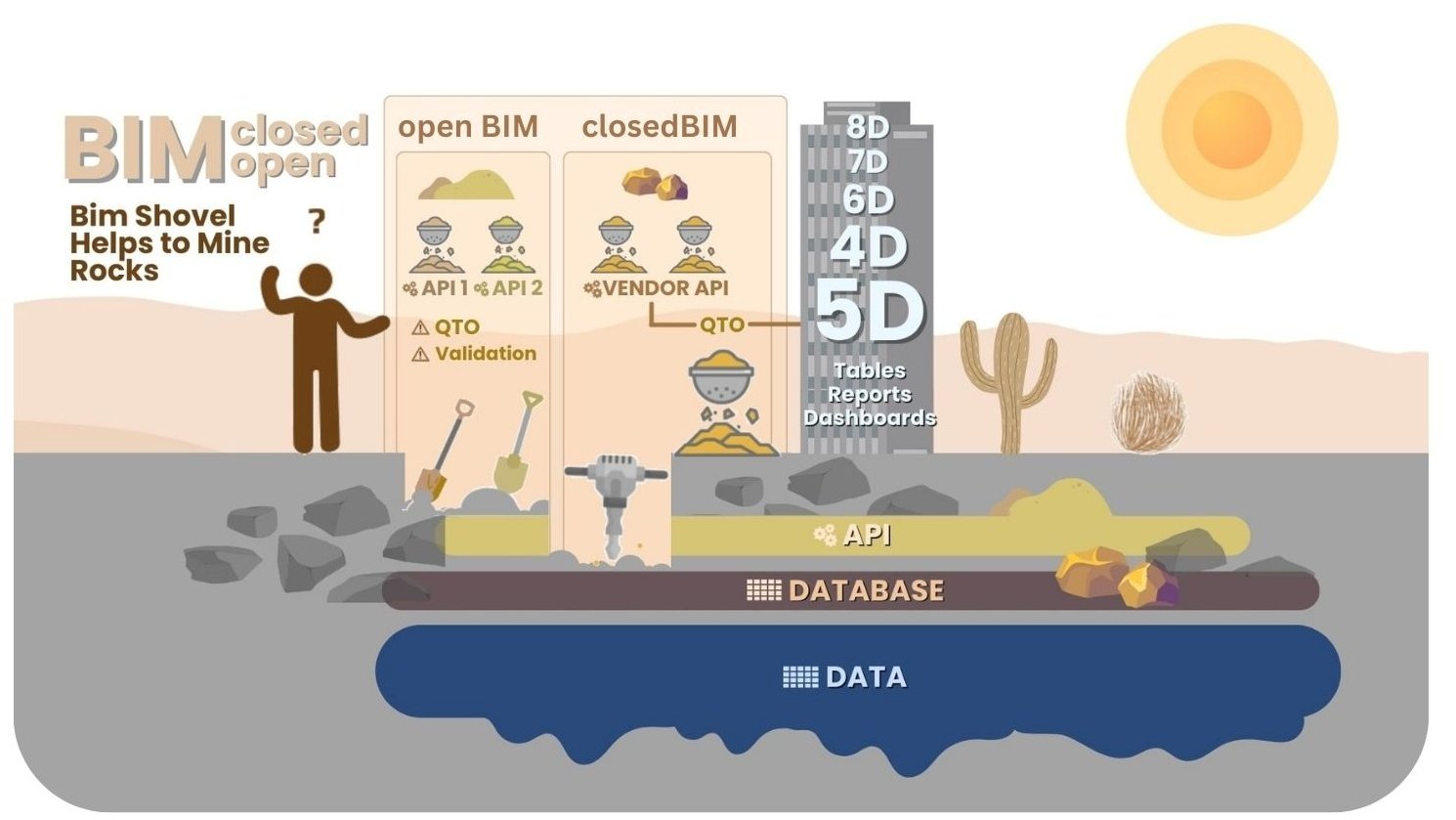
image150
Fig. 4.1-10 CAD professionals (BIM) can access native data through API -connections or vendor tools.

In special CAD (BIM) formats, information about the characteristics and attributes of project elements is collected in a hierarchical classification system, where entities with corresponding properties are located, like the fruit of a fruit tree, in the most recent nodes of the data classification branches (Fig.‎ 4.1-11).

Data extraction from such hierarchies is possible in two ways: either manually, by clicking on each node, as if processing a tree, cutting down selected branches of categories and types with an axe. An alternative option – the use of program interfaces (APIs) – implies a more efficient, automated approach to data retrieval and grouping, eventually transforming it into a structured table for use in other systems.

Different tools such as Dynamo, pyRvt, Pandamo (Pandas + Dynamo), ACC, or open source solutions, such as IfcOpSh or IFCjs for IFC format, can be used to extract structured data tables from CAD (BIM) projects.

Modern data export and conversion tools allow to simplify data processing and preparation by dividing the content of CAD models into two key components: geometry information and attribute data (Fig.‎ 4.1-13) – meta-information describing the properties of design elements (Fig.‎ 3.1-16). These two layers of data remain linked through unique identifiers, thanks to which it is possible to precisely map each element with geometry description (via parameters or polygons) to its attributes: name, material, stage of completion, cost, and so on. This approach ensures the integrity of the model and allows flexible use of data both for visualization (geometric model data) and for analytical or management tasks (structured or loosely structured), working with the two types of data separately or in parallel.
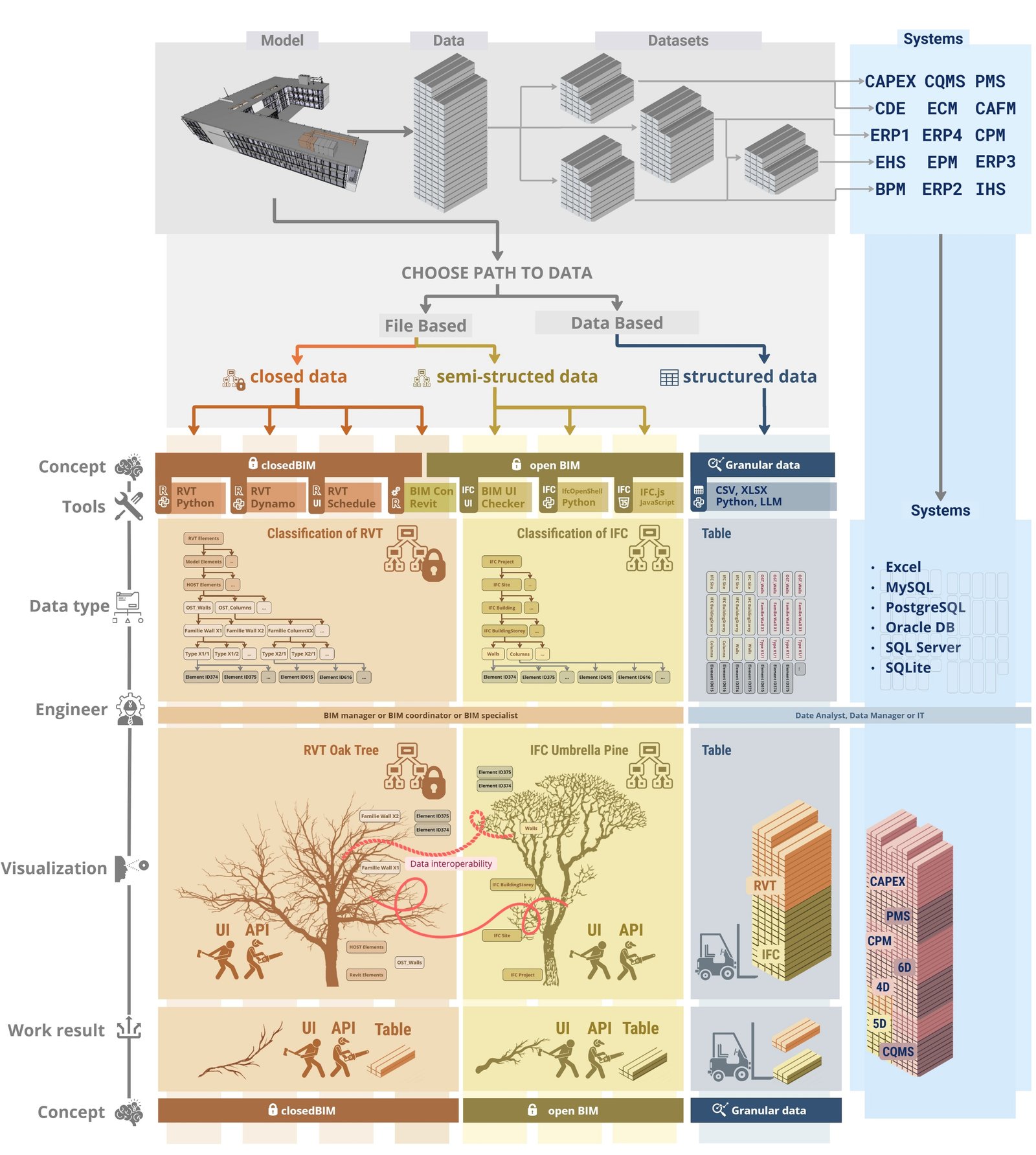
image87
Fig. 4.1-11 The view of information from CAD databases (BIM) is presented to the user in the form of classification trees.

With the development of reverse engineering technologies and the advent of software development kits SDK (Software Development Kit) for CAD data conversion – availability and conversion of data from closed CAD program formats (BIM) has become much easier. It is now possible to legally and safely convert data from closed formats into universal formats suitable for analysis and use in other systems. The history of the first reverse engineering tools (“Open DWG”) and the struggle for dominance over CAD vendors’ formats was discussed in the chapter “Structured data: the foundation of digital transformation”.

Reverse engineering tools allow legitimate retrieval of data from closed proprietary formats, breaking down information from the mixed CAD (BIM) format into the data types and formats required by the user, making it easier to process and analyze.

Using reverse engineering and direct access to information from CAD databases makes information accessible, allowing open data and open tools, as well as analyzing data with standard tools, building reports, visualizations, and integrating with other digital systems (Fig.‎ 4.1-12).

image20
Fig.‎ 4.1-12 Direct access to CAD data minimizes dependencies on software platforms and moves to a data-centric approach.

Since 1996 for DWG format, since 2008 for DGN format and since 2018 for RVT it has been possible to convert initially closed CAD data formats into any other formats, including structured formats, conveniently and efficiently with the help of reverse engineering tools (Fig.‎ 4.1-13). Today, almost all major CAD (BIM) and large engineering companies in the world use SDKs – reverse engineering tools to extract data from closed CAD (BIM) vendor formats (“Members: Founders and corporate members,” 2024).
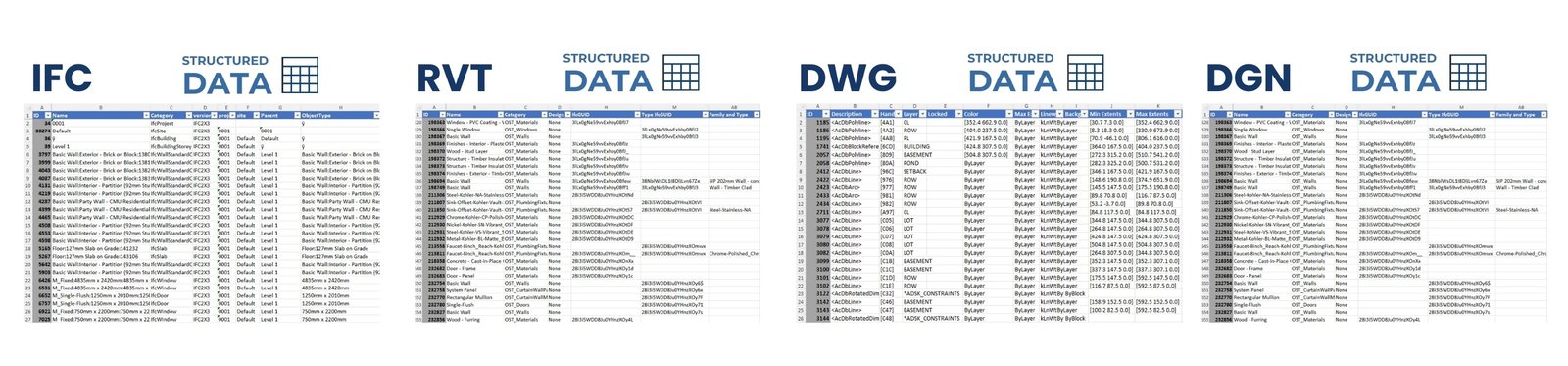
image156
Fig.‎ 4.1-13 Using reverse engineering tools allows you to convert CAD (BIM) program databases into any convenient data model.

Converting data from closed, proprietary formats to open formats and separating mixed CAD (BIM) formats into geometric and meta-information attribute data simplifies the process of working with it, making it available for analysis, manipulation, and integration with other systems (Fig. 4.1-14).

In today’s work with CAD data (BIM), we have reached the point where you don’t need to request permission from CAD (BIM) vendors to access information from CAD formats.
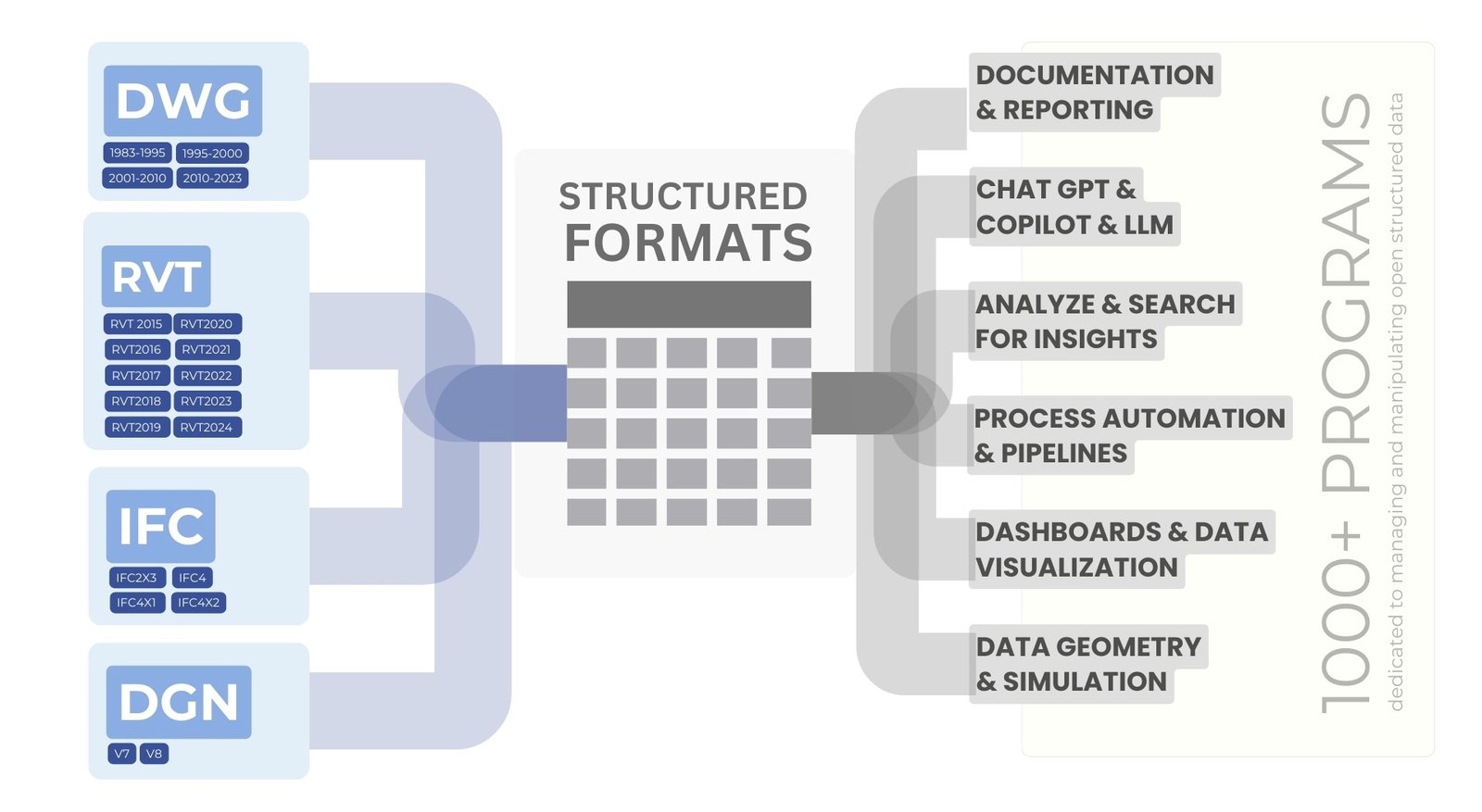
image162
Fig.‎ 4.1-14 Modern SDK tools allow legal conversion of data from proprietary CAD database formats (BIM).

Current trends in CAD design data processing continue to be shaped by key market players – CAD – vendors who are working to strengthen their position in the data world and create new formats and concepts.

.

Leave a Reply

Change language

Post's Highlights

Stay updated: news and insights


We’re Here to Help

Fresh solutions are released through our social channels

UNLOCK THE POWER OF DATA
 IN CONSTRUCTION

Dive into the world of data-driven construction with this accessible guide, perfect for professionals and novices alike.
From the basics of data management to cutting-edge trends in digital transformation, this book
will be your comprehensive guide to using data in the construction industry.

Related posts 

Focus Areas

Search

Search
Sorry, no articles found.

✕

Don't miss the new solutions


✕
✕

Linux

macOS

Looking for the Linux or MAC version? Send us a quick message using the button below, and we’ll guide you through the process!

✕

📥 Download OnePager

Welcome to DataDrivenConstruction—where data meets innovation in the construction industry. Our One-Pager offers a concise overview of how our data-driven solutions can transform your projects, enhance efficiency, and drive sustainable growth. 

✕

🚀 Welcome to the future of data in construction!

You're taking your first step into the world of open data, working with normalized, structured data—the foundation of data analytics and modern automation tools.

By downloading, you agree to the DataDrivenConstruction terms of use 

Stay ahead with the latest updates on converters, tools, AI, LLM
and data analytics in construction — Subscribe now!

✕

🚀 Welcome to the future of data in construction!

You're taking your first step into the world of open data, working with normalized, structured data—the foundation of data analytics and modern automation tools.

By downloading, you agree to the DataDrivenConstruction terms of use 

Stay ahead with the latest updates on converters, tools, AI, LLM
and data analytics in construction — Subscribe now!

✕

🚀 Welcome to the future of data in construction!

You're taking your first step into the world of open data, working with normalized, structured data—the foundation of data analytics and modern automation tools.

By downloading, you agree to the DataDrivenConstruction terms of use 

Stay ahead with the latest updates on converters, tools, AI, LLM
and data analytics in construction — Subscribe now!

✕

🚀 Welcome to the future of data in construction!

You're taking your first step into the world of open data, working with normalized, structured data—the foundation of data analytics and modern automation tools.

By downloading, you agree to the DataDrivenConstruction terms of use 

Stay ahead with the latest updates on converters, tools, AI, LLM
and data analytics in construction — Subscribe now!

✕

🚀 Welcome to the future of data in construction!

You're taking your first step into the world of open data, working with normalized, structured data—the foundation of data analytics and modern automation tools.

By downloading, you agree to the DDC terms of use 

✕

🚀 Welcome to the future of data in construction!

You're taking your first step into the world of open data, working with normalized, structured data—the foundation of data analytics and modern automation tools.

By downloading, you agree to the DataDrivenConstruction terms of use 

Stay ahead with the latest updates on converters, tools, AI, LLM
and data analytics in construction — Subscribe now!

✕
DataDrivenConstruction offers workshops tested and practiced on global leaders in the construction industry to help your team navigate and leverage the power of data and artificial intelligence in your company's decision making.

Reserve your spot now to rethink your
approach to decision making!

✕


🚀 Welcome to the future of data in construction!

By downloading, you agree to the DataDrivenConstruction terms of use 

Stay ahead with the latest updates on converters, tools, AI, LLM
and data analytics in construction — Subscribe now!

✕
Have a question or need more information? Reach out to us directly!
Schedule a time to discuss your needs with our team.
Tailored sessions to help your team grow — let's plan together!
✕
Have you attended one of our workshops, read our book, or used our solutions? Share your thoughts with us!
Name
✕
Data Maturity Diagnostics

🧰 Data-Driven Readiness Check

This short assessment will help you identify your company's data management pain points and offer solutions to improve project efficiency. It takes only 1–2 minutes to complete and you will receive personalized recommendations tailored to your needs.

✕

Clean & Organized Data

Theoretical Chapters:

Practical Chapters:

What You'll Find on
DDC Solutions:

  • CAD/BIM to spreadsheet/database converters (Revit, AutoCAD, IFC, Microstation)
  • Ready-to-deploy n8n workflows for construction processes
  • ETL pipelines for data synchronization between systems
  • Customizable Python scripts for repetitive tasks
  • Intelligent data validation and error detection
  • Real-time dashboard connectors
  • Automated reporting systems
✕

Connect Everything

Theoretical Chapters:

Practical Chapters:

What You'll Find on
DDC Solutions:

  • CAD/BIM to spreadsheet/database converters (Revit, AutoCAD, IFC, Microstation)
  • Ready-to-deploy n8n workflows for construction processes
  • ETL pipelines for data synchronization between systems
  • Customizable Python scripts for repetitive tasks
  • Intelligent data validation and error detection
  • Real-time dashboard connectors
  • Automated reporting systems
✕

Add AI & LLM Brain

Theoretical Chapters:

Practical Chapters:

What You'll Find on
DDC Solutions:

  • CAD/BIM to spreadsheet/database converters (Revit, AutoCAD, IFC, Microstation)
  • Ready-to-deploy n8n workflows for construction processes
  • ETL pipelines for data synchronization between systems
  • Customizable Python scripts for repetitive tasks
  • Intelligent data validation and error detection
  • Real-time dashboard connectors
  • Automated reporting systems
055 Translation of CAD data (BIM) into a structured form
This website uses cookies to improve your experience. By using this website you agree to our Data Protection Policy.
Read more
×