image150
055 Translation of CAD data (BIM) into a structured form
29 January 2025
Picture 1
057 Speed of decision making depends on data quality
31 January 2025

056 CAD solution vendors move to structured data

From 2024, the design and construction industry is undergoing a significant technological shift in the use and processing of data. Instead of free access to design data, CAD -system vendors are focusing on promoting the next new concepts. Approaches such as BIM (created in 2002) and open BIM (created in 2012) are gradually giving way to modern technological solutions that CAD vendors are starting to promote (А. Boiko, “The Age of Change: IFC is a thing of the past or why ADSK and other CAD vendors are willing to give up IFC for USD in 14 key facts,” 24 November 2024):

  • Moving to the use of “granular” data that allows for efficient information management and a shift to data analytics
  • Emergence of USD format and implementation of Entity-component-system approach (ECS) for flexible data organization
  • Active use of artificial intelligence in data processing, process automation and data analytics
  • Developing interoperability – improved interaction between different programs, systems and databases

Each of these aspects will be discussed in more detail in the sixth part of the book “CAD and BIM: marketing, reality and the future of design data in construction”. Within this chapter we will only briefly outline the general vector of change: the largest CAD vendors are now striving to rethink the way design information is structured. One of the key shifts is the rejection of the classic file-based storage model in favor of a granular, analytics-oriented data architecture that provides continuous access to individual components of the model (А. Boiko, “The Age of Change: IFC is a thing of the past or why ADSK and other CAD vendors are willing to give up IFC for USD in 14 key facts,” 24 November 2024).

The essence of what is happening is that the industry is phasing out cumbersome, specialized and parametric formats that require geometric kernels in favor of more universal, machine-readable and flexible solutions.

One such driver of change is the USD (Universal Scene Description) format, originally developed in the computer graphics industry, but already recognized in engineering applications thanks to the development of the NVIDIA Omniverse (and Isaac Sim) platform for simulations and visualizations (А. Boiko, “The Age of Change: IFC is a thing of the past or why ADSK and other CAD vendors are willing to give up IFC for USD in 14 key facts,” 24 November 2024). Unlike the parametric IFC, USD offers a simpler structure and allows describing geometry and object properties in JSON format (Fig.‎ 4.1-15), which facilitates information processing and speeds up its integration into digital processes. The new format allows storing geometry (in addition to BREP -NURBS – more details in Part 6 of the book) in the form of MESH polygons, and object properties in JSON, which makes it more convenient for automated processes and work in cloud ecosystems (А. Boiko, “The post-BIM world. Transition to data and processes and whether the construction industry needs semantics, formats and interoperability,” December 20, 2024).

Some CAD and ERP vendors already use similar formats (e.g. NWD, SVF, CP2, CPIXML), but most of them remain closed and unavailable for external use, which limits the possibilities of data integration and reuse. In this context, USD can play the same role as DXF did in its time as an open alternative to proprietary formats like DWG.
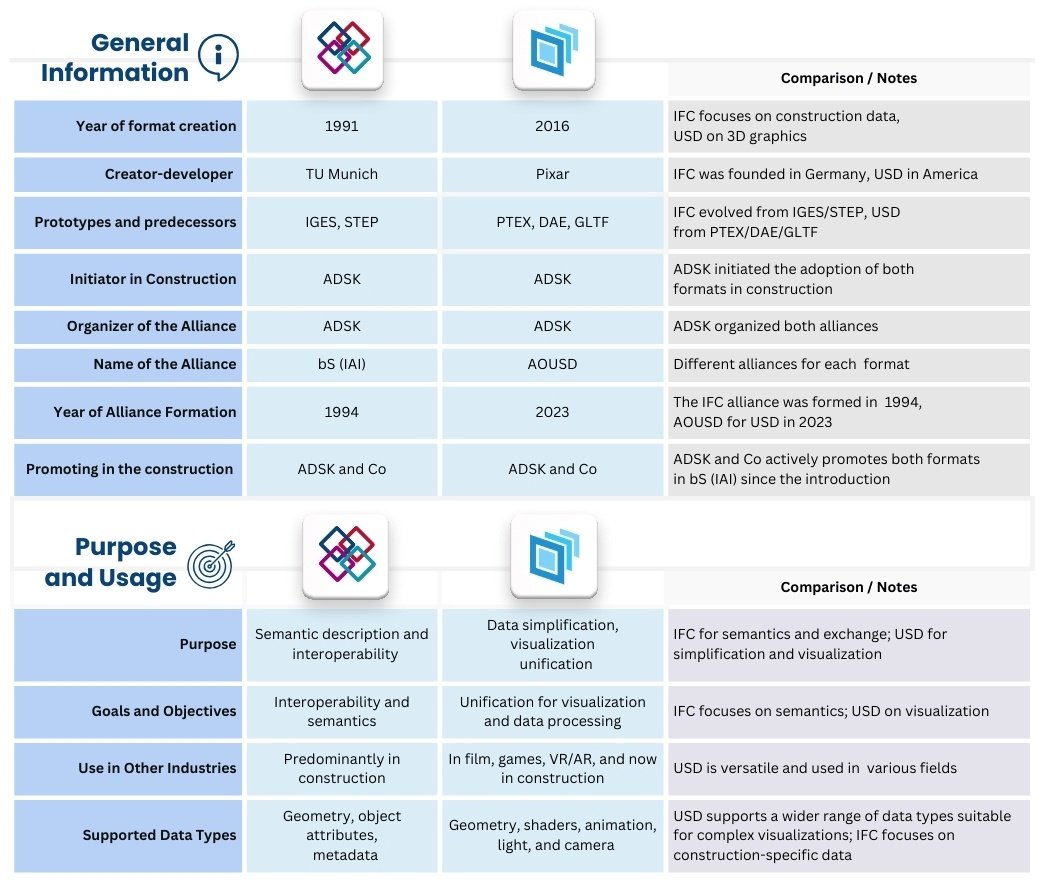
Рисунок 1
Fig.‎ 4.1-15 USD format as an attempt by CAD vendors to meet the demand for interoperability and independence of design data from geometry kernels.

The transition of major developers to open and simplified USD, GLTF, OBJ, XML (closed NWD, CP2, SVF, SVF2, CPIXML) and similar formats (Fig.‎ 3.1-17) reflects the global trend and industry demand for data simplification and increased accessibility. In the coming years, we can expect a gradual move away from complex parametric standards and formats with dependence on geometric kernels in favor of lighter and more structured solutions. This transition will accelerate the digitalization of the construction industry, facilitate process automation and simplify data exchange.

Despite the strategic plans of CAD -vendors to promote new open formats, construction industry professionals can also fully access data from closed CAD systems, without the need for CAD (BIM) tools, by using reverse engineering tools.

All these trends inevitably lead to a shift from bulky, monolithic 3D models to universal, structured data and to the use of formats that have long been proven in other industries. Once project teams begin to see CAD models not just as visual objects or a set of files, but as databases containing knowledge and information, the approach to design and management changes dramatically.

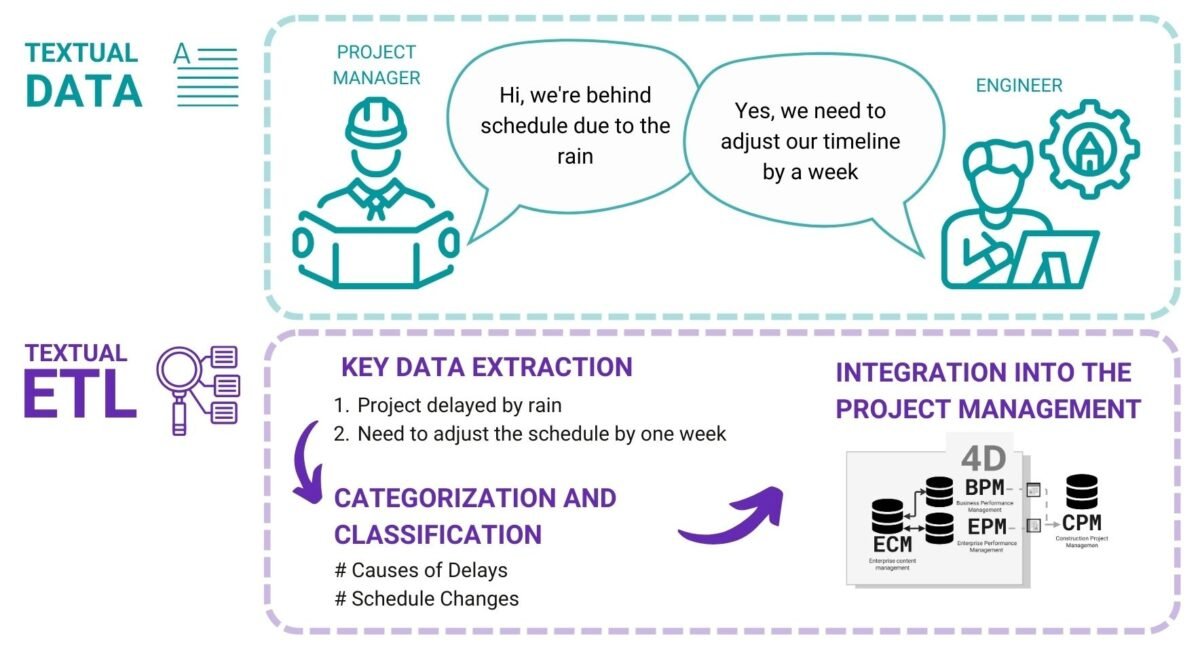
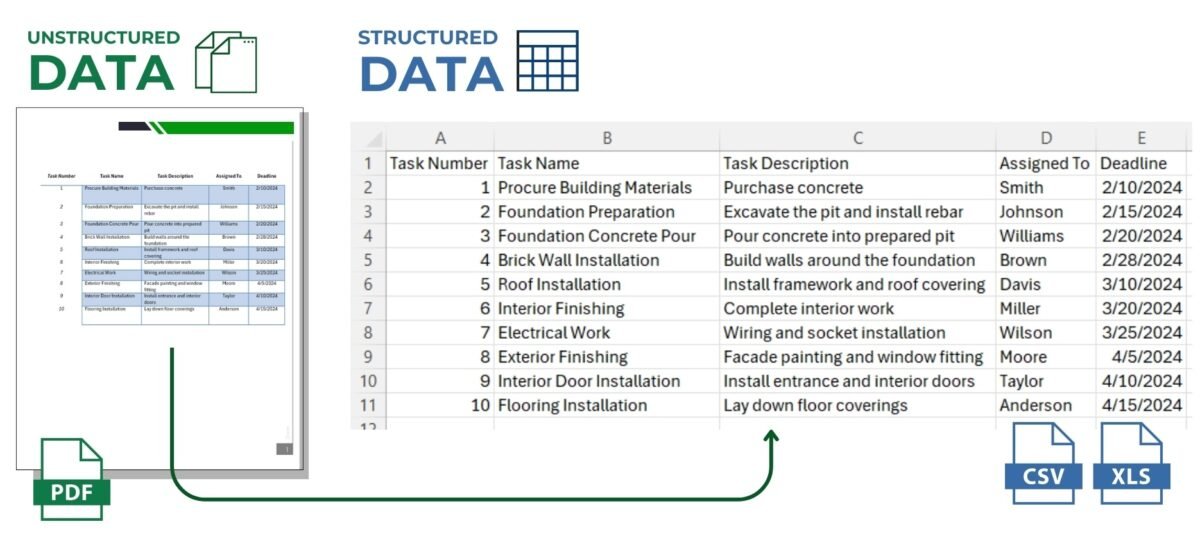
Once teams have learned how to extract structured data from documents, texts, drawings and CAD models, and have access to databases, the next key step is data modeling and quality assurance. It is this step that largely determines the speed of processing and transformation of information that will ultimately be used to make decisions in specific application tasks.

.

.

Leave a Reply

Change language

Post's Highlights

Stay updated: news and insights


We’re Here to Help

Fresh solutions are released through our social channels

UNLOCK THE POWER OF DATA
 IN CONSTRUCTION

Dive into the world of data-driven construction with this accessible guide, perfect for professionals and novices alike.
From the basics of data management to cutting-edge trends in digital transformation, this book
will be your comprehensive guide to using data in the construction industry.

Related posts 

Focus Areas

Search

Search
Sorry, no articles found.

✕

Don't miss the new solutions


✕
✕

Linux

macOS

Looking for the Linux or MAC version? Send us a quick message using the button below, and we’ll guide you through the process!

✕

📥 Download OnePager

Welcome to DataDrivenConstruction—where data meets innovation in the construction industry. Our One-Pager offers a concise overview of how our data-driven solutions can transform your projects, enhance efficiency, and drive sustainable growth. 

✕

🚀 Welcome to the future of data in construction!

You're taking your first step into the world of open data, working with normalized, structured data—the foundation of data analytics and modern automation tools.

By downloading, you agree to the DataDrivenConstruction terms of use 

Stay ahead with the latest updates on converters, tools, AI, LLM
and data analytics in construction — Subscribe now!

✕

🚀 Welcome to the future of data in construction!

You're taking your first step into the world of open data, working with normalized, structured data—the foundation of data analytics and modern automation tools.

By downloading, you agree to the DataDrivenConstruction terms of use 

Stay ahead with the latest updates on converters, tools, AI, LLM
and data analytics in construction — Subscribe now!

✕

🚀 Welcome to the future of data in construction!

You're taking your first step into the world of open data, working with normalized, structured data—the foundation of data analytics and modern automation tools.

By downloading, you agree to the DataDrivenConstruction terms of use 

Stay ahead with the latest updates on converters, tools, AI, LLM
and data analytics in construction — Subscribe now!

✕

🚀 Welcome to the future of data in construction!

You're taking your first step into the world of open data, working with normalized, structured data—the foundation of data analytics and modern automation tools.

By downloading, you agree to the DataDrivenConstruction terms of use 

Stay ahead with the latest updates on converters, tools, AI, LLM
and data analytics in construction — Subscribe now!

✕

🚀 Welcome to the future of data in construction!

You're taking your first step into the world of open data, working with normalized, structured data—the foundation of data analytics and modern automation tools.

By downloading, you agree to the DDC terms of use 

✕

🚀 Welcome to the future of data in construction!

You're taking your first step into the world of open data, working with normalized, structured data—the foundation of data analytics and modern automation tools.

By downloading, you agree to the DataDrivenConstruction terms of use 

Stay ahead with the latest updates on converters, tools, AI, LLM
and data analytics in construction — Subscribe now!

✕
DataDrivenConstruction offers workshops tested and practiced on global leaders in the construction industry to help your team navigate and leverage the power of data and artificial intelligence in your company's decision making.

Reserve your spot now to rethink your
approach to decision making!

✕


🚀 Welcome to the future of data in construction!

By downloading, you agree to the DataDrivenConstruction terms of use 

Stay ahead with the latest updates on converters, tools, AI, LLM
and data analytics in construction — Subscribe now!

✕
Have a question or need more information? Reach out to us directly!
Schedule a time to discuss your needs with our team.
Tailored sessions to help your team grow — let's plan together!
✕
Have you attended one of our workshops, read our book, or used our solutions? Share your thoughts with us!
Name
✕
Data Maturity Diagnostics

🧰 Data-Driven Readiness Check

This short assessment will help you identify your company's data management pain points and offer solutions to improve project efficiency. It takes only 1–2 minutes to complete and you will receive personalized recommendations tailored to your needs.

✕

Clean & Organized Data

Theoretical Chapters:

Practical Chapters:

What You'll Find on
DDC Solutions:

  • CAD/BIM to spreadsheet/database converters (Revit, AutoCAD, IFC, Microstation)
  • Ready-to-deploy n8n workflows for construction processes
  • ETL pipelines for data synchronization between systems
  • Customizable Python scripts for repetitive tasks
  • Intelligent data validation and error detection
  • Real-time dashboard connectors
  • Automated reporting systems
✕

Connect Everything

Theoretical Chapters:

Practical Chapters:

What You'll Find on
DDC Solutions:

  • CAD/BIM to spreadsheet/database converters (Revit, AutoCAD, IFC, Microstation)
  • Ready-to-deploy n8n workflows for construction processes
  • ETL pipelines for data synchronization between systems
  • Customizable Python scripts for repetitive tasks
  • Intelligent data validation and error detection
  • Real-time dashboard connectors
  • Automated reporting systems
✕

Add AI & LLM Brain

Theoretical Chapters:

Practical Chapters:

What You'll Find on
DDC Solutions:

  • CAD/BIM to spreadsheet/database converters (Revit, AutoCAD, IFC, Microstation)
  • Ready-to-deploy n8n workflows for construction processes
  • ETL pipelines for data synchronization between systems
  • Customizable Python scripts for repetitive tasks
  • Intelligent data validation and error detection
  • Real-time dashboard connectors
  • Automated reporting systems
056 CAD solution vendors move to structured data
This website uses cookies to improve your experience. By using this website you agree to our Data Protection Policy.
Read more
×